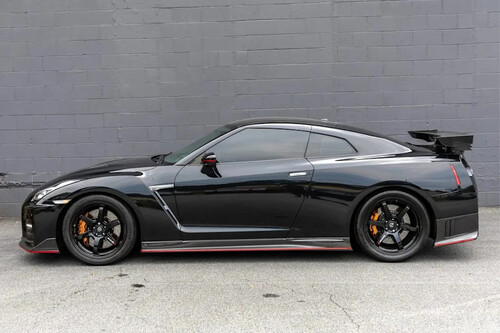
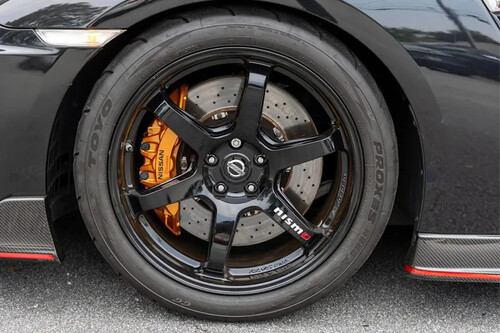
Watch: A GT-R Ran From a Georgia Trooper at 170 MPH. Federal Tire Rules Stop Testing at 99.The Auto WireShawn HenryTue, September 22, 2026 at 12:30 PM UTCAdd us on Google1 / 2Watch: A GT-R Ran From a Georgia Trooper at 170 MPH. Federal Tire Rules Stop Testing at 99.The Georgia State Patrol dashcam clip going around again this week is short, dark and entirely familiar: a cruiser, an interstate at night, and a Nissan GT-R at 170 mph that simply stops being there. We covered the footage when it first surfaced, when the number attached to it was 175. The version making the rounds now says 170. Both land in the same place.Here is the part nobody says out loud about video like this. The GT-R was the only object in that frame operating comfortably inside the envelope it was built for. The cruiser was not. The pavement was not. And the federal apparatus that certifies a car as fit to sell in this country had stopped verifying anything roughly 70 mph earlier.That gap is the story. The chase is just what made you look.AdvertisementAdvertisementA sourcing note: The Auto Wire has not independently confirmed the driver, the date or the outcome of this pursuit. The footage is attributed to the Georgia State Patrol, and the speed claimed on screen varies between versions of the clip.A GT-R at 170 mph is the easy partStart with what Nissan itself publishes. The R35's VR38DETT is a 3.8-liter twin-turbo V6 rated at 565 horsepower at 6,800 rpm and 467 lb-ft of torque, feeding a rear-mounted dual-clutch transaxle and ATTESA E-TS all-wheel drive. Curb weight is 3,935 pounds. Drag coefficient is 0.26. The front brakes are six-piston Brembos clamping 15.35-inch rotors, and the tires are Dunlop run-flats, 255/40ZRF20 up front and 285/35ZRF20 at the rear, according to Nissan's own press kit.For that hardware, 170 mph is not the difficult part. Composure at speed was the R35's entire reason for existing, and it spent the better part of two decades getting better at it before the final example came off the line in Tochigi. The car in that video was doing something it was engineered to do.Almost nothing around it was.The federal tire test stops at 99 mphFederal Motor Vehicle Safety Standard No. 139 governs new radial tires for light vehicles. Its high-speed performance test presses a tire against a 1.7-meter drum at 85 percent of maximum load and runs it, uninterrupted, through three consecutive 30-minute stages: 140 km/h, then 150, then 160. The standard itself spells out the whole procedure.AdvertisementAdvertisementOne hundred sixty km/h is 99.4 mph.That is the ceiling of the federally required high-speed test. Every speed rating above it, including the V, W, Y and ZR markings enthusiasts quote like scripture, comes from industry and European standards rather than from anything NHTSA makes a manufacturer demonstrate. A Y-rated tire is certified by its maker to a speed the federal government has never once asked it to reach.That drum test is also generous. Ambient temperature is held between 32 and 38 degrees Celsius, the surface is smooth and clean, the load never shifts, and the entire run takes 90 minutes. A Georgia interstate at night has expansion joints, crowned pavement, debris, heat still sitting in the asphalt, and a car whose aerodynamic load on each corner changes every time the driver breathes on the wheel.Now do the crash mathThe same ceiling shows up on the crashworthiness side. NHTSA's 5-Star frontal test drives a vehicle into a fixed barrier at 35 mph. The side barrier test fires a 3,015-pound moving barrier at 38.5 mph. The side pole test happens at 20 mph.AdvertisementAdvertisementCrash energy scales with the square of speed, which is the most underappreciated number in vehicle safety. A 3,935-pound GT-R at 170 mph carries roughly 5.1 megajoules of kinetic energy. The same car at the 35 mph of that frontal test carries about 0.22 megajoules. Call it a factor of 24.No airbag, no crumple zone and no pretensioner in any production car is designed to manage that. Not because engineers got lazy, but because there is no structure you can attach to a two-ton coupe that would.The reaction-time arithmetic is even simpler. At 170 mph a car covers 249 feet every second. Look down for two seconds and you have traveled roughly a tenth of a mile blind.Enforcement has its own arithmeticIf you cannot engineer the road for it, the fallback is enforcement, and enforcement carries its own bill. The Justice Department's Bureau of Justice Statistics counted roughly 68,000 police vehicle pursuits by state and local agencies in a single year, and found that pursuit-related crashes killed an average of 355 people annually from 1996 through 2015. About one person a day.AdvertisementAdvertisementThat is why pursuit policies keep tightening, and why the top-speed contest was conceded years ago. As Michigan State Police's annual patrol vehicle testing shows, no cruiser sold in America wins a straight-line argument with a modern performance car. The radio wins. The helicopter wins. The cruiser does not.So legislatures started sentencing the carThis is the shift almost nobody noticed. According to IIHS tracking of state law, the District of Columbia in 2024 became the first U.S. jurisdiction to create an intelligent speed assistance program for speeding offenders. Eight states have since followed: Arizona, Hawaii, Illinois, Maryland, New York, Virginia, Washington and Georgia.Read that list again. Georgia is on it. The state in the video now has a legal mechanism to bolt a governor into a convicted speeder's car. We have already walked through how Virginia's program and Illinois' version actually function.For a century, American traffic law punished the person. Points, fines, surcharges, suspension. The machine was left alone. Speed-limiter sanctions punish the machine, and they do it using hardware that already ships in most new cars. Forward cameras read speed limit signs. Navigation databases store posted limits. Chevrolet already buries a configurable speed limiter in a Corvette menu. The capability arrived years ago. Only the legal trigger was missing.Washington, meanwhile, is running a simulator studyIn November 2023, after investigating a North Las Vegas crash in which a Dodge Challenger entered an intersection at a recorded 103 mph and nine people died, the NTSB recommended that NHTSA require intelligent speed assistance in all new cars, and asked 17 automakers to install it voluntarily.AdvertisementAdvertisementNearly three years later, NHTSA's visible work on the subject is research. A June 25, 2026 Federal Register notice filed under Docket NHTSA-2025-0787 describes driving simulator and closed-track studies at the University of Iowa examining whether drivers will accept the technology. The notice states that the work "is not immediately intended to inform regulations or policy."That is the federal position on speed, written in the flattest language available. States are moving because Washington is not, and they are moving one convicted driver at a time.The advertising rhymeThe NTSB sent one more recommendation in 2023, and this one went to IIHS: find out whether marketing that celebrates risky driving does measurable harm.IIHS answered in May 2026. Across more than 1,500 television spots from 2018, 2020 and 2022, performance was the dominant theme in 43 percent of them. Speed turned up more than twice as often as safety. Over those four years, the share of ads leading with safety fell from 11 percent to 3 percent.AdvertisementAdvertisementBuried in that same research is a detail worth sitting with. A Nissan 300ZX Turbo commercial that aired during the 1990 Super Bowl drew enough criticism from safety groups that Nissan agreed to stop running it.Thirty-six years later, the most-watched piece of Nissan performance footage of the week is a police dashcam, and nobody had to buy the airtime.What this means if you buy used performance carsThere is an ownership lesson here with no politics attached. A car taken to 170 mph has put serious heat into its brakes and fluids, loaded its driveline in a way no warranty contemplates, and asked its tires to work well past anything a federal test verifies. None of that shows up on a history report, and none of it is visible at a walkaround.As these cars age into collector territory, provenance will matter more than mileage. The useful question stops being where a car has been and becomes how fast, for how long, and how often.What to rememberThe clip is not evidence that the GT-R is a dangerous car. It is evidence of a gap between what a mass-produced coupe has been capable of since 2008 and what any rule, test, barrier or patrol car has ever been validated against.AdvertisementAdvertisementEvery safety promise attached to that GT-R was verified at a fraction of the speed in the video. The car went anyway.America has chosen to close that gap at the driver's end, one court order at a time, because closing it at the car's end would mean admitting that the number on the spec sheet is negotiable. The next viral pursuit clip will not change the physics. It will only push the argument a little further toward the car.The post Watch: A GT-R Ran From a Georgia Trooper at 170 MPH. Federal Tire Rules Stop Testing at 99. appeared first on The Auto Wire.