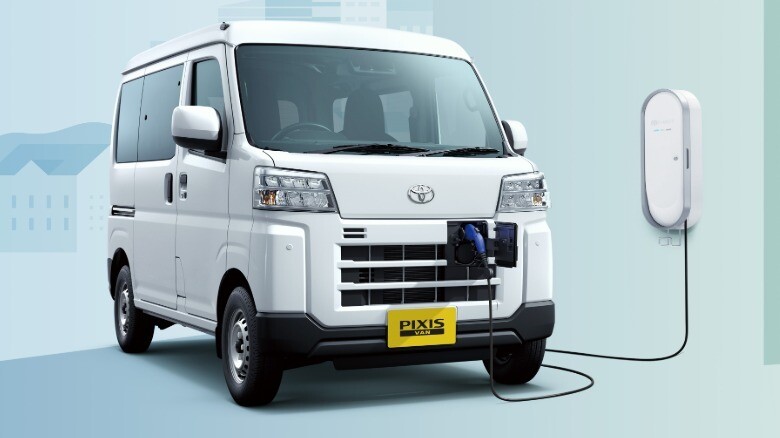
We think kei trucks are cool, but you must permit us at least a little cynicism about Toyota's coming new Scion KEI-01 trucklet. It's not actually new; it tops out at 25 mph, it will be sold only to fleets (for starters, at least), will be built in America, and our guess is that its price tag will be in the low 20s (as in $20,000, not a small stack of twenties). To the thousands (millions?) of you who've ever dreamed about owning a brand-new, dirt-cheap, right-hand-drive micro-truck, this seems somewhere between a tease and a bait and switch. But also, we kind of love the thing and kind of want one. The Quickest of Quick Drives Toyota—er, sorry, Scion by Toyota—treated us and a band of fellow journalists to what might be the shortest test drive in MotorTrend history: a brief loop, one you'd measure in yards rather than miles, on a rocky dirt road that, we suppose, was well suited to the KEI-01's four-wheel-drive setup. And now, having had minutes of experience behind the KEI-01's tiny wheel, we're pleased to present our report. Toyota Kei (pronounced "K," like the letter) vehicles, for those who don't know, are a type of vehicle indigenous to Japan. Built to specific size and displacement limits, they're cheaper to register and insure, plus they're dead-easy to park, which is an important consideration in Japan's densely packed cities. You'll find them on other continents, often with larger engines. Several have made it to the U.S. Many belong to intrepid enthusiasts who have imported them from overseas, while others were bought new or gently used for off-highway utility roles such as park maintenance. That's likely the role the KEI-01 (itself a rebadged Toyota Pixis, which itself is a rebadged Daihatsu Hijet Hi-Max) will fulfill. Since the KEI-01 won't come anywhere close to passing American crash-test standards—in a cab-over kei-truck, the driver is the crumple zone—the Scion by Toyota has been classified as a Low Speed Vehicle (LSV) under federal standards. That means it's limited to 25 mph, and in most states, it will be restricted to roads with a speed limit of 35 mph or less. (We're sure someone, somewhere, will figure out how to jailbreak the KEI-01's speed limiter. Unmodified Kei cars can reach speeds of 60 mph or better, though we've tried this and cannot enthusiastically recommend it.) Toyota The Pickup Truck You Wear The KEI-01 is just over 11 feet long—barely half the length of a long-bed, crew-cab Super Duty—and although it splurges on space with an extended cab, most of the length of this trucklet has been allotted to the bedlet. That leaves the engine, controls, and a couple of passengers to be stuffed into the tiny cab. As a result, you don't get into the KEI-01 so much as put it on. The placement of the front wheel slightly forward of the spot where your butt is supposed to go makes ingress awkward. Once seated, you're literally wrapping your legs around the powertrain, which lives under the twin bucket seats. The non-adjustable steering column juts upward, though given the lack of space ahead of it, it's kind of amazing that the steering wheel is nearly as vertical as one in a car—and it's more amazing still to see no buttons on the steering wheel whatsoever (in this day and age!). The column stalks are reversed per Japanese practice, with turn signals on the right and wipers on the left. Remember, you aren't a proper kei car driver until you've signaled a right turn with your windshield wipers. Toyota The driver faces a dashboard of hard, gray plastic that should be instantly familiar to anyone who has ever sat in a Japanese economy car from the early 1990s. Only the small center display screen indicates that the cabin was designed this century, but not by much; so far as we can tell, this version of the Hijet was introduced roundabout 2014. That said, one has to love the simplicity. The gauge panel has an analog speedometer, an LCD panel for fuel and odometer, and a few warning lights. The KEI-01 we drove had a metric speedo; we don't know if that was because it was rushed to assembly or a way to make the 25-mph top speed feel faster than it is. The air conditioner controls—yes, the KEI-01 comes with an air conditioner!—consist of mechanical sliders that move with a satisfying thack and clack. We're 99 percent sure this is the same climate control panel that Toyota used for the 1981 Celica (seriously). Switchgear is minimal, because there aren't many things in the KEI-01 that need to be switched on. In Search of Sideways Push the start button (one of the KEI-01's few concessions to the 2020s) and the 660cc three-cylinder sneezes instantly to life and purrs silently beneath your posterior. Credit to Toyota, or Scion, or Daihatsu, or whichever: three-cylinder engines are inherent shakers, and what a brilliant idea to let this one double as a seat massager. Toyota Grabbing the absurdly large 1990s-style T-handle gear selector, we shifted the KEI-01's CVT into drive. We contemplated the push-button four-wheel-drive system, which can be selected for Auto (the truck senses wheelslip) and Lock (full-time) modes, and decided to leave the truck in two-wheel drive in the vain hope we might get a little sideways action going. (We are what we are, and besides, we'd just finished some very satisfying track time in the masterful GRMN Corolla.) Off we went. We don't know how much power the KEI-01's engine produces yet—our best guess is about 50 horsepower and 42 lb-ft of torque—but it doesn't take much to get this 1,800-or-so-pound truck up to its feeble top speed. With our foot to the floor (or halfway, or off; it didn't seem to make much difference), the speedometer stayed painted on the 40 km/h mark, the engine buzzing like a (Honda) generator. A manual transmission would, of course, make it more interesting—Daihatsu offers a five-speed in Japan—but with a 25-mph limit, third, fourth, and fifth would likely atrophy and fall right out of the gearbox. Ride? Handling? Couldn't tell you. The KEI-01 uses MacPherson struts up front and leaf springs and live axles out back, and on the dirt path Toyota had us drive, it bounced and bounded like … well, like a tiny lightweight truck with a primitive suspension on an unimproved road. We were more worried about damaging its dinner-plate-size tires than anything else. The steering wheel reliably made the KEI-01 go left or right, more or less in accordance with our wishes. We jerked at the wheel in the hopes of getting into a righteous slide, but the slow ratio—about four turns lock to lock—made that difficult, as did the utter lack of urgency on the engine's part. We bounced our way around the little track, parked the KEI-01, and wondered what our chances were of getting another few laps in the GRMN Corolla. (They turned out to be excellent.) Toyota We Still Kind of Love the Silly Thing We realize we might be painting our experience in the KEI-01 as a remarkably unfun, but you must remember that we've driven kei vehicles before, so forgive us if we're a little jaded. (Also, the three-minute dirt-road drive was kind of a disappointment.) If you've never experienced one of these little vehicles, they really are great fun. There is, of course, the novelty of right-hand drive, which always injects a sense of surreality. (Judging the left side of the car is trickier than you might imagine, even in a vehicle this small.) Nifty, too, is peeking at the world through an expansive windshield so close to your face that you practically wear it like a contact lens. Really, though, if you want to have fun with the KEI-01, try parking it. With its miniscule turning radius and sheetmetal that ends just inches ahead of your knees, it's a whole new world of close-quarters maneuverability. And we love that if one kneels next to the bed, one can see the whole works: Its frame, driveline, exhaust, drive shaft, and a rear axle the diameter of a fashion model's wrist are all on display. We have no doubt the KEI-01 will make a great utility vehicle. Its bed dimensions are tiny, but the sides and tailgate can be hinged down (or removed, if you want a kei flatbed), making loading a cinch. We're all familiar with the low-liftover trunk, but who ever heard of a low-liftover pickup bed? Toyota We Like It, But We Don't Get It What baffles us, though, is this whole Scion by Toyota strategy. What, exactly, is the point of calling this a Scion and selling it to fleets? Is Toyota hoping to generate excitement among JDM fans who frequent public parks? Are there maintenance workers at the zoo whose job satisfaction would be reduced if they drove this truck badged as a Toyota or a Daihatsu? Are Highlanders and Siennas selling so poorly that Toyota needs to build these things in Indiana to keep the workers busy? What exactly is this new iteration of Scion supposed to be besides, as we speculated in our First Look, a repository for things Honda sells that Toyota doesn't? The mysteries abide, and we can only hope Toyota will give us a better opportunity to sample this newest and most modest of Scions. We're hoping for a drive here in Los Angeles. Griffith Park has 20 miles of paved roads and 50-plus miles of dirt trails and bridle paths, and there are always trash cans that need emptying.

 Liked by Abigail Johnson, Mia Martin
















 Liked by Abigail Johnson, Mia Martin