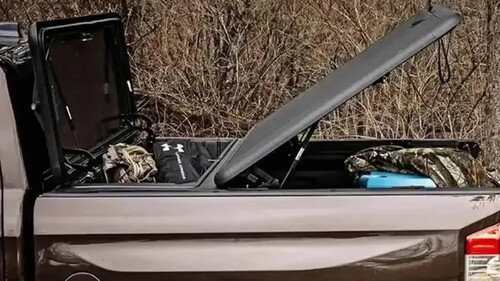
This Solar-Panelled Tonneau Cover Changes the GameGannon Burgett - Car and Driver"Hearst Magazines and Yahoo may earn commission or revenue on some items through these links."For as long as they've been around, aftermarket tonneau covers have been almost exclusively about protection and security, keeping cargo out of the elements and away from prying eyes. It's a relatively simple, effective solution. But it leaves roughly 30 to 40 square feet of flat, sun-drenched space that could be put to work in other ways.Worksport has a new solar-integrated tonneau cover that can turn your truck bed into an energy source. The company calls it Solis, and this tonneau cover generates off-grid power using integrated solar cells while also fulfilling the traditional duties of a bed cover. We recently got a chance to try out the Solis hardware on a demo truck that had the cover preinstalled.Gannon BurgettWorksport Solis Solar Tonneau Cover$1,499 at worksport.com- Can charge passivelyAdvertisementAdvertisement- Seamlessly works with power stations- Simple installation- Tough to justify the cost- A handy accessory for an off-road lifestyle and remote job sitesStandard bed rails and heavy-duty C-clamps make installation a no-drill project.Gannon Burgett - Car and DriverInstallation and FitmentIntegrating solar panels into a truck accessory could easily result in an overly complex mounting procedure, but the Solis ships and installs like a standard hard tonneau cover. You also don't need an electrical engineering degree or an entire weekend to get this thing sitting right on your truck.The system relies on standard bed rails and heavy-duty C-clamps to attach to the truck bed, skipping the need to drill into the sheetmetal. While we didn't get a chance to install the cover from scratch ourselves, we were able to observe the preinstalled unit from top to bottom; for all intents and purposes, it installs like any other tonneau cover. The only difference is that you'll end up with a pair of MC4 connections hanging inside the bed for powering whatever power station you choose to use.AdvertisementAdvertisementYou do need to note the added weight of the solar hardware; the panels and wiring make the Solis noticeably heavier than a standard, equivalently sized aluminum or composite trifold. Worksport says one person can install it alone, but having two people to lift and position the cover would certainly make your day easier.To maximize cargo capacity, the unit rests above the bed rails instead of sitting flush against them. This means you keep all the depth your truck bed originally came with, ensuring coolers, toolboxes, battery packs, and gear bins still fit cleanly underneath.The Solis folds like any other tonneau cover of this style, but only two-thirds of it folds back.Gannon Burgett - Car and DriverEase of Use and AccessibilityAccessing your gear is a familiar process, though it comes with a functional design compromise. You can access the bed, but only two‑thirds of the cover folds back; the panel near the bulkhead stays fixed to protect the solar connections and wiring. So, if you're regularly hauling dirt bikes, large furniture, or other big items pushed all the way up to the front of the bed, that fixed panel is something you'll need to work around.When you fold the rear sections open, the cover relies on standard straps and clips to stay secure. There is no heavy-duty mechanical locking mechanism specifically designed for the folded position, but the straps maintain proper tension and didn't cause any concern as we went around trying to jostle them loose.AdvertisementAdvertisementThe Solis system operates passively, so you don't have to switch modes or reconnect anything when opening the tailgate. It just does its job quietly in the background while you load and unload your truck, outputting power when the panels are soaking in the sun.A thick, clear coating protects the solar panels—the coating is designed to prevent scratches from affecting panel performance.Gannon Burgett - Car and DriverBuild Quality and DurabilityVisually, the Solis matches the aesthetic and feel of other high-end tonneau covers. The aluminum frame was sturdy and showed no signs of fading during our inspection; minor marring appeared in high‑use areas of the heavily used demo unit, but otherwise it looked in great shape considering the abuse it had endured.Structurally, Worksport engineered precise tolerances on the hinges while allowing for some flexibility to absorb forces generated by a moving truck bed over uneven terrain, which is especially important considering there are cables running through the hinges across various points to get power from the panels to the main harness.Interestingly, the heavy-duty solar panels actually protect the cover due to their durability. Worksport recommends caring for the panels like any other car part, but they are built to be used as a truck bed. If the panels get scratched from hauling rough cargo, the scratches are purely cosmetic and, according to Worksport, do not reduce solar energy collection by any notable amount.AdvertisementAdvertisementLike almost all trifold covers on the market, the Solis is not perfectly waterproof. Expect minor water entry behind the tailgate or bulkhead during heavy rain or carwashes. However, the cover's electronics are designed to withstand pretty much any weather.Gannon Burgett - Car and DriverSolar Performance and FeaturesAccording to Worksport, the main engineering challenge was wiring management. Wiring that constantly bends typically fails over time due to material fatigue, so solving the hinge routing was key to ensuring the Solis can keep on powering your adventures for years to come. After years of development, Worksport managed to route the integrated wiring into the hinges in such a way that the panels can fold repeatedly without strain.The panels for this particular configuration (a 5.5-foot bed on a Ford F-150) generate up to 380 watts in optimal sunlight and produce roughly 60 watts on overcast days. Thankfully, during our hands-on time with the unit, we got both sunny and overcast weather and confirmed output within 20 watts of those stated figures.As a whole, that's a rather substantial amount of passive energy collection for a vehicle footprint—especially when paired with a 1-kWh-or-larger battery pack, as you can pull from the battery during heavy use and recharge between uses.AdvertisementAdvertisementShould you need to remove the cover completely to haul an oversized load, you can detach the Solis, lean it against a wall facing the sun, and it will continue to generate power, effectively operating as a semiportable solar panel.Additionally, the Solis can function as a battery maintainer for the truck with additional accessories, helping vehicles with aftermarket parasitic draws. So, if you run a winch, heavy-duty lighting, or communications radios that slowly drain your main battery while parked, this feature alone could save you from a dead truck.Except for the solar cells, the Solis system is made in the United States.The Cor Battery SystemWorksport's patented Cor battery system is designed specifically to handle the energy generated by the Solis. The modular setup uses 960-Wh cores that slide into the main housing, where standard 120-volt outlets and USB plugs are located. These cores can be hot-swapped into the main unit, so if you run out of charge for one, simply toss in another, and you're good to go.Worksport Cor Battery System$799 at worksport.comWorksport emphasizes how much the engineers and designers prioritized safety in the battery's construction. The integrated battery management system (BMS) hardware identifies heat generation at the individual cell level, allowing the battery to proactively shut down or isolate problems before thermal runaway occurs. Considering this unit lives in a bouncing pickup truck baking in the sun, such a level of thermal management is critical.AdvertisementAdvertisementAssuming full output from the 380 watts' worth of panels, you can charge a single core from 50 percent to full in roughly 1 hour, 30 minutes, while a complete 0 to 100 percent charge requires just over three hours. If you need to ensure a full battery after a few rainy days or extensive use, you can also plug a Cor unit into a standard wall outlet and fully recharge in less than 60 minutes.App Integration and InterfaceHaving a screen on the battery is great, but for remote monitoring, Worksport developed a dedicated smartphone app. The app logs historical charging data and allows you to control basic functions of the cover and battery system.Worksport emphasized that the software is managed by an in-house development team, allowing Worksport to push updates and refine the digital interface without having to rely on third-party developers.The Solis cover powers the Cor battery system, which then powers a cooler chock-full of ice-cold beverages.Gannon Burgett - Car and DriverThe VerdictThe Solis doesn't fundamentally change how a truck bed works, and it's not a particularly new concept (people have been DIYing solar rigs onto the tops and backs of vehicles for decades). But it manages to create a simple all-in-one solution that offers the best of truck-bed coverage with the convenience of having integrated solar cells that work with both first-party and third-party battery systems.AdvertisementAdvertisementSure, most pickup owners won't need this, and the up-front investment is substantial. On a purely cost basis, the couple-kilowatts of possible energy harvested daily—saving you 40 cents or so—would take the better part of 16 years to pay back. But if you are outfitting a new truck to serve as a mobile base camp for work or play, the Worksport Solis, whether paired with the Cor units or other portable power stations, proves that your truck bed is capable of doing much more than simply covering cargo.Why Trust Us?The Gear Team helps readers make informed purchasing choices about automotive gear, tools, and accessories through hands-on product evaluations and comprehensive testing. Car and Driver's renowned testing standards mandate that we use all products we feature, and that our findings and recommendations are based on personal experience and knowledge, not hype. We won't claim to have tested something we haven't, and we'll never recommend a product we wouldn't buy ourselves.The Gear Team's product selection and gear picks are editorially independent; Car and Driver has a strict policy against accepting payment for placement in articles.We've evaluated dozens of product categories, like radar detectors, dash cams, and tonneau covers. Visit our Tested & Trusted page to see the very best in automotive gear. Read more about our testing process here.AdvertisementAdvertisementYou Might Also LikeGift Guide: Best Ride-On Electric Cars for KidsFuture Cars Worth Waiting For: 2025–2029