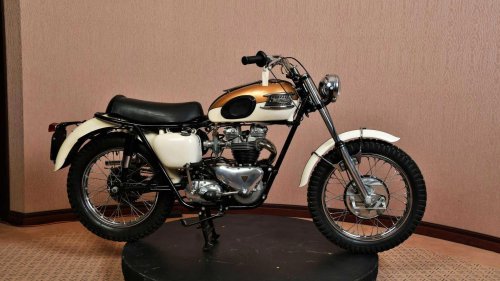
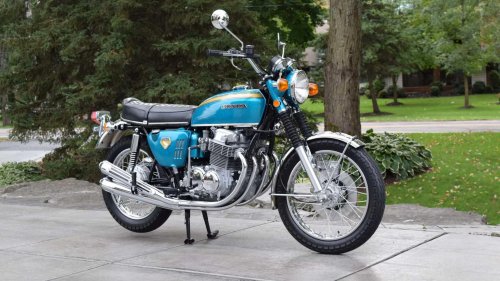
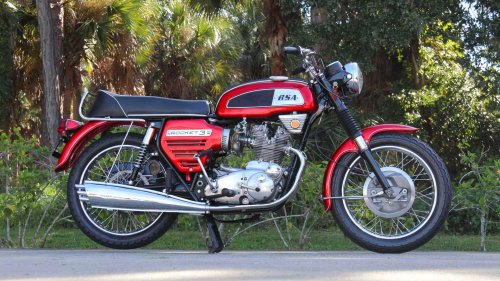
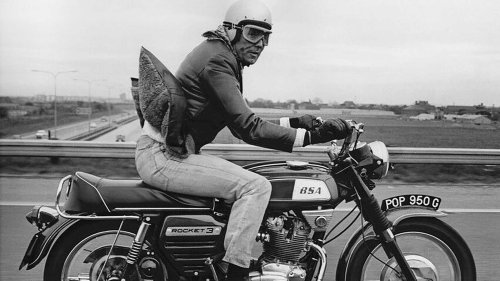
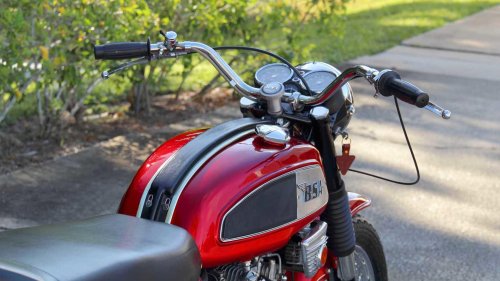
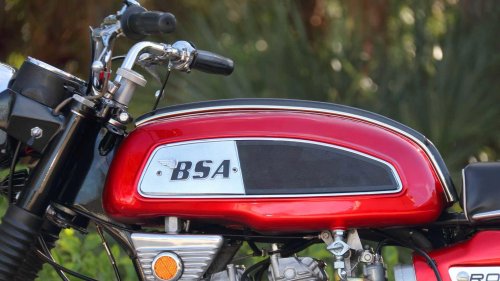
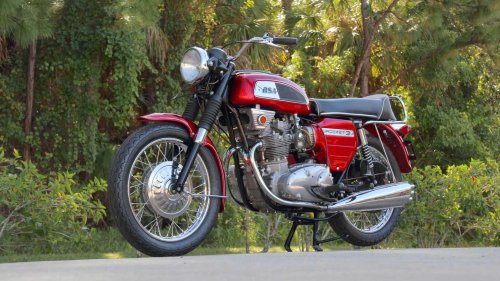

























Britain’s bikes ruled the roads in the 1950s and early 1960s but, as the rest of the world caught up, its bikes were looking decidedly second-rate. Aging designs and outdated technology opened the door for other nations and, when Honda released the CB750 in 1969, it signaled the near death of the entire British industry. There was one bike that tried to save the country’s industry, though, which is largely forgotten today. Britain’s Motorcycle Industry Needed A Hero In The Late 1960s Mecum British brands were the dominant force in motorcycling through the 1950s and most of the 1960s. Manufacturers like Triumph, BSA, Norton, and Royal Enfield all had reputations for building fast, exciting bikes that were not only at home on English roads, but which found fame around the world. Marlon Brando rode a Triumph Thunderbird in 1953’s The Wild One, while Steve McQueen’s stunt double, Bud Ekins, jumped a modified Triumph TR6 Trophy in 1963’s The Great Escape.But as the 1960s wore on, the British bike industry was increasingly showing signs of age. A lack of innovation meant that bikes looked dated, both aesthetically and mechanically, while quality control issues (especially oil leaks) were harder to overlook as competition from other nations intensified. The industry needed a halo bike and, in 1969, it would have one. The problem was, it was from Japan. The Honda CB750 Changed The Rules Overnight MecumWhen Honda released the CB750 in 1969, it was a revelation. Purposely designed to challenge British bikes, the CB750 had everything that British bikes didn’t; things like an electric starter, hydraulic front brakes, reduced vibrations, and that famous Honda reliability. Riders suddenly saw that they no longer had to put up with the foibles commonly associated with British bikes, and the bike accelerated an already rapid decline for the industry.But as people clamored over this new Japanese model, one British brand tried to prevent the death of the nation’s industry. Coming out just before the CB750, it needed to prove that Britain wasn’t dead yet. The BSA Rocket 3 Triple Was Britain's Answer To The CB750 MecumThe British motorcycle industry was already in decline by 1968. Japanese manufacturers had been flooding the market with reliable, user-friendly motorcycles, and British brands were truly feeling the pinch. BSA in particular was struggling, having been the largest motorcycle manufacturer at the start of the decade. It needed something larger and more powerful to counter the threat from Japan, so BSA teamed up with Triumph (whom it owned at the time) to create a bike to take on the US market.That partnership would create two very closely related, albeit slightly different bikes in the BSA Rocket 3 and the Triumph Trident. Though both would feature nearly identical 740 cc three-cylinder engines, the BSA was more aggressive in its design and its handling, creating what many felt was a more interesting bike.It had a four-speed gearbox on launch and made 58 hp, with some questioning the “ray gun” design choices. Still, the sturdy steel frame and telescopic forks helped the bike to handle well, with the engine's relatively low placement lowering the center of gravity and helping make the bike surprisingly agile.via GoodwoodContemporary reviews called it a “two-wheeled Cadillac”, but noted that the drum brakes — which were the same size as those on much lighter BSA twins — were perhaps inadequate for this much heavier bike. They’d also be second-best when compared to Honda’s CB750, given that the challenger had the aforementioned hydraulic front brakes.While the mechanical accolades might have belonged to the CB750, the Rocket would arguably win on feel. It gained a reputation for having more character, thanks in part to the three-cylinder between the rider’s legs. Rather than the smooth, refined power Hondas have become famous for, the Rocket had a more guttural howl at higher revs that riders found intoxicating, and which elicited far more emotion than the CB750’s. The Rocket 3 Was Fast, Charismatic, And Arrived At The Worst Time MecumWhile the Rocket 3 was made for the road, it was no slouch in racing trim as not only did it win, but it beat Honda’s CB750. American racer Dick Mann rode a Rocket 3 to victory in the 1971 Daytona 200, having ridden a Honda CR750 (the racing version of the CB750) to victory the previous year.The Isle of Man was where the Rocket 3 truly shone, however. Honda had tried to take on the fearsome Mountain Course in 1970 and mustered an eighth and ninth place, but the Rocket 3 was in a league of its own. “Slippery Sam”, as the bike became known, was a race-prepared Triumph Trident that won five consecutive production 750 cc class wins at the TT, dominating the race and becoming, to date, the only bike to win the Production 750 TT five years in succession.But for all the bike’s positives, it simply wasn’t enough to save its country’s bikes from decline.MecumPart of the problem with Rocket 3 lay in its timing. A redesign delayed the release of the bike by 18 months, which led to it coming out just four weeks before the CB750. While the Rocket 3 carried with it the weight of years of British indifference, the CB750 was new, exciting, and exotic. It was part of an emerging trend of forward-thinking Japanese bikes, and beat the Rocket 3 on most metrics. Then there was the price. The BSA was $1,750 on launch, while the CB750 undercut it at $1,500.The CB750 went on to become a powerhouse, selling over 400,000 bikes in its production run from 1969 to 2008. Conversely, the Rocket 3 ceased production in 1972, as BSA-Triumph fell into severe financial difficulty and was reorganized the following year into the government-backed Norton Villiers Triumph group. The Rocket 3 Became A Symbol Of British Motorcycling’s Final Stand MecumThe Rocket 3 today is a rare collectors bike, as fewer than 5,900 Rocket 3s were made. Condition plays a considerable role in the bike’s value, with 1969 model year bikes going between $6,000 and $16,000 depending on the quality. Around $8,000 to $10,000 is typical, which is considerably less than the roughly $25,000 you’re looking at on average for a decent CB750.The Rocket 3 wasn’t a perfect bike, nor was it objectively better than the CB750, but it was the best that Britain had to offer at the time. Its forgotten legacy is evidence that the British industry was in too much of a tailspin to have been saved regardless of how good the bike was, and its market position being usurped by the CB750 just moments later showed that it didn’t really have an answer to Japan’s manufacturing might. But it was the British industry going out on its feet with a powerful, pioneering, exciting bike that ultimately couldn’t undo the crash that had been set in motion.Sources: Honda, IOMTT, Rider Magazine, Classic.com, TRO3C, Cycle World