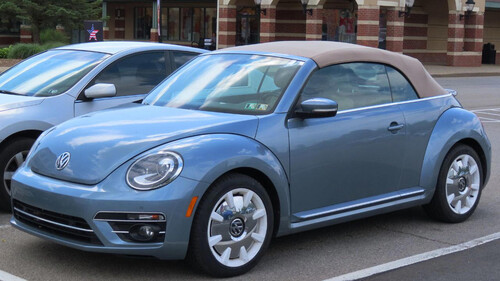
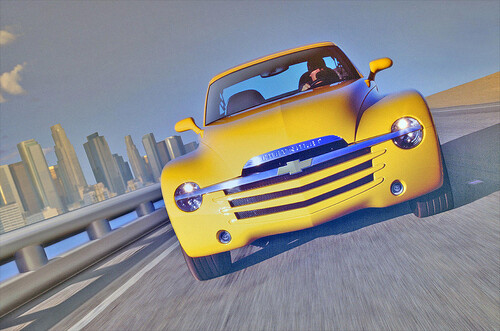
Autoblog and Yahoo may earn commission from links in this article.Why Do They Call It Y2K?As a late-90s baby, my first foray into cars as a little tyke couldn't have come at a better time for the automotive industry as a whole. Many automakers may have entered the 2000s by reheating some of their leftovers, but the first half of the decade is marked by icons that still catch the attention of today's dedicated enthusiasts. We'd be here for a while, but cars like the Honda S2000, the BMW E46 M3, the Lamborghini Murcielago and the Ferrari 360 Modena are just a few great machines in a list longer than the ancient scrolls. While this part of the decade is littered with future concours favorites immortalized on bedroom posters, the 2000s was defined by an emerging car design phenomenon known as the Retro Future trend. Capturing the overwhelming optimism surrounding the turn of the millennium, this movement reinterpreted the mid-century styling cues of classics through a distinctly modern lens. Automakers skillfully blended nostalgic heritage elements with futuristic tech and sleek digital aesthetics, and in return, drivers had vehicles with a unique sense of familiarity paired with cutting-edge innovations. AdvertisementAdvertisementIt worked, for a while, and then it mostly stopped, leaving behind a small handful of cars that now read less like a passing fad and more like a genuine moment in automotive history. Though it died off toward the end of the decade, this design philosophy ultimately reshaped automotive styling for a new era. These five vehicles had defined this period of somewhat recent history and left their mark in enthusiasts the world over.VolkswagenView the 5 images of this gallery on the original articleVolkswagen New BeetleLaunched for the 1998 model year, nothing kicked off the retro-future era quite like the Volkswagen New Beetle, which became the clearest possible statement of intent for the entire design movement that followed it. This nostalgic machine originated from the Concept One penned by designers J Mays and Freeman Thomas, which transitioned quickly from concept to production after it became a crowd favorite at auto shows. Built on the Golf platform, the more modern iteration ditches the original air-cooled Beetle's rear-engine layout, for something resembling the era it existed in. The New Beetle may have borrowed the silhouette and the bug-eyed charm of the original, but modernized it by turning an old, familiar shape into a modern front-engine, front-wheel-drive economy car.Sales were strong enough in the first several years that Volkswagen leaned even further into the nostalgia angle, even offering special editions that directly referenced the original hippie-era Beetle. In 2012, the New Beetle was replaced with an updated model featuring a lower, wider stance while still acting as an homage to the original Type 1. By the time its successor exited production in 2019, the updated Beetles proved that a legacy nameplate could be something that carries the emotional weight of a beloved car while still retaining modern technology; a formula that other automakers would try to replicate with mixed success over the following years. Getty ImagesBMW Z8But where the New Beetle chased the mass-market, the BMW Z8 was something more exclusive. Built to echo the spirit of the 507, the Bavarian Motor Works achingly beautiful and commercially unsuccessful roadster from the late 1950s. Designed by Henrik Fisker (yes, that Fisker), the Z8 wrapped a hand-built aluminum body around a chassis powered by the S62 V8 borrowed from the E39 M5, giving it genuine performance credentials to back up its stunning looks. Beamer made the Z8 for just three years; from 2000 to 2003, building less than 6,000 examples, making it a rarity compared to other offerings like the Z3 and Z4 roadsters. Its James Bond cameo in "The World Is Not Enough," complete with the car being sawed in half by a helicopter-mounted circular saw, only added to its mythology among enthusiasts who never got the chance to see one in person.AdvertisementAdvertisementUnlike most retro-future cars, the Z8 was more of a coachbuilt exotic than a mass-market vehicle. This is most evident in today's collector market, where clean examples now command prices many multiples of their original sticker, a trajectory almost none of its retro-future contemporaries have managed to match. Despite it being a collector's jewel, critics at the time panned the Z8 for its driving dynamics and handling; particularly, a chassis so stiff, it led Jeremy Clarkson to liken it to a dump truck. Where most of this era's cars are remembered fondly as charming curiosities, the Z8 is remembered as something closer to an actual automotive achievement. StellantisView the 5 images of this gallery on the original articlePlymouth ProwlerIf the Z8 was the trend's most refined execution, the Plymouth Prowler was something different. Introduced for the 1997 model year, the Prowler was a hot rod-inspired vehicle that looked straight out of the 50s and 60s. Its exaggerated, fendered silhouette was paired with an aluminum-intensive construction that was genuinely advanced for the time, though its achilles heel would lie in its powertrain. Early cars used a V6 borrowed from the Chrysler LHS sedan, a decision that disappointed enthusiasts expecting a proper V8 under the hood. Chrysler eventually eeked out more power in later years, but the car never got the V8 that its owners wanted from the factory. Today, enthusiasts, tuning shops and individual owners have managed to shoehorn Hemi V8s, even the 707-horsepower supercharged Hellcat V8 engines.Ironically, the actual and perceived power mismatch became part of the Prowler's identity, and it's exactly why this car became a cult object. Its exotic shape also made it a common sight in the music videos of the era, with the Prowler turning up as a flex piece in a handful of early-2000s rap videos alongside the Escalades and Rolls Royces that defined the genre's car culture at the time. Despite this, production ended in 2002 after Chrysler made close to eleven thousand of them, a low enough number to make clean examples particularly rare. In a nutshell, the Prowler was not intended to be fast, but it was trying to be a design statement. It was Chrysler's attempt to capture the spirit of hot-rodding in a way that can be bought at the showroom, and on those terms, it succeeded. FordFord Mustang (S197)By the time the fifth-generation Mustang, internally known as the S197, launched for the 2005 model year, Ford had watched the New Beetle prove the commercial case for heritage-driven design and decided to apply the same thinking to its most important nameplate. Designer Sid Ramnarace drew heavily on the original Mustang fastback from the sixties, translating its long hood, short deck proportions and fastback roofline into a modern platform without leaning on cartoonish exaggeration the way other retro-future designs did. The result reoriented an entire segment: where the outgoing SN95 Mustang had drifted toward a generic, forgettable shape through the 1990 and early 2000s, the S197 gave the car back its identity in a way that resonated with both Mustang devotees and a new generation of owners. In turn, sales jumped during its first model year, which showed that a well-placed bet on nostalgia can revive a struggling model.AdvertisementAdvertisementWhat separates the S197 Mustang from most of its retro-future contemporaries is that it wasn't just a novelty item developed for a quick buck. During its nine-year model run, Ford seriously used the S197 platform as a canvas for some amazing creations, including limited edition models like the Bullitt and hardcore variants like the Shelby GT500. In 2008, Ford improved on the retro-styling by introducing a facelifted version for the 2010 model year, which spawned a Boss 302 revival and the return of the high-performance Shelby GT500. Today's S650 Mustang uses the same playbook that Ford designers established over 20 years ago — don't mess with a familiar shape if people like it. National Motor Museum/Heritage Images/Getty ImagesView the 4 images of this gallery on the original articleMini Cooper (2001)Launched under BMW ownership for the 2001 model year, the reborn Mini had baggage none of its contemporaries had. It wasn't just a car, but a piece of British cultural identity with roots in 1960s pop culture and motorsport. BMW's engineering team, working with design input that carefully studied the proportions and character of the original 1959 design, built a car that was considerably larger than the original by necessity, since they were handicapped by modern safety and comfort standards. But what they couldn't make up in size, Beamer focused on what made the original feel great: the go-kart-like handling, the Mini's distinctive silhouette, and a level of customization and personality that made the car feel like a genuine successor. Critics and buyers responded enthusiastically, and the car became an immediate sales success that established Mini as a standalone brand rather than a footnote in BMW's historical portfolio.Unlike most of the cars on this list, the reborn Mini never really stopped selling, which gives it a slightly different legacy than the fad-adjacent status the rest of the retro-future movement eventually settled into. BMW continued developing the platform and expanding the lineup for decades afterward, adding bigger variants, performance trims, and eventually electric versions. This evolution has made the "original" 2001 Mini a wholly new creation on its own; it proved that a heritage-driven brand relaunch could sustain itself commercially for the long haul rather than burning out after a few years. After more than two decades, the "new Mini" proved that retro-future design could become a permanent identity rather than just a phase that one just abandons; it had a game plan for the long haul.AdvertisementAdvertisementRelated: Cheap New Sports Car Prices Versus Their Old Counterparts: Look What Inflation Has DoneIt's not just a phase, Mom. None of these five cars share a platform, a price point, or a target buyer. However, each one represents a different automaker's specific bet on the same underlying idea: that a well-loved shape from decades past could be rebuilt with modern engineering and sold to a new generation of buyers (or some of the original ones, too). Decades later, what ties them together isn't commercial success or failure, but uniqueness. Cars like these sit in a parking lots that resemble quiet conformity. In today's white crossover world, it's a hard thing to pull off, and it's exactly why they have quietly become future classics.There are a few vehicles from this era that I have left out that deserve a mention, which include cars like the Chrysler PT Cruiser, the Ford Thunderbird, Chevy SSR, Jaguar S-Type and even the Toyota FJ Cruiser. At the end of the day, these cars and more proved that a trend isn't always just a quick phase that disappears overnight. One success leads to another idea, and soon a trend forms amongst those who want to chase opportunity with their back catalogs. Even though retro-future design is something that not every designer leans toward in today's automotive climate, this period in the early 2000s left a huge mark on the entire industry that still reverberates today. This story was originally published by Autoblog on Aug 21, 2026, where it first appeared in the Features section. Add Autoblog as a Preferred Source by clicking here.