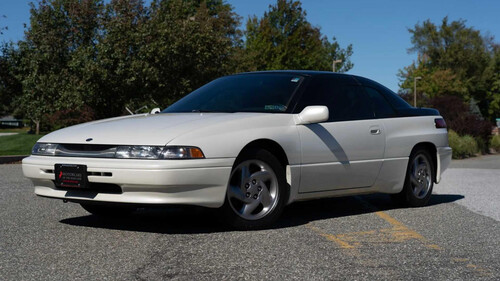
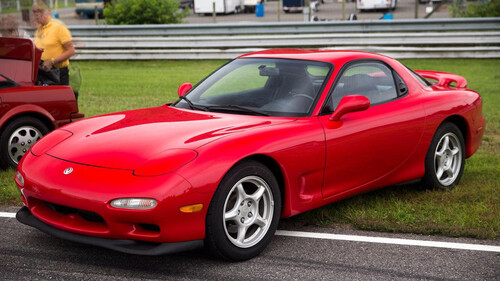
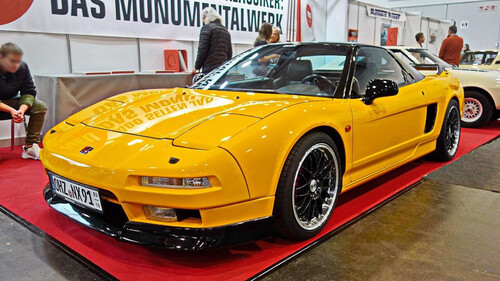
A yellow, Honda Beat with black cloth convertible top up, and steel wheels on a black top against a white brick building. - Guyon / Wikimedia CommonsIt's safe to say that the Japanese Bubble Economy, albeit a pain for Japan when things finally collapsed, was a boon to the car enthusiast community. It answered the question "if automakers had unlimited funds to make cars, what would they build?" Much of the results are unforgettable, from the micro machines that are the Honda Beat and Mazda's Autozam AZ-1, to the cars that would fit perfectly into any of the first three "Fast & Furious" franchise movies. I know that's a generalization, but bear with me. Whether a newly minted model or a facelift of an existing one, each car was built in near maximalist fashion, and any and all technology that could be outfitted in these machines was likely included. They were built to impress, and indeed the did.The beauty of the era is partially revealed in your answers to this past weekend's question. A couple of interesting things I noticed while compiling your answers are that some of these cars sure look similar and many have interesting, quirky design notes. We also learned that I might actually know a little more about this era of cars than most, as Old_SLAAB_Guy missed the exit on the question and did give us a "bubbly car," unfortunately a 1999 Ford Taurus isn't a Japanese bubble car. But points for trying I guess?With that said, here are some of your favorite Japanese bubble cars.AdvertisementAdvertisementRead more: These Dead Cars Need To Stay DeadThe simply magical Mitsubishi 3000GTThe driver's side of a red, 1991 Mitsubishi 3000GT in a dealer parking lot. - AutotraderThere's a lot of great cars from this era – the original LS being one of them. That car was absolutely game changing. Despite the greatness and impact of that car, though, I have to take a swing with something a little different – the Mitsubishi 3000GT VR4. Before the 1990s, Mitsubishi was just another Japanese car brand with nothing really memorable in the American market. They definitely weren't the high priced performance company (yes, I know about the Station – but outside of us car nerds that car had zero impact). Then they decided they wanted to go big time and invested in product, including a turbocharged, AWD sports car with active aero and 4-wheel steering. All that stuff is taken for granted today, but back in 1991? It was magic, and could only be produced in that era.From Gordon S.Mazda Eunos CosmoA driver's side shot of a grey 1991 Mazda Eunos Cosmo in front of a warehouse building with garage ports. - Bring a TrailerEunos Cosmo.Much as I'd have loved that Amati plan to succeed, with 20/20 hindsight it'd have destroyed Mazda, and they realized it in the nick of time. And remember, we're talking "Bubble economy" and not "Cars shaped like bubbles."AdvertisementAdvertisementFrom DungBeetle 62The other AZ1A black, 1991 Autech Zagato Stelvio AZ-1 on the green lawns of the Greenwich Concours d'Elegance. - Mr.choppers / Wikimedia CommonsMy favorite is the other AZ1; the Autech Zagato Stelvio.From Junkman356Honda NSXA beautiful goldonrod yellow 1996 Honda NSX from the front corner driver's side, parked alongside grass at a car show. - Calreyn88 / Wikimedia CommonsHonda NSX. It proved that Japan can manufacture supercars just like the Europeans, and the styling remains timeless today.AdvertisementAdvertisementFrom GiantsgiantsMazda RX-7, 3rd generationA bright silver Mazda RX-7 parked on large bricks. - Aaron Lai / Wikimedia CommonsFD will always be my timeless favorite. You don't need mid engine if you make a tiny lightweight engine and put it completely behind the front axle.From fabeyMitsubishi FTOA silver 1995 Mitsubishi FTO from the front corner driver's side, parked on an empty parking structure. - TCL19 / Wikimedia Commonsrecently developed a big soft spot for the Mitsubishi FTO. Just a quirky little stepchild of a car, looked like some sort of A80/FD mashup but was front wheel drive and built to compete with the Type R integra and (apparently, ive never driven one) handled near as good or better depending on who you were talking toAdvertisementAdvertisementFrom JaredOfLondonNissan FigaroA pink Nissan Figaro with white heart decals and a barbie sign on the front license plate holder, parked along a city street. - Calreyn88 / Wikimedia CommonsFigaro for sure. I owned one from 2016 to 2019. The biggest head turner I've seen. People would follow me and swarm the car when I went into a parking lot.From David GA whole listA white, 1995 Nissan Skyline GT-R (R33) in a parking lot with a large stone wall background. - Bring a Trailer1) R33 Skyline GTR2) 2nd Gen Eclipse GST/GSX3) And just to make folks go "huh", 92-96 Camry (which I had, and many more modded to go less slow and look fast.)Honorable mention to the other midsize Japanese sedans (Maxima, 4th and 5th Gen Accord, Galant, etc) for finding ways to be slightly better than bland on styling and making the bland engines fun.AdvertisementAdvertisementFrom OB the 2ndThis guy owns bothA black, 1991 Nissan Skyline GT-R (R32) on a paved road in a forested area. - Bring a TrailerI'm partial (since I own both cars) but I'd say it's a toss-up between the R32 GT-R or the Z32 Twin Turbo.From where I stand, the R32 GT-R is THE GT-R. Its complete and utter domination in motorsport bred a JTCC/Group A rulebook change, and forced every other race team on the grid to either change to R32 GT-R's or be outpaced. Neither the R33 or the R34 GT-R achieved such dominance in motorsport afterwards, as the rules were changed in every venue they were competitive within solely to equalize them to the remaining playing field.As for the Z32, its introduction in March 1989 flipped the script entirely. Prior to it, Japanese sports cars were mainly considered either cheap or cushy and mushy. The VG30DETT was such an epic powerhouse that even today, many Z32's are making over 800WHP on completely stock internal VG's. That's just turbos and bolt ons in a car with a truly exotic-looking body. As one of the first mass-produced cars designed/engineered on a supercomputer, it lit a fire under the Japanese governments ass, putting the fear of a 300+BHP Twin Turbo power plant and a 180mph/300km/h top speed in the hands of the youth of the Showa Bubble Economy. This fear resulted in the "Gentleman's Agreement", something that mandated all Japanese cars be limited to "300PS/276BHP" from the factory (or so they said).The Z32 also directly forced Honda, Toyota, Ferrari, Porsche and many others to step up and upgrade their quality and standards of manufacturing.From S. N.Subaru SVXThe rear passenger corner full-body shot of a red 1993 Subaru SVX on a cement driveway with trees in the background. - Bring a TrailerThe Subaru SVX. That's why I own three of them hahaAdvertisementAdvertisementFrom Darius CrawfordMy husband saw this and said "oh that's where they all went."Want more like this? Join the Jalopnik newsletter to get the latest auto news sent straight to your inbox, and add us as a preferred search source on Google.Read the original article on Jalopnik.