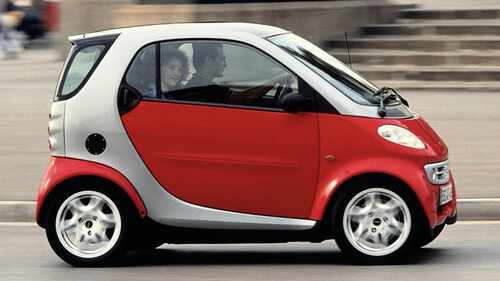
Autoblog and Yahoo may earn commission from links in this article.Whether for their safety or utility, Americans have a clear preference for large-and-in-charge vehicles, but that's not the case in foreign markets. Over in Europe, small cars and hatchbacks are among the most popular vehicles due to their city-friendly sizes and high fuel economy. Over in the Isle of Man, however, small is taken to the extreme. There, one manufacturer holds the record for the Guinness-recognized world's smallest production car.Heritage Images / Getty ImagesThe original Peel P50The world's smallest production car hails from the Isle of Man, which is situated in the middle of the Irish Sea. Created by Peel Engineering, the P50 made its world debut at the 1962 Earl's Court Cycle and Motorcycle Show in London. It featured a single door, three wheels, and weighed in at around 130 lbs. Advertising was simple, making the claim that the P50 was capable of seating "one adult and a shopping bag." picture alliance / Getty ImagesIt measured just 54 inches long and 41 inches wide, but looks can be deceiving. Jeremy Clarkson of Top Gear stands at six-foot, five-inches tall and not only did he fit in the tiny one-seater, but he drove it to work, and then some.AdvertisementAdvertisementThe original Peel P50 saw a two-year production run, starting in 1963 and ending in 1964. Approximately 47 examples of the microcar were sold at a £299 price tag. Of those, around 30 examples survive to this day, and they can be worth quite a pretty penny. In 2013, an original 1964 Peel P50 sold for over $120,000 at auction. To up the ante, a 1963 model was sold for $176,000 at a 2016 auction.Heritage Images / Getty ImagesView the 1 images of this gallery on the original articleInterestingly, Clarkson went on to create a smaller version of Peel Engineering's microcar, dubbed the P45, for an episode of Top Gear. Not only was it shorter and narrower than the P50, but it was capable of traveling at up to 34 mph. While it was unofficially the smallest microcar, it was created solely as a satirical version of the P50 and was never meant for production.Thinking about selling your car? Get an instant cash offer online now. Click here to get started.No reverse gearNaturally, the 1963-64 Peel P50 was no powerhouse. It came equipped with a 49-cc engine mated to a three-speed manual transmission. In all, the P50 was capable of producing a whopping 4.5 horsepower and achieved a top speed of 38 mph. Both the manufacturer and owners claim the microcar earned upwards of 100 mpg. Funnily enough, it had no reverse gear. Instead, it needed to be physically lifted and moved by pulling it around.LAT Images / Getty ImagesSince the original P50 had three wheels and a small engine, it was technically classified as a motorcycle. As a result, it lacked a speedometer. In 1963, the P50 was priced at £199, later increased to £299, making it slightly more affordable than a good motorbike. Peel Engineering wasn't shy about its microcar, and sent it all over the world for safety testing. In the United States, the Bureau of Transportation tested the P50 by rolling it down an embankment. The inspector managed to escape unharmed, and he passed the microcar as a result.A modern revivalIn 2011, Gary Hillman and Faizal Khan received an £80,000 investment, roughly $109,000 today, to start a new company and begin producing revised versions of the P50. While the range originally included three models, it was eventually reduced to two. Not long after, the company introduced more variants, including the P50 Jolly beach car. The Trident, a two-seater version with four wheels, made its return as well.P50CarsLike the original P50, the modernized version measures in at 54 inches long and 41 inches wide. It weighs a tad bit more though, at 230 lbs. While the original two-stroke 49cc engine offers a top speed of 38 mph and earns 120 mpg, the Sports version wields a 125cc gas engine capable of pushing the P50 to 48 mph.AdvertisementAdvertisementThe modern P50 is also available with an electric drivetrain. While the base version is capable of traveling at speeds of 30 mph, the high-output electric motor can achieve a top speed of 50 mph. Regardless of electric motor, the P50 can travel up to 50 miles on a single charge and takes up to four hours to charge from a standard household outlet.picture alliance / Getty ImagesWhile all P50 models are built by hand, the modernized versions are available in kits as well. By ordering a kit, owners are able to source their own power, wheels, and finishing components in their own region or from P50 Cars. Despite their size, the modern Peel P50 costs a good deal more than the original. A standard factory-built model starts at $16,395, while kit models run $8,695, and no, that doesn't include shipping.Shopping for a new car? Click here to get a great deal on your next vehicle. Powered by Carvana, no haggle pricing, 100% online.Final thoughtsCentral Press / Getty ImagesSmall cars may not hold a candle to crossovers, trucks, or SUVs, but even the Smart Fourtwo makes the modern Peel P50 look sizable by comparison. The original Peel P50 may not have been around long, but the microcar left its mark on the industry. Not only has it spent some time in the spotlight of modern media, but it was a unique oddity in its day as well. Going forward, it's destined to remain a historical lesson and a niche model that isn't likely to lose its place as the world's smallest production car anytime soon.Disclaimer: Autoblog aims to feature only the best products and services. If you buy something via one of our links, we may earn a commission.AdvertisementAdvertisementThis story was originally published by Autoblog on Aug 21, 2026, where it first appeared in the Features section. Add Autoblog as a Preferred Source by clicking here.