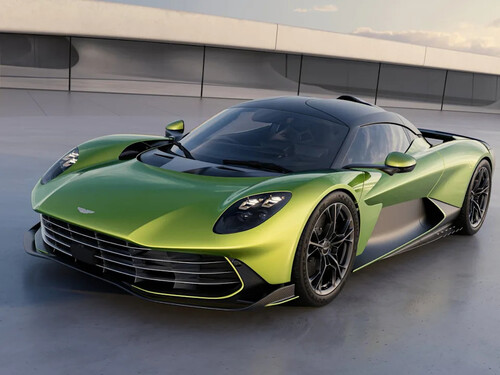
The Aston Martin Valen Is a V-12 MasterpieceAston MartinThe Aston Martin Valen you're seeing here for the first time is a true departure from the folks in Gaydon, and it is not just the lack of British Racing Green on display. Raw speed, less weight, and a loud roar were Aston Martin's primary motivators in developing its latest bespoke model, and the results are Road & Track-certified.Revealed on Friday at the Quail, a Motorsports Gathering during Monterey Car Week, the Valen is meant to raise some eyebrows. It's built on the chassis of the Aston Martin Vanquish, bringing along that car's V-12 powertrain, but it's tweaked by Q—the British automaker's bespoke service named after a certain fictional spy's quartermaster—for maximum performance. Aston Martin insists that this is still a grand touring car, but it won't be as plush or as quiet as your typical V-12 Vanquish.Aston MartinThe heart of the Valen is a twin-turbo, 5.2-liter V-12 making 838 horsepower and 737 lb-ft of torque, making it not just Aston Martin's most powerful front-engined car ever, but the most powerful one ever sold for street use. Thanks to the combination of that motor and a ZF eight-speed automatic transmission, the Valen races from 0-60 miles per hour in three seconds flat. Aston Martin has electronically limited the Valen's top speed to a reasonable 214 mph.AdvertisementAdvertisementDelivering all that force requires care, so particular attention was paid to the Valen's throttle mapping, which changes according to the selected drive mode: Sport, Sport+, and Track. The Sport and Sport+ maps are shorter, and require less pedal travel to access more power; on the other hand, Track mode offers a longer, more progressive pedal travel for a more precise throttle action.Keeping weight down was another focus of the Valen project. Aston engineers managed to shed almost 250 pounds from the V-12 platform, primarily through the use of carbon fiber, aluminum, titanium, and magnesium. Solid aluminum suspension arms, knuckles, and titanium chassis bolts account for 37 pounds of weight reduction alone, while a new set of magnesium wheels is also responsible for cutting pounds and minimizing unsprung mass.Dynamically, the Aston Martin Valen relies on Bilstein DTX semi-active dampers and model-specific springs to meet its G-loading metrics. Both hardware and software changes were made to the electronic stability control and suspension systems on the Valen, to ensure a sharper edge. Even the level of tire camber was adjusted to match the car's character. Aston Martin also tweaked the brake booster, to maintain firm pedal feel from its carbon ceramic brakes.Aston MartinPerhaps the most exciting part of the Valen is its boisterous 12-into-four exhaust system. Aston Martin wanted to make sure the Valen roared at low and high speeds alike, so it created a trick system to increase volume while staying street-legal. We take a deeper dive into the system here, but the big news is that the Valen is 50 percent louder than the Vanquish. And not only is it louder, but the quad exhaust tips operate semi-independently; the upper exhaust exits are always open, while the lower valves only do so under certain throttle positions.AdvertisementAdvertisementThe aggressive approach to mechanical design carries over to the Valen's design. Instead of softly sculpted lines and gaping front ends, the car features sharp lines and an attack-ready stance. The headlights are recessed deep into a slim, sharp leading edge, while the radiator aperture and geometric mesh grille connect directly to the front splitter. There's a single, functional hood vent near the middle of the hood, too.Down below, the Valen features saw-tooth vortex generators that do indeed produce downforce, as well as a tighter section of side-view glass. The rear end of the Valen is even sharper, with a solid tailgate and fixed aerodynamic wing on the trunk lid. That performance-focused design is balanced out by a trunk with more than six cubic feet of capacity and an optional, bespoke luggage set. A full-width light bar sits beneath the upswept tail (which also adds functional downforce), while a perforated panel below the light strip helps extract hot air from the exhaust.Aston MartinThe interior of the Valen was developed around the principle of visual lightness, and a series of 3D-printed components is key to this philosophy. The switchgear from the Aston Martin Valhalla has been transferred into the Valen, alongside a set of newly developed Sport Plus seats or lightweight carbon fiber performance chairs. Customers can choose between semi-aniline leather and Alcantara or a full semi-aniline leather interior, depending on their preference. The center console is also new, with some elements from the Valhalla taken as inspiration, and the center screen angle has been adjusted to be more favorable to the driver.The launch color of the Valen, Satin Andromeda Red, was not chosen randomly. Aston Martin wanted to showcase the Valen as the tip of its spear, and a softer green hue like those often featured on the company's cars wasn't going to cut it. An exposed carbon fiber exterior is also available, for those who want it; the carbon fiber grains can even be tinted by Aston Martin's Q department upon request.Aston MartinOnly 150 units of the Aston Martin Valen will be produced, with first deliveries scheduled for the second quarter of 2027. Representatives for Aston Martin told Road & Track that the bespoke models would likely be 2027 model-year units. The Valen will start at $2 million per unit, though bespoke options will likely push the final price tag significantly higher for each.You Might Also LikeIf You Can Only Own One Car, Make It One of TheseThese Are the Most Popular Cars by State