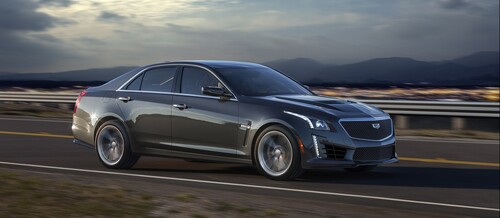
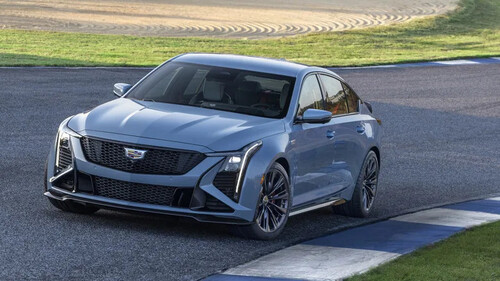
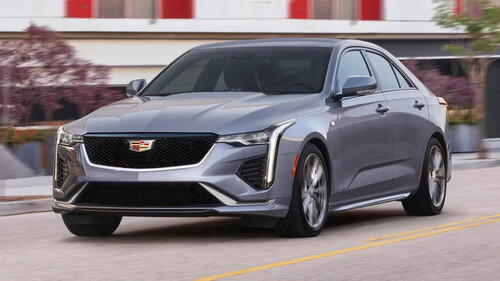
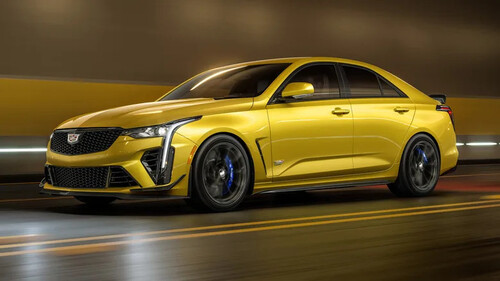
The 22:38 Coast-To-Coast Cadillac Finally Showed Its Cockpit, And It Explains The Whole RunBackfire NewsJohn LloydTue, September 22, 2026 at 5:27 PM UTCAdd us on GoogleThe 22:38 Coast-To-Coast Cadillac Finally Showed Its Cockpit, And It Explains The Whole RunFive months after a Cadillac CT4-V Blackwing crossed the bottom of the United States in 22 hours and 38 minutes, the crew behind the run finally pointed a camera at the interior. It is not a caged, stripped, fire-bottled race car. It looks like a small dispatch center that someone crammed into a compact sport sedan and then drove at an average of 104 mph for nearly a full day.The walkthrough went up this week on the CannonballCC Instagram account, credited to builder and driver Tommy Thomas, whose own profile lists him as the current Jacksonville Beach to San Diego record holder at 22:38. It is the first real look at the hardware, and it quietly answers the question that has followed this run since April: what does a drive like that actually require?Watch it yourself: the CT4-V Blackwing cockpit tour, posted by CannonballCC and credited to builder and driver Tommy Thomas.Start with what the video showsWork from the frame, not from the legend. Visible in the opening seconds: a factory Cadillac steering wheel with a red marker at twelve o'clock, saddle leather with red stitching, and at least four separate displays fighting for space across the dash and center stack. One rides a long suction-cup arm reaching to the base of the windshield. Another is clamped high near the passenger A-pillar. Two more hang from articulating mounts over the console. Underneath them, a thick loom of wiring, including one very obvious blue cable, runs down the center tunnel to a black box parked where a passenger's knees would normally live. A mesh screen is hung against the passenger glass.AdvertisementAdvertisementThat is what is on camera. Fuel cell capacity, detector and jammer models, antenna counts, driver count: none of that is established by this footage, and the team has not published a build sheet. The internet has cheerfully filled in those blanks anyway, with numbers that do not agree with each other. We will pass.The numbers the team publishedFrom the crew's own April post: 2,362 miles from Jacksonville Beach, Florida to Dog Beach in San Diego, California, in 22 hours and 38 minutes, running the Old Spanish Trail across the southern half of the country. They listed an overall average of 104 mph and a moving average of 106. They also thanked spotters and overwatch, which is the unglamorous logistics layer that never makes the highlight clip and almost certainly mattered more than anything bolted to the car.The 21-minute problemThose two averages are the most revealing numbers in the whole post, because together they give away the entire strategy. Divide 2,362 miles by a 106 mph moving average and you get roughly 22 hours and 17 minutes with the wheels turning. Subtract that from the 22:38 elapsed time and the entire coast-to-coast run contains something like 21 minutes of not moving.Twenty-one minutes. That is every fuel stop, every driver change, every bathroom break and every traffic light in Jacksonville and San Diego, combined. Most people burn that at a single interstate travel plaza deciding between taquitos. It is also exactly why the cabin looks the way it does. If you cannot afford to stop, every decision has to be made at speed, which means navigation, traffic, threat detection, fuel state and elapsed time each need a dedicated display and a dedicated pair of eyes watching it.AdvertisementAdvertisementWorth noting what the car itself contributes here, and what it does not. The CT4-V Blackwing runs a 3.6-liter twin-turbo V6 rated at 472 horsepower, which is a lot, and almost beside the point. A sedan cruising at 104 mph is barely working. The real constraints on a run like this are fuel range, traffic density and a human being's ability to keep making good decisions at hour 19. Cadillac's V-Series program, the same engineering culture behind halo cars like the 685-hp CT5-V Blackwing F1 Collector Series, handed this crew a stable, comfortable, long-legged platform. Everything else in that cabin is aftermarket problem-solving.It is a coast-to-coast record. It is not the Cannonball record.This is where the story got loud. The classic Cannonball route runs Manhattan to Redondo Beach, California, roughly 2,800 miles, and the widely recognized benchmark there still stands at 25 hours and 39 minutes. Jacksonville Beach to San Diego is a shorter road through an entirely different part of the country. Calling it a coast-to-coast record is fair. Calling it the Cannonball record is not, and the CannonballCC profile itself keeps the categories separate, listing a 36:44 New York to Los Angeles time and a 32:56 San Diego to Jacksonville semi-autonomous run alongside the 22:38.The team has also pushed back on the version of events that went viral. Replying to a repost of their run, the account wrote that they beat "the previous record by 57 minutes," a mark set in 2024 by a different team, rather than the roughly 20-minute improvement over their own earlier time that got copied across the internet. That is not a rounding error. Taking 57 minutes out of somebody else's record is a very different achievement from trimming 20 minutes off your own.The most useful comment came from a rivalUnder the original post, an account in the name of Arne Toman, one of the drivers on the recognized New York to Los Angeles run, congratulated the crew and noted that when his team took on the Southern Trail in 2018, they were pulled over three times, twice in Texas.AdvertisementAdvertisementThat throwaway line is the best context in the entire comment section. A clean run is not the default on this route. It is the outlier, and it is the single most fragile assumption in any plan like this. Twenty-one minutes of total stopped time does not survive one traffic stop, let alone three.The part the highlight reel leaves outSustaining 104 mph on American public roads is illegal in all fifty states. Nothing on this continent posts a limit remotely close to it. The fastest legal road in the country, a stretch of Texas toll highway, tops out at 85 mph. Well before triple digits you leave speeding-ticket territory and enter reckless driving, which across much of the country is a misdemeanor carrying jail exposure, not a fine you mail in with a check.Enforcement has been getting sharper, not softer, at both ends of this particular route. Florida, where the run started, has been leaning hard on its super speeder statute, as the driver of a 137-mph Lamborghini recently discovered. California, where it finished, now has its own 100-mph license rule. And an attempt does not need to end in a crash to end badly, as the driver arrested in Colorado during another cross-country attempt found out. The insurance tail is the quiet part: a reckless driving conviction typically drags a surcharge behind it for three to five years, and some carriers will simply decline to renew you rather than price it.What it proves, and what it does notThe footage establishes that this Blackwing was heavily prepared for exactly one job and that its cockpit was organized around information rather than speed. It does not establish the route taken hour by hour, the number of people behind the wheel, the fuel strategy, or whether anyone was stopped along the way. These runs are self-reported by nature. The only verification any of them ever get is whatever the participants choose to publish.AdvertisementAdvertisementWhat the video does teach is the thing enthusiasts most consistently get wrong about record attempts: the fast part is not the hard part. Any modern 472-hp sedan will hold 110 mph until the tank runs dry. The hard part is building an environment where a couple of humans can process five or six streams of data for 22 straight hours without making the one mistake that ends the run, or something worse. Those screens are not a flex. They are the car.There is one legitimately useful takeaway in here for the rest of us, and it is that situational awareness scales better than horsepower. That idea is already going mainstream in far more boring form, with Rivian building Waze police and speed camera alerts straight into the dashboard. Same instinct, roughly one twentieth of the wiring, and dramatically less legal exposure.