Tesla CEO Elon Musk delivered on his promise to show a physics-defying Roadster supercar with SpaceX thrusters, allowing it to fly through the air, jump over cars and perform kickflips like a skateboard.
But skeptics questioned Musk’s 2028 production timing and whether any of the car’s gravity-defying tricks are street legal. Tesla showed a different Roadster prototype in 2017 with production set for 2020.
“Not holding my breath,” said Karl Brauer, executive analyst at iSeeCars. “Is the concept of a super-fast, short-distance flying car cool? Yes. Does it introduce the potential for death and lawsuits? Also yes.”
Gene Munster, managing partner at Deepwater Asset Management, described the Oct. 15 reveal in Texas as “an engineering flex with no commercial value beyond embarrassing traditional car makers” in a post on the social-media platform X.
Musk has previously said the Roadster won’t generate significant revenue for Tesla.
The EV maker didn’t give pricing for the car, which it said would be offered in three varieties: Performance, Thrust and Rocket. Reservations require deposits of $50,000 for the Performance and $250,000 for the upgraded Thrust. The Rocket is listed as “invite only.”
Tesla describes the Performance version as “road ready,” with a suction system that maximizes downforce. The limited-release Thrust is “race ready” with cold-gas thrusters for 0 to 60 mph acceleration in under one second. Both have two seats.
The Rocket is a one-seat variant with thrusters “that support forward and upward acceleration as well as lateral rotational movement,” Tesla said. It can fly but is “not approved for public road use,” the company acknowledged.
In 2017, Tesla priced the Roadster starting at $200,000, with a $50,000 deposit.
Manually driven Tesla
Musk said the new Roadster — the second generation of Tesla’s first production car released in 2008 — eventually would become the company’s only manually driven vehicle as it pivots to robotaxis and robots.
Tesla discontinued its Model S sedan and Model X crossover this year to repurpose the assembly line at its Fremont, Calif., plant for Optimus humanoid robots.
The automaker currently produces the Model 3 sedan, Model Y crossover, Cybertruck pickup, Cybercab robotaxi and Semi truck.
“If you’re going to have only one manually driven car, let’s take it to the limits and way past the limits,” Musk said during the 30-minute Roadster presentation.
Musk prefaced the supercar unveiling by saying he had invited Tesla fans to the SpaceX facility in McGregor, Texas, to dispel any claims the video was faked. Musk is the rocket company’s founder.
“You guys can tell people you saw it with your eyes, because what you see with your eyes, you will not believe,” said a jubilant Musk, who added that successfully pulling off the demonstration wasn’t guaranteed. “It’ll probably work. But if it doesn’t work, we’re at a safe distance.”
There was no human driver for safety reasons, Tesla said. The car appeared remotely operated.

Keep up with product planning news with Automotive News' regularly updated database.
Future Product database: 5-year vehicle timelines
Future Product guide: Our 10-week series on future products by brand
Thrusters work in first stunt
In the first stunt, the Roadster drove up a towering curved ramp until it was upside down, held by fans that suck the car to the surface, Tesla said. It then flipped right side up and floated to the ground on its thrusters.
“Well, it worked,” Musk said. “I should say that this is not necessarily a safety-optimized car. But it takes the fun meter to 11 out of 10.”
Marques Brownlee, a popular YouTube presenter and Roadster reservation holder, wrote on X that he was skeptical.
“They really got on stage and said this newly designed 4,000+ pound car can do flips and go half the speed of sound,” wrote Brownlee, who regularly reviews cars. “This is a prank, right?”
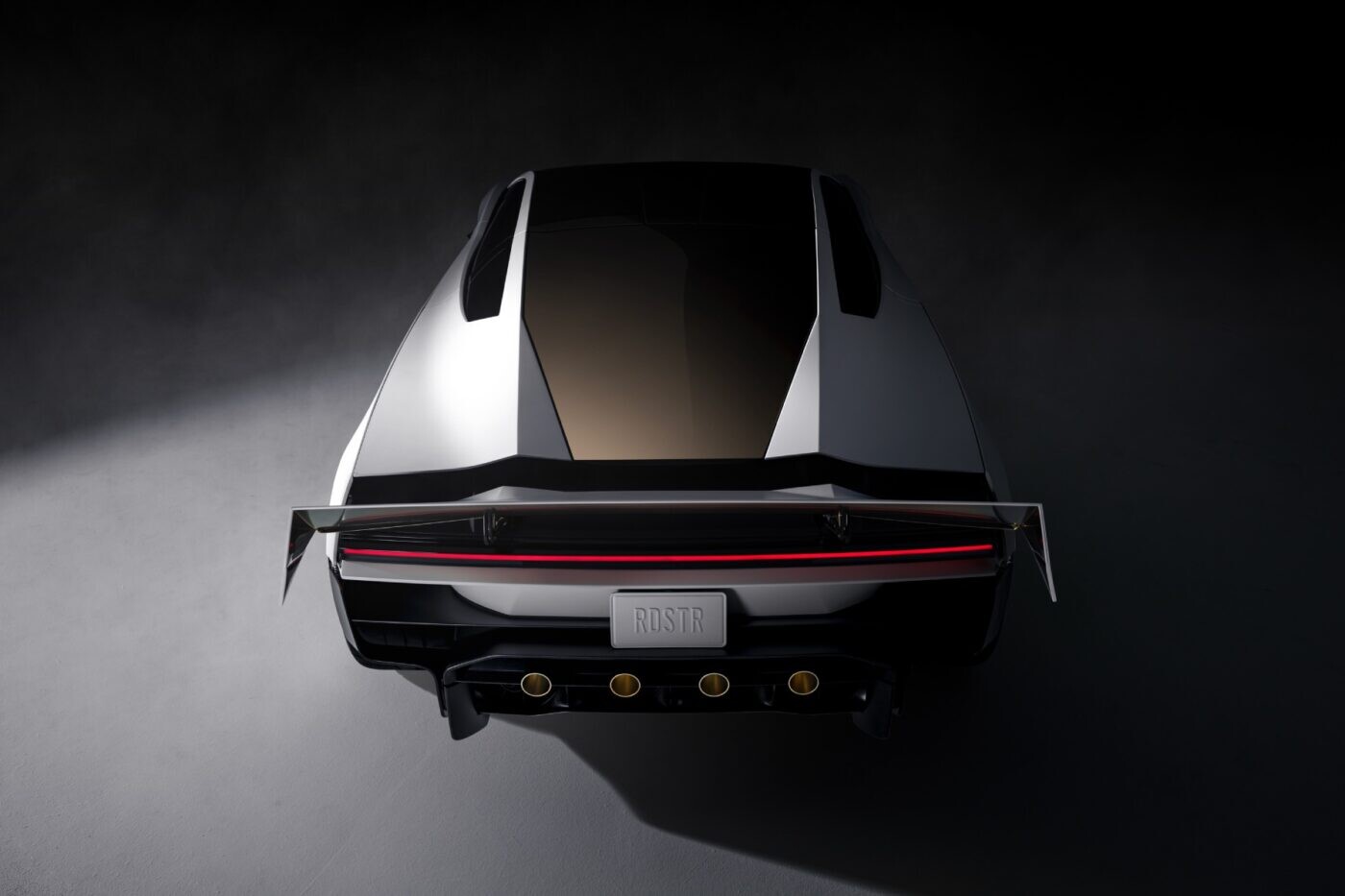
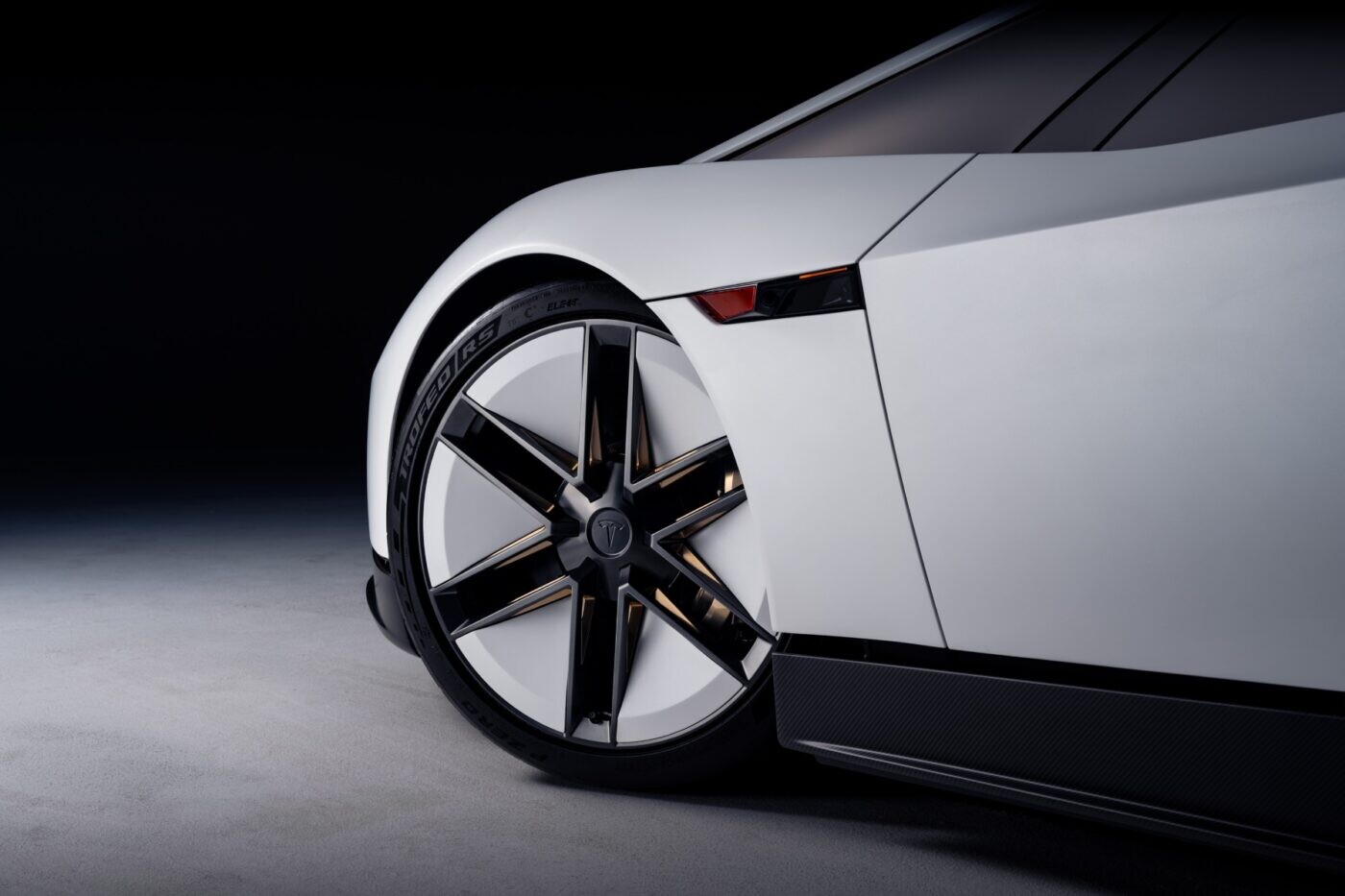
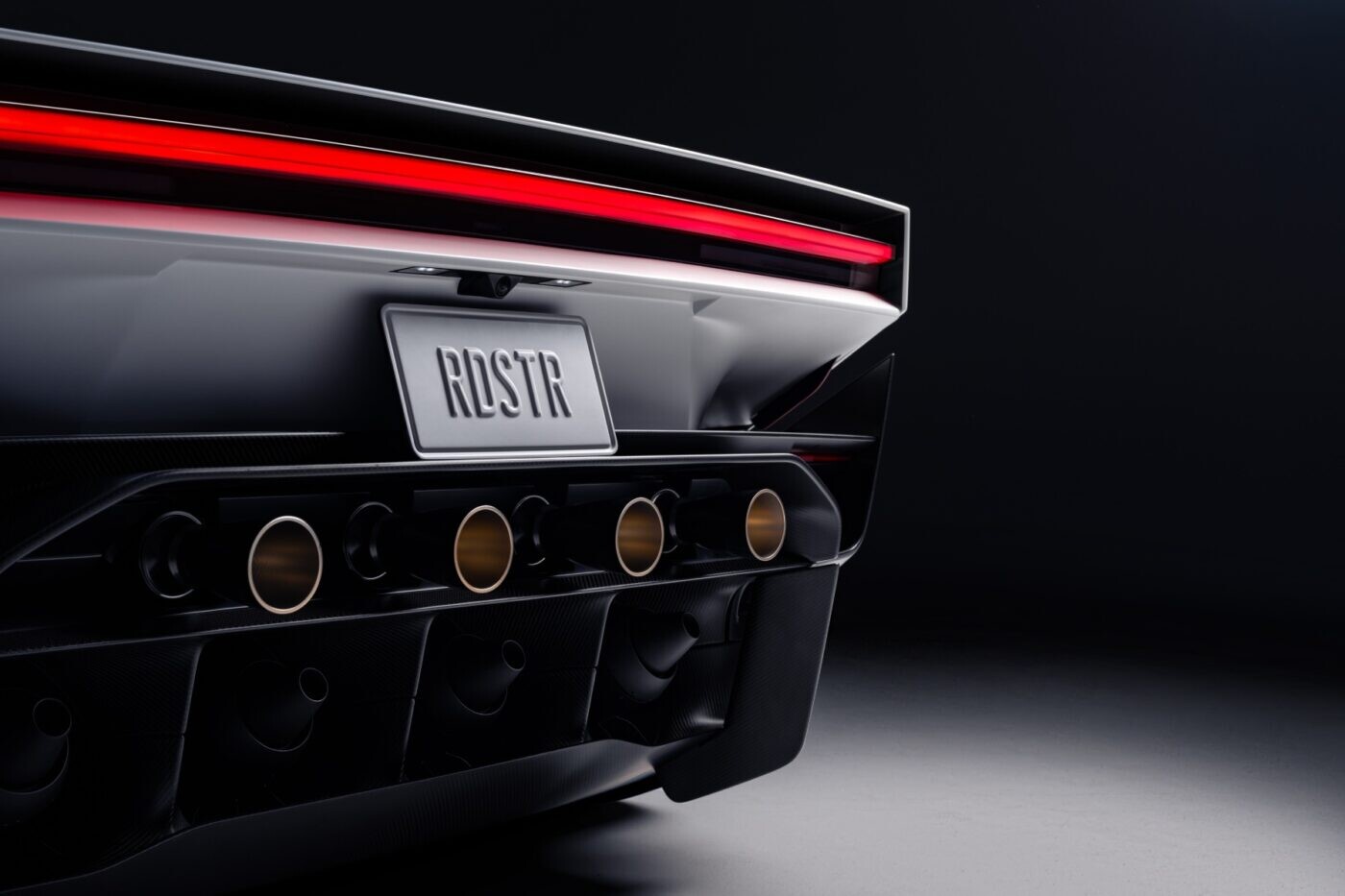
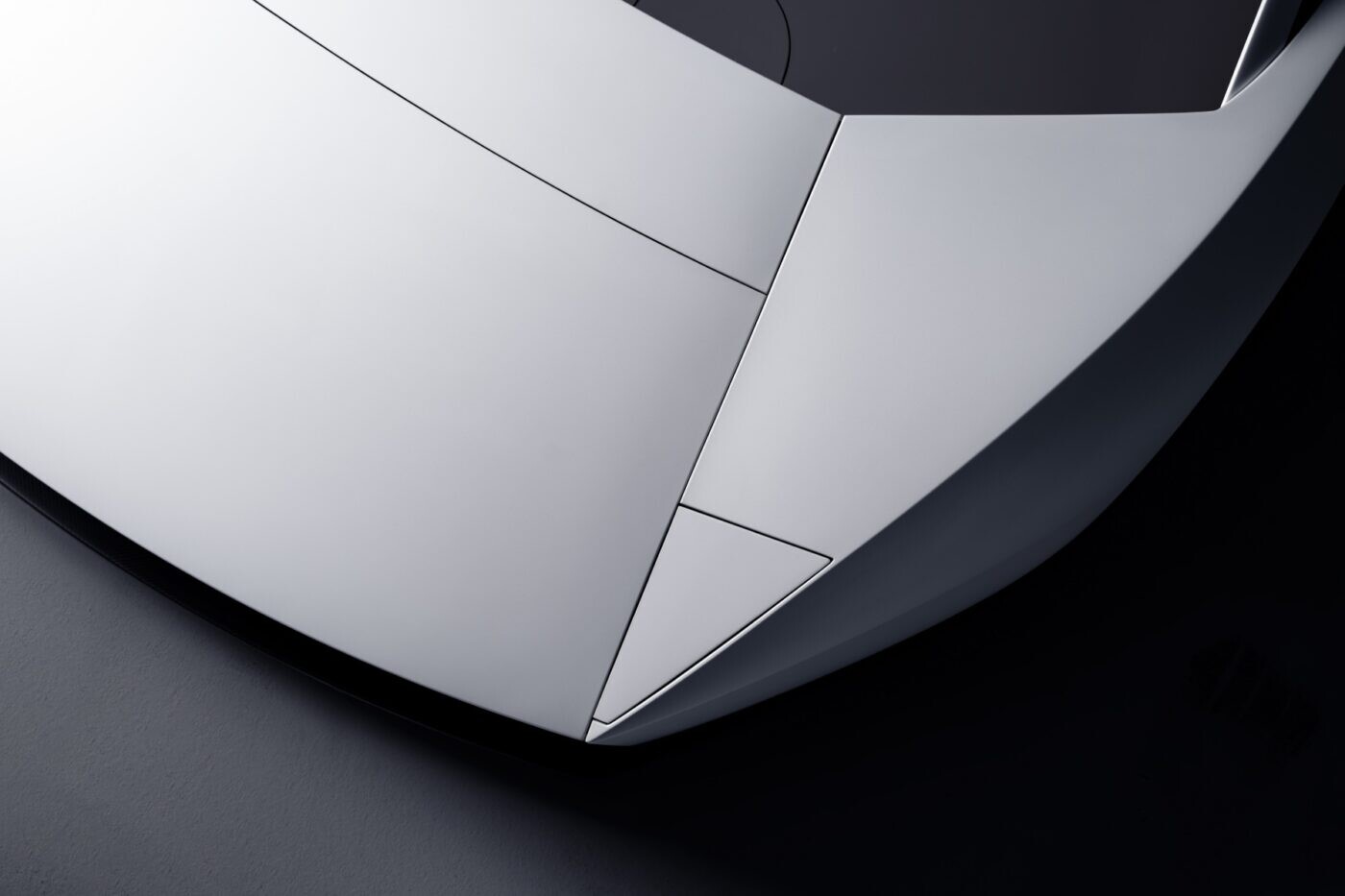
The new Roadster abandons the rounded look of the 2017 prototype for angular lines that Tesla said were inspired by the SR-71 spy plane and F-35 fighter jet.
The supercar has white paint and gold-tinted glass. Inside, a yoke replaces the steering wheel, and the seats are molded into the frame to save weight, said Tesla chief designer Franz von Holzhausen.
The thrusters use compressed air stored in carbon-fiber tanks, which the car can refill on its own, Musk said. The Roadster’s suction fans give it so much grip in corners that “it’s going to crush every track record that has ever existed,” he said.
The Roadster can go more than 300 miles on a charge, about half of what Tesla promised in 2017. The base model reaches 60 mph in under 1.6 seconds, and the top version can break 230 mph, according to Tesla, which didn’t give horsepower or battery size. Musk suggested top speed could be pushed much higher.
During the event, Tesla showed a driverless Roadster accelerating to 60 mph in 0.81 seconds.
Pushing laws of physics
“This car is meant to be the best driver’s car, and to do that, we wanted to break the laws of physics,” said Lars Moravy, Tesla’s vice president of vehicle engineering.
In another stunt, the supercar deployed its thrusters to jump into the air and do a roll while soaring over five Tesla vehicles, like a stunt motorcycle jumping a row of cars.
“I’m not sure it’s necessarily legal in all jurisdictions,” Musk quipped to laughter from the audience. “But there will be such a car that someone can own. It’s going to be pretty wild that you can have a rocket car.”
Musk said a future demonstration could attempt the Idaho canyon jump that daredevil Evel Knievel failed in 1974. “Some people may know about Evel Knievel’s attempt to jump the Snake River Canyon,” he said. “Let’s give it another shot.”
Near the end of the event, Musk said: “We enter production in 2028, actually.”
Musk is well known for missing his self-imposed deadlines for launching new models and software features, including a decade of promises for personal autonomous vehicles.
“Actually, for real,” Moravy said, echoing Musk’s production promise.