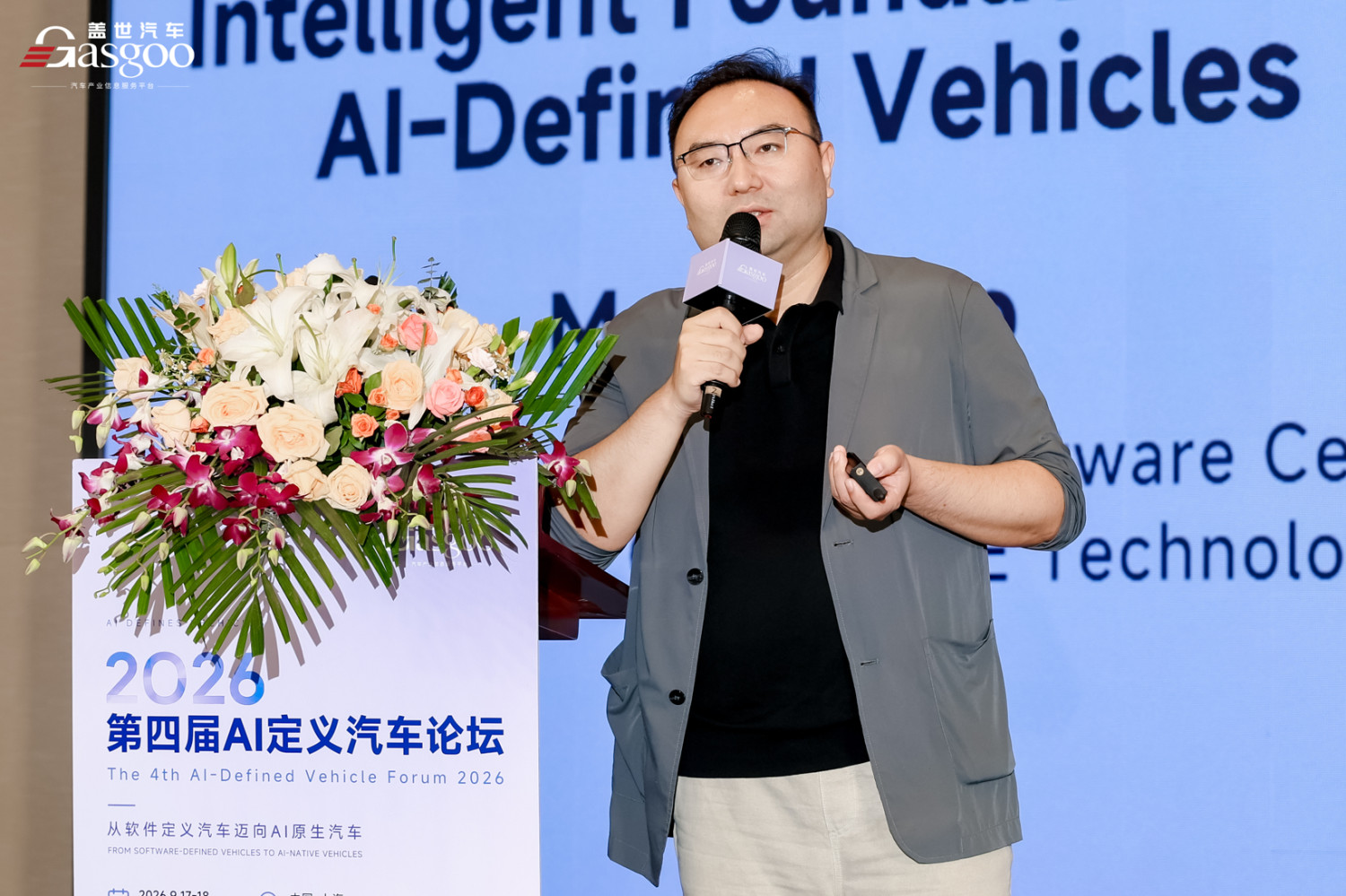



















Gasgoo Munich-"What is a true AI car? It's a question I get asked constantly, yet one I can never answer with a standard definition."Meng Chao posed this question at the 2026 AI-Defined Vehicle Forum on September 17. He is the senior director of SAIC Motor Passenger Vehicle's intelligent software center and CTO of Z-ONE Tech. To him, an AI car isn't just a voice assistant or a specific autonomous driving feature; it's an entirely new product paradigm capable of understanding user goals, breaking down tasks, and mobilizing the vehicle's full capabilities.Meng draws a sharp line between Software-Defined Vehicles (SDV) and AI-Defined Vehicles (AIDV). The SDV era relied on pre-written deterministic rules, with AI serving largely as an add-on whose core value was cutting costs and boosting efficiency. In the AIDV era, behavior is generated through model inference and learning within safety boundaries. This makes AI central to the vehicle's native architecture and shifts the focus toward user experience and a generational leap in the product.He illustrates this shift with a scenario: It's raining at night, a child is asleep in the back seat, and the user says, "Keep it quiet, find an open pharmacy along the way, and remind me when we get close."Under a traditional software system, the user would have to search for a pharmacy, adjust the route, modify the cabin environment, and set a reminder separately. In a Native AI system, the vehicle understands the goal—"buy medicine"—and the constraints—"don't wake the child, minimize detours, remind before arrival." It then coordinates navigation, the cabin, vehicle controls, and ecosystem services, dynamically replanning as external conditions change."The question of judging in-car AI should shift from ‘what model is used' to ‘what it can fully accomplish for the user.'" Meng categorizes in-car AI into five stages, from A1 to A5. These progress from "large-model-enhanced voice" to "executable task agents" and "full-vehicle physical agents," eventually evolving into an "AI-native mobility partner."At the architectural level, Meng argues that AI-defined vehicles require support from four pillars: Native AI products, an edge-cloud collaborative model system, AI software infrastructure, and chips and hardware.Z-ONE Tech is currently exploring a "1+N" agent architecture. One System Agent handles intent recognition, task orchestration, and conflict arbitration. Meanwhile, a lower layer features multiple domain agents—covering the cabin, driving, vehicle control, and energy—that execute tasks collaboratively.He emphasizes that the "1+N" approach does not mean letting a "large model control the vehicle directly." The System Agent manages global tasks, while domain agents and SOA services are responsible for maintaining capability and safety boundaries.As models integrate deeply into vehicles, underlying hardware must evolve. Meng believes chips can no longer be judged solely by TOPS; model compilation efficiency, memory bandwidth, scheduling utilization, thermal stability, and safety reliability together determine the true "effective computing power."To address the "memory wall" created by large models, bandwidth can be boosted in the short term through HBM and 3D stacking. The mid-term focus is on compute-in-memory, while optical computing may emerge as a longer-term technological path.Meng also notes that AI-native products demand not just a shift in technical architecture, but a corresponding adjustment in organizational structure. He cites Conway's Law to warn that legacy organizations hinder progress. If the product architecture is next-generation but the organization remains stuck in the old way of dividing software and functions, the new AI system will struggle to take root.In his view, whether it's a car or an embodied robot, these are merely different terminal forms for AI deployment. What truly deserves attention isn't a specific feature or product form. Instead, it is whether a sustainable ecosystem has been established behind it—one encompassing evolving models, software infrastructure, data loops, and computing power.