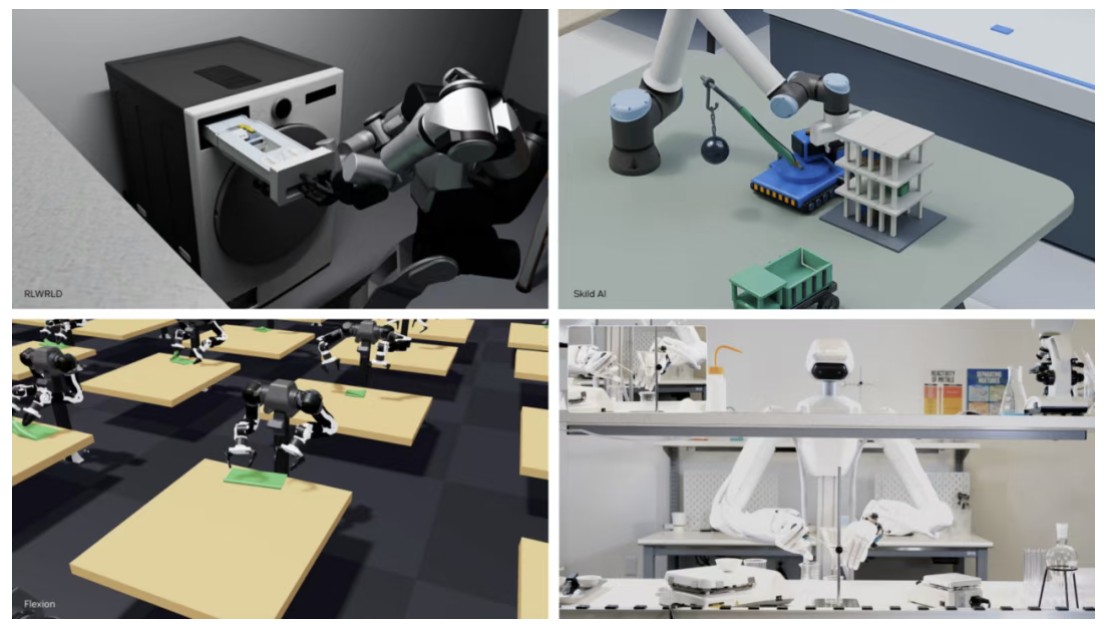
NVIDIA took the stage at the Conference on Robot Learning (CoRL) to unveil the GR00T 2 world action model, Isaac Lab 3.0 open-source framework, and a developer preview of Isaac Lab-Arena 0.4. The new toolkit is designed to bring higher precision and scalability to robot training. Image Credit: NVIDIA Built on NVIDIA’s Cosmos, GR00T 2 is an open, state-of-the-art world action model trained on diverse data sets, including 100,000 hours of open-source human first-person footage. Even without specific task demonstrations, the model managed to complete at least 40 out of 50 evaluation tasks. GR00T 2 supports learning from human demonstrations and transferring skills across different robot bodies without the need for additional robot-specific data. Its generalization is robust: the model achieved a 71% average success rate with just a single demonstration per task, climbing to 95% with five demonstrations. Furthermore, AI agents can leverage the model’s API to execute skills sequentially and recover autonomously from errors. The updated Isaac Lab 3.0 open-source framework allows researchers to rapidly construct training environments using agents and simulation-ready assets, while offering the flexibility to switch between PhysX and Newton physics solvers. Thanks to deep integration with the Newton physics engine, the framework can model deformable objects like cables and cloth, and handle complex joint systems such as dexterous robot hands with numerous coupled joints. Isaac Lab-Arena, an open-source framework for large-scale policy evaluation, has released a 0.4 developer preview. It enables developers to build diverse, reproducible evaluation schemes and run robot policies in parallel across thousands of variable conditions. The resulting analysis pinpoints the specific conditions that lead to failure, helping researchers identify exactly what needs to be addressed in the next training iteration. NVIDIA had two papers named finalists for the conference’s Best Paper Award. GRAIL proposes a digital generation pipeline for robot learning that can automatically generate 3D assets and scenes ready for physics simulation. Meanwhile, RoboTTT introduces a new robot model and training scheme that extends visuo-motor context length by three orders of magnitude compared to state-of-the-art strategies, all without increasing inference latency.

 Liked by Owen Fortin, Jacob Hall







 Liked by Owen Fortin, Jacob Hall