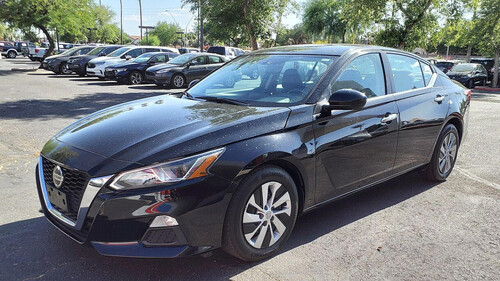
Nissan CVT Transmission Reliability: The Models and Years Used Buyers Should AvoidAutoblogCobus F. PotgieterMon, September 21, 2026 at 4:29 PM UTCAdd us on GoogleAutoblog and Yahoo may earn commission from links in this article.The continuously variable transmission (CVT) has become a popular go-to for automakers prioritizing smoothness and fuel efficiency. Because it has no gears – just a reinforced belt sliding up and down two opposed variable-diameter pulleys – there are no jolts and surges due to gear changes, and the engine is kept in its optimal operating range.The first Nissan to use a CVT was the March city hatch in 1992, and the first US Nissan was the Mk1 2003 Murano. Interestingly, this early Nissan CVT transmission's reliability wasn't the worst, and it would get even worse for Nissan before it got better. Let's look at the worst and best Nissan CVTs for reliability.The Most Unreliable Nissan CVTsNissan's CVTs are supplied by Jatco, which is Nissan's in-house transmission manufacturing company.2003-2007 Nissan MuranoThe 1st-generation Murano was a gamble for Nissan. It came with the reliable VQ35 V6 engine, but only with a CVT automatic and no other transmission choice. A CVT belt is usually limited in the amount of torque it can transmit, and that early JF010E/RE0FO9A CVT paired with the stout 3.5-liter V6 was initially praised for its smoothness, but soon developed an evil reputation, with complete failures occurring between 100,000 and 150,000 miles. Loss of hydraulic pressure would cause slippage and premature belt wear, and Nissan would eventually be forced to issue a 10-year/120-mile warranty extension.2006-2008 Nissan Murano SEUser IFCAR on Wikimedia2008-2013 Nissan AltimaThe Jatco JF011E (Nissan code RE0F10A) is arguably the most problematic Nissan CVT. The JF011E in the 5th-generation Altima with the 2.5-liter 4-cylinder engine suffered from inadequate cooling, causing overheating in sustained highway driving, in hot weather, and on steep hills. This would break down the transmission fluid, leading to improper lubrication and accelerated wear, activating limp mode and restricting vehicle speed to protect itself. Once you hear the tell-tale bearing whine, the damage is already done. Early signs of failure can start at 60,000 miles.2008 Nissan Altima 2.5 SUser Elise240SX on WikimediaThe V6 Altima models used the same JF010E transmission as the 1st-generation Murano; it's a different transmission from the JF011E used in the 4-cylinder Altimas, but also an unreliable unit. The P0868 diagnostic code would pop up, indicating hydraulic pressure loss, leading to belt slip, scoring of the pulleys, belt wear, and impending failure as soon as 100,000 miles.2008-2018 Nissan RogueThe 1st-generation Rogue used the same JF011E CVT as the 5th-gen Altima, so the failures described for it above under the Altima 4-cylinder section are the same. The improved JF016E/CVT8 (Nissan code RE0F10D) in the 2nd-generation Rogue fixed the thermal issues, but introduced a new problem that reared its head if you drove the car hard. Aggressive torque converter lockup under full-throttle acceleration reportedly put a lot of strain on the transmission and wore out the oil pump's internal flow-control valve.2011 Nissan Rogue SUser IFCAR on WikimediaThis caused the transmission to lose hydraulic pressure and the belt to slip, depositing wear-inducing debris in the transmission fluid and clogging the valve body. Making matters worse for both these Rogue generations is that Nissan marketed the CVTs as being filled for life and needing no fluid changes, which turned out to be an expensive mistake, forcing Nissan to settle various class-action lawsuits over transmission failures. Be wary of these older Rogues, and look at our article on the most reliable Rogue model year to avoid pitfalls.2007-2014 Nissan SentraLooking at the model years, you may have guessed where this is going. Yes, the 2007 Sentra used the same JF011E CVT as the 4-cylinder Rogue and Altima models, and it's prone to the same failures. The redesigned 2013 Sentra introduced the redesigned JF015E/CVT7 transmission, but while it solved the overheating issues, it came with sun gears and auxiliary clutch packs that were prone to wear and failure, leading to hesitation, jerking, and eventual failure. It was improved after MY2014, but was never known for its durability.2011 Nissan Sentra 2.0U.S. National Highway Traffic Safety AdministrationAdvertisementAdvertisement2013-2018 Nissan PathfinderDespite being a heavy-duty CVT with a steel-link chain and not a push belt, the JF017E/RE0F10E/J in the 2013 Pathfinder was problematic from the start, exhibiting behavior jokingly referred to as the "Pathfinder shudder". A failing valve body would not regulate transmission pressure, causing the chain to slip and judder. Problems started as early as 60,000 miles. There were several class-action lawsuits, technical service bulletins, and eventually, extended warranties offered to cover affected cars.2014 Nissan Pathfinder PlatinumCars.comThere was even a recall for a fluid hose that could pop off and dump all the transmission fluid on the road. The transmission was steadily improved over seven years until 2020, when it was mostly sorted out with an upgraded valve body, new diagnostic logic, and more measures. The 2013 and 2014 model years seem to be the worst, but hydraulic control issues plagued the transmission until at least 2018.2015-2018 Nissan Maxima and MuranoFollowing on from the above Pathfinder issues, the same JF017E in the 2015-2018 Maxima and Murano models gave the same problems. The Beaver vs. Nissan North America class action covered 2015-2018 Muranos and Maximas and forced Nissan to extend its powertrain warranty to 84 months or 84,000 miles and reimburse owners for out-of-pocket transmission repairs.2016 Nissan MaximaDrew PhillipsView the 2 images of this gallery on the original articleMost Reliable Nissan CVTsAre you likely to experience fewer Nissan CVT transmission problems if you opt for a later model? In general, yes; if you stick to the 2019 model year or later in newer designs such as the CVT-XS instead of the older push-belt types. By all accounts, the most reliable models and years of older CVT-equipped Nissans seem to be:AdvertisementAdvertisement2017-2019 Altima2021-2023 Altima2017-2020 Rogue2022-2024 Rogue2021+ SentraThe CaveatWith a CVT, there are always caveats, however. Even the later, more reliable Nissan CVTs are subject to strict maintenance requirements, and missed fluid changes will quickly degrade even a reliable design. You must insist on a verifiable transmission maintenance history before buying a used Nissan with a CVT; in fact, it's not negotiable on a used CVT at all. New fluid and the replacement of both filters are required every 30,000 miles. If this is not the case, the transmission may be a ticking time bomb. A neglected CVT can fail dramatically.Subaru TR580 CVT Teardown by I Do CarsI Do Cars/YouTubeFinal ThoughtsEarlier CVT generations from most automakers are the most unreliable, and it took several years for designs and reliability to improve. The older Nissan CVTs with the push-belt system in the mentioned cars should be avoided at all costs, and even the later ones should not be considered unless conservative maintenance protocols were followed. A failed CVT can easily cost the money you paid for an old, used Nissan to fix, and isn't worth it on used cars with low market values.This story was originally published by Autoblog on Sep 21, 2026, where it first appeared in the Car Buying section. Add Autoblog as a Preferred Source by clicking here.