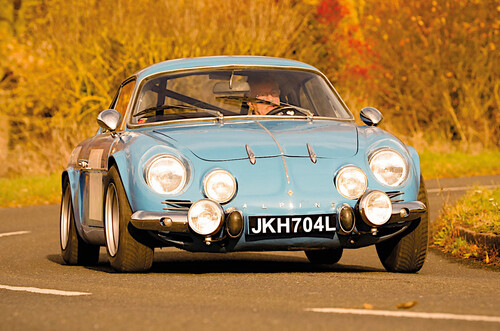
Classic & Sports Car – Alpine A110 GT4: from rally stage to the school gatesHunkered-down road-hugging good looks, almost invariably accompanied by that trademark metallic-blue paint.A rally heritage going back to the foundation of the marque, and encompassing two Rallye Monte-Carlo victories.Cars don't get more emblematic than the Alpine A110.But alongside the frontline Berlinette there was another version.Less glamorous, less powerful, more practical – but also blessed with a relatively long commercial life, albeit one lived in the shadow of its attention-hogging sibling.AdvertisementAdvertisementThis was the A110L or GT4, a 2+2 variant of which between 200 and 300 were made – sources are vague – between 1962 and '69.Classic & Sports Car – Alpine A110 GT4: from rally stage to the school gatesThe Alpine A110 GT4's origins lie in the A108 Coupé 2+2, first seen in the summer of 1960, and put into production for the 1961 season by the marque's sub-contractor Chappe Frères et Gessalin – future maker of the Simca-powered CG.Run by the Chappe brothers – Albert, Abel and Louis – and brother-in-law Amédée Gessalin, the family firm based just outside Paris was to become a specialist in glassfibre coachwork, and had been making the bodies for the original fastback Alpine A106s.These were bonded to a 4CV platform by Chappe, then trimmed and painted before being sent to the nascent Alpine concern.Classic & Sports Car – Alpine A110 GT4: from rally stage to the school gatesThis was still very much a sideline to marque founder Jean Rédélé's main business of selling Renault cars, and initially operated under the wing of the Renault concession owned by Rédélé's father-in-law Charles Escoffier.AdvertisementAdvertisementIn 1961 just 10 cars would be made.But Alpine was establishing a new design, based around a tubular backbone chassis, and was in the process of taking body construction in-house.One story goes that Chappe felt that it risked being excluded, so came up with an occasional four-seater variant to keep at least some of the Alpine business.Another version of that tale has the 2+2 being created by Rédélé and his team, then being passed to Chappe for manufacture.Classic & Sports Car – Alpine A110 GT4: from rally stage to the school gatesThis seems slightly less plausible, given the awkwardness of the Alpine A110 GT4's lines, which feature an abruptly squared-off glasshouse incorporating the rear window from a Renault 8.AdvertisementAdvertisementWith his well-developed sense of aesthetics, would Rédélé really have overseen such an ungainly design?Whatever the finer points of history, the 2+2 was shown at the 1960 Paris Salon as a steel-bodied prototype, built on a version of the new A108 tubular chassis extended in its wheelbase by 7cm or just shy of 3in.As on all A108s and the subsequent A110s, the coil-sprung suspension was by unequal-length wishbones at the front (with an anti-roll bar) and simple swing-axles at the rear.Classic & Sports Car – Alpine A110 GT4: from rally stage to the school gatesThe glassfibre shell of production cars was bolted in place, rather than bonded to the frame as on other Alpines, and power came from the Dauphine Gordini engine, in either 40bhp 845cc format or as a 903cc unit uprated to 55bhp by tuner Marc Mignotet.AdvertisementAdvertisementNot only were the bodies made by Chappe, but the cars – perhaps 100 in all – were also assembled and trimmed by the company, with just the running gear and final detailing being carried out by Alpine.But the Coupé 2+2 was not well received, and at the 1962 Paris show a revised model was announced, with a more rounded rear roofline and the wheelbase extended by a further 10cm (4in).Classic & Sports Car – Alpine A110 GT4: from rally stage to the school gatesThe front end was unchanged, and continued to use a Renault Floride/Caravelle windscreen.The 2+2 was, in theory, still available, for two further seasons and on the longer wheelbase, but it is doubtful that many more were constructed: the new car, known as the Coupé GT4, was a much happier-looking proposition.AdvertisementAdvertisementSold only as an A110, the GT4 was thus always equipped with the five-main-bearing Renault 8 engine, as opposed to the three-main Dauphine unit that powered the A108s.At first this was a 956cc motor and it delivered 51bhp, against the 55bhp which propelled the more sporting Berlinette.Classic & Sports Car – Alpine A110 GT4: from rally stage to the school gatesFor 1964, a 66bhp version of the Renault 8 Major's 1108cc engine became available as an option, with the 956cc unit no longer being listed after the 1965 model year.For those wanting to carry their young children at even greater velocities, the peaky hemi-head R8 Gordini motor was offered to customers for 1966, in initial 95bhp 1108cc tune.AdvertisementAdvertisementA year later there followed the further options of either a 1255cc or 1296cc Gordini unit, these respectively developing 105bhp or a meaty 120bhp.For the final 1969 season, the car was available only with the 66bhp 1108cc engine – known as the '70' – or in spicier 1255cc R8 Gordini tune.Classic & Sports Car – Alpine A110 GT4: from rally stage to the school gatesAs with the preceding Coupé 2+2, the GT4 was largely constructed by Chappe, which continued to bolt the body to the chassis rather than bonding it in place.Against the 8000 or so A110 Berlinettes that were made in France – along with another approximately 3500 assembled overseas in Mexico, Brazil, Spain and Bulgaria – the GT4 is, rather inevitably, a rarity among Alpines.AdvertisementAdvertisementHowever, for former Renault sales representative Jacques Paquereau, who is the owner of the delightful example you see photographed here, that is part of the appeal.So, too, is this lesser-known model's greater affordability.Classic & Sports Car – Alpine A110 GT4: from rally stage to the school gatesBerlinettes have never been undervalued, whereas the GT4 has always been much more the poor relation – and with a price-tag to match. Indeed, Paquereau was able to purchase his 1966 car for a modest £600, back in 1981.The trade-off, despite the revised roofline of the GT4, is a certain portliness to the car's appearance.That said, even with the more upright glasshouse, nobody could surely accuse this Alpine A110 GT4 of being unattractive.AdvertisementAdvertisementMore to the point, a 5ft 6in passenger can just about squeeze their legs into the back, splayed behind the front seats; meanwhile, their head won't touch the roof.Classic & Sports Car – Alpine A110 GT4: from rally stage to the school gatesFamily travel is thus perfectly feasible, in a way it wouldn't be in, say, an MGB GT.Small pockets in the rear quarters, along with side armrests, make the back of the Alpine an agreeable berth, while the decent front boot – the radiator stays with the engine – means that you need not leave home four-up with little more than a set of toothbrushes.The cockpit is also a pleasant place to be, with criss-cross stitching to the vinyl seats, a crackle-black moulded dashboard with two big Italian-style soup-plate dials, plus smoked sunvisors and hefty chrome door furniture lifted from the Renault Caravelle.Classic & Sports Car – Alpine A110 GT4: from rally stage to the school gatesExposed screwheads signal that this is a limited-production specialist car, but everything is as tidily presented as you would expect from the dapper tie-and-blazer garb of Jean Rédélé himself.AdvertisementAdvertisementPaquereau sings the praises of the GT4: "It's far better than a Caravelle."There's no comparison in terms of roadholding – it's extraordinary for a rear-engined car, thanks to the negative camber and asymmetric Michelin XAS tyres."The ride is firm, but it's very well mannered and up in the mountains it's a delight."The GT4 is indeed an enjoyable device. The rack steering is quick and informative, with just the right amount of weight, and a delicate wood-rim wheel adds to the pleasure.Classic & Sports Car – Alpine A110 GT4: from rally stage to the school gatesWith the swing axles on the A110 restrained by diagonal radius arms, the car corners flat, holding a tight line with no run-wide 'fat' to pay off.If the rear-engine configuration is evident, it's more on long straights, where there's just an edge of instability – a feeling of lightness to the nose.Fed by a twin-choke Weber instead of the Solex of pre-'68 cars, the '70'-spec alloy-head 1108cc engine in the Paquereau car revs sweetly and is smooth and torquey, with strong acceleration in third and relaxed 60-70mph cruising; a maximum of around 100mph was quoted.It's all the more of a shame, therefore, that the gearchange is such a challenge.Classic & Sports Car – Alpine A110 GT4: from rally stage to the school gatesVague and sloppy, it makes it difficult to find neutral or reverse, or indeed to know what gear you are in; the bushing needs replacing, says Paquereau.Past experience suggests he's right: the Renault shift does lack precision across the gate, but should be slicker than this.As for the four unassisted discs, they are a little dead at the pedal but provide effective braking.It's a sporting enough cocktail, with none of the laid-back suppleness of the Caravelle whose mechanicals it shares – as testified by the crashes that the stiffly controlled suspension sends through the structure on poor roads.Classic & Sports Car – Alpine A110 GT4: from rally stage to the school gatesThere wasn't a lot of choice at the time for a French person wanting an individualistic small sports coupé, so there was a definite logic to Alpine offering the GT4 as a more hardcore alternative to the Caravelle, which was well suited to posing at the seaside.Whether that made it worth 60% more than the mainstream Renault is another matter.There was, however, another game in town: from the '62 show, Simca was offering its svelte Bertone-styled 1000 Coupé.At a 1964 price of FFr12,000, against 17,390 for the GT4, it would have been a committed Alpine enthusiast who paid the extra for the slightly home-built charms of the GT4.Rough marketplace justice it may be, but the 'family' Alpine never stood much of a chance, especially once Rédélé had sharpened his focus and concentrated on the Berlinette.Nonetheless, it's hard not to warm to such a crisp and practical little machine.Images: Tony BakerThis was first in our November 2013 magazine; all information was correct at the date of original publicationWe hope you enjoyed reading. Please click the 'Follow' button for more super stories from Classic & Sports Car.