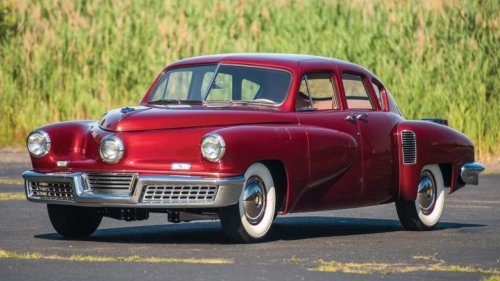
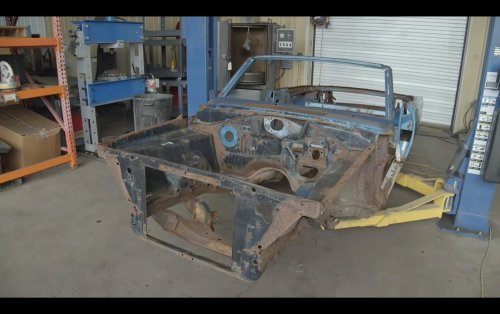
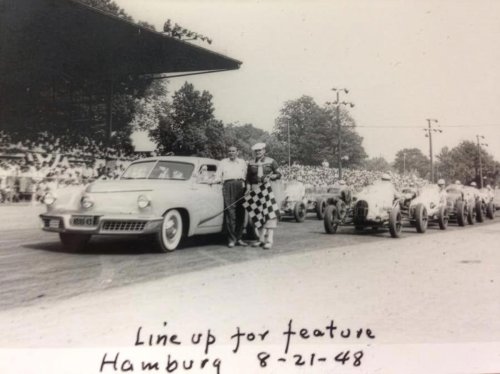
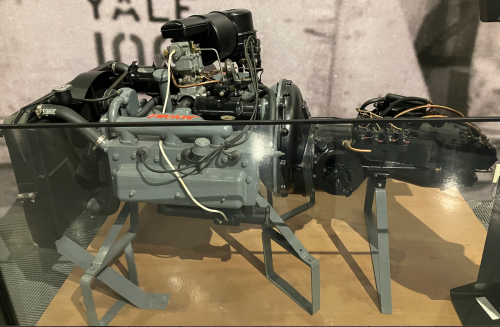
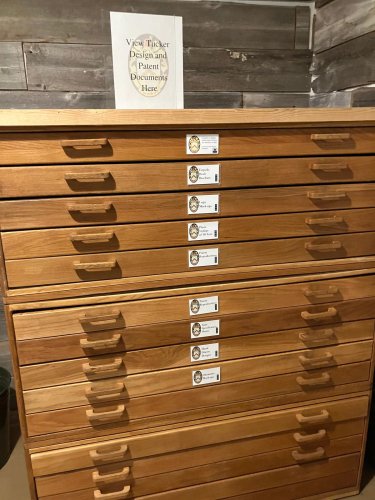
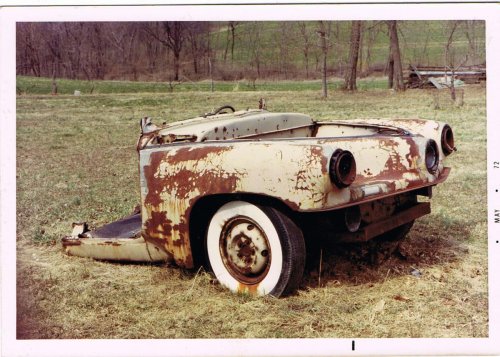
A new, original Tucker 48 Torpedo is on its way to a museum near you. It will be the 48th of 47 known survivors among the 51 (including the prototype) cars the Tucker Corporation produced in its brief lifetime. Depending on how quickly sufficient donations are raised, it could take up to six years before you can see it.The 48th Tucker is serial number 1018. It has been known among Tuckerfosi for a long time, though for the time being, it probably is not what anyone would call a “car,” certainly not a “survivor.” Tucker #1018 is the somewhat rusty chassis with the two front wheels, front seat frame, steering wheel, and inner front trunk panels you see in the photo(s).It has been separated for perhaps 73 years from its still like-new 335 cubic-inch air-cooled aluminum Franklin horizontally opposed rear-mounted six, which has been on display in the Cammack Collection of the Antique Automobile Club of America museum in Hershey, Pennsylvania, for many of those years.When it is rebuilt, within the next six years Nostalgic Motoring Ltd.’s owner/proprietor Mark Lieberman hopes, the 48th surviving Tucker 48 will offer museum-goers an educational, “clear view” look at Preston Tucker’s groundbreaking design. Old photo.But we are getting ahead of the story.Number 1018’s unique Tucker story begins in 1953, when the low-slung sedan was involved in a catastrophic one-vehicle crash into a tree at high speed in East Aurora, New York. Its remains, with the front part of the frame intact and the engine in showroom shape indicates the driver lost control and somehow crushed much of its sheetmetal without separating its front wheels. The tow truck removing the Tucker from the tree tore its remains in half.The car was owned by George McKinney of Bradford, Pennsylvania, according to the display of its remains, though the display card does not indicate whether McKinney or someone else was behind the wheel at the time of the crash.We know this much: “For decades, its fate remained unknown,” the museum card reads.Considering it was a five-year-old sedan though of rare lineage when it was seemingly totaled, it’s rather surprising that everything but the engine wasn’t dropped into a crusher.Forty-five-ish or 50 years later, 1018’s chassis, pretty much as you see it here, ended up in the hands of Mark Lieberman, owner and proprietor of Nostalgic Motoring in Auburn Hills, Michigan. Nostalgic is one of three shops with prime expertise in all things Tucker, including history, restoration, and parts.Another is Rob Ida, whose Rob Ida Concepts in Morganville, New Jersey, works closely with Preston Tucker’s great-grandsons, Mike and Sean, who restore Tuckers and sell memorabilia and branded clothing as Preston Tucker LLC from Lancaster, Pennsylvania, about 28 miles southeast of Hershey.Lieberman says he purchased #1018’s remains in the late 1990s or early 2000s with hopes of somehow putting it back together. By then, real estate investor David Cammack already had #1018’s engine. Cammack owned the largest collection of Tuckers with #1022, 1001, and the Tuckermatic automatic transmission-equipped 1026, according to Hemmings, when he died in April 2013 at the age of 85. Engine.Housed at the Antique Automobile Club of America in Hershey, the Cammack Tucker Collection also includes one of two Tucker test chassis, several Tucker/Aircooled Motors engines, and approximately 50,000 blueprints for most every component used in Tucker production.Lieberman placed #1018’s remains on permanent loan to the Ypsilanti Automotive Heritage Museum, which celebrates cars with connections to the Michigan town southwest of Detroit, including Hudson, Kaiser-Frazer, and the Chevrolet Corvair. While Tuckers famously were assembled in a Chicago factory, the Tucker Corporation was incorporated in Ypsilanti, Michigan.Lieberman’s permanent loan of #1018 stipulated the Ypsi museum return it to him if ever pulled from display. But curator Jack Miller, son of the Hudson dealer whose showroom became the museum, removed #1018 after roughly a year and sold it to Mustang collector Marty Mieras, of Grand Rapids, Michigan, Lieberman says. Miller died at the end of 2020, aged 81.Mieras did not respond to an email request for an interview.During much of the first 20 years of the 21st Century, Mieras did not want to sell #1018 back to him, Lieberman says. But a few years ago, Lieberman had a 1970 Ford Mustang that Mieras wanted. It was a “good bargaining chip,” and the two reached a deal in September 2023.Original Tucker blueprints.“I didn’t have clear vision of the Clear Vision Tucker yet,” Lieberman says. He does now.Lieberman donated #1018 to the AACA Museum at Hershey, which has begun a fundraising campaign to rebuild it as the Clear Vision Tucker.It will be a drivable car touring various museums around the nation as an educational piece, which jibes with a quote by David Cammack printed on a wall at his Tucker collection in Hershey:“I wouldn’t want it if I had to keep it in a safety deposit box… Who wants something like that? You can’t enjoy it and nobody else can. That’s not my nature.”Also on display at the Cammack Collection is a maroon Tucker Torpedo “movie car” created by Rob Ida’s father, Bob, for Francis Ford Coppola’s Tucker: The Man and His Dream (1988), Cammack’s three Tuckers, the vast blueprint files, and a Tucker front clip and steering rack that lets museum-goers turn the wheel and watch the center headlight follow it. As the name implies, Lieberman’s “Clear Vision” for #1018 is not to fabricate new sheetmetal for the Tucker Torpedo, but rather to render a new body from original spec (thank you, David Cammack, for collecting those blueprints) in see-through acrylic or polycarbonate. 1018’s front clip, also separated from the chassis and engine some time after the 1953 crash, passed through a number of hands, including Dearborn, Michigan, shopping mall builder and former owner of Lionel trains, Dick Kuhn.That’s step-three, Lieberman says, after (one) Rob Ida’s shop repairs rust and replaces sheetmetal on the frame, resets the suspension mounts, and (two) delivers #1018 to Nostalgic Motors where Lieberman’s shop will make the engine, transmission, and brakes operational. After all this is done, the AACA will tour the Clear Vision Tucker as an educational piece, traveling to other museums across the US. “It’s more than a static display,” he says. “It has to survive being driven.”To be made of sheet acrylic or polycarbonate, the Tucker 48 body will have a driver’s door that opens and closes, but Lieberman and Ida do not yet know whether making the three other doors operational is practical. If it can be done, #1018 also gets a new back seat and parcel shelf.This will cost a lot, a six-figure sum, but still under $1 million, Lieberman figures. And that’s where the story of the Clear Vision Tucker begins. Making its debut at a special event at Hershey Friday evening, May 8, the AACA launched a fundraising event to pay for the rebuild. Contribute $100 or more to get a special Tucker t-shirt. Contribute $250 or more and get the t-shirt plus your name on the Clear Vision Tucker display at the AACA museum.


















 +32 others