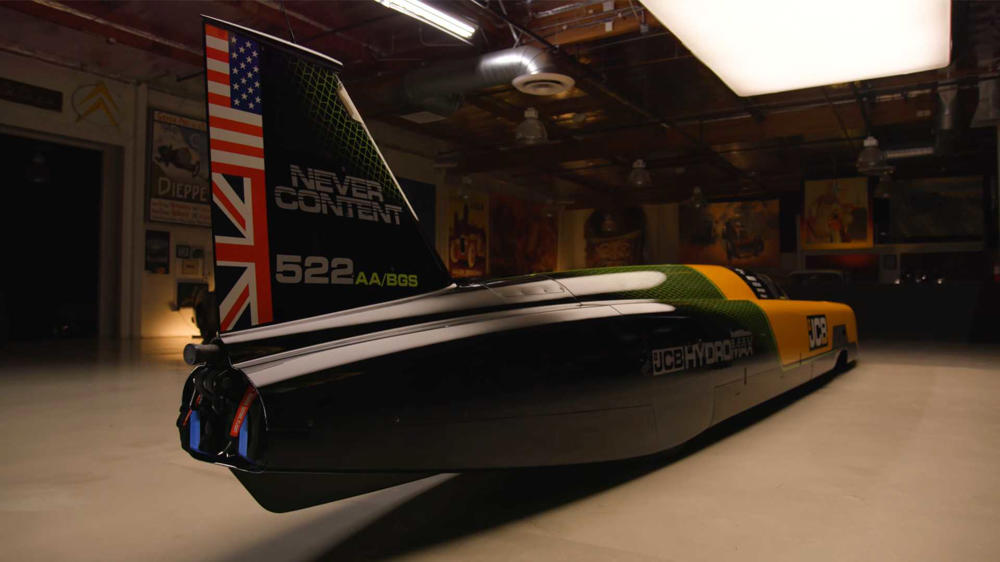
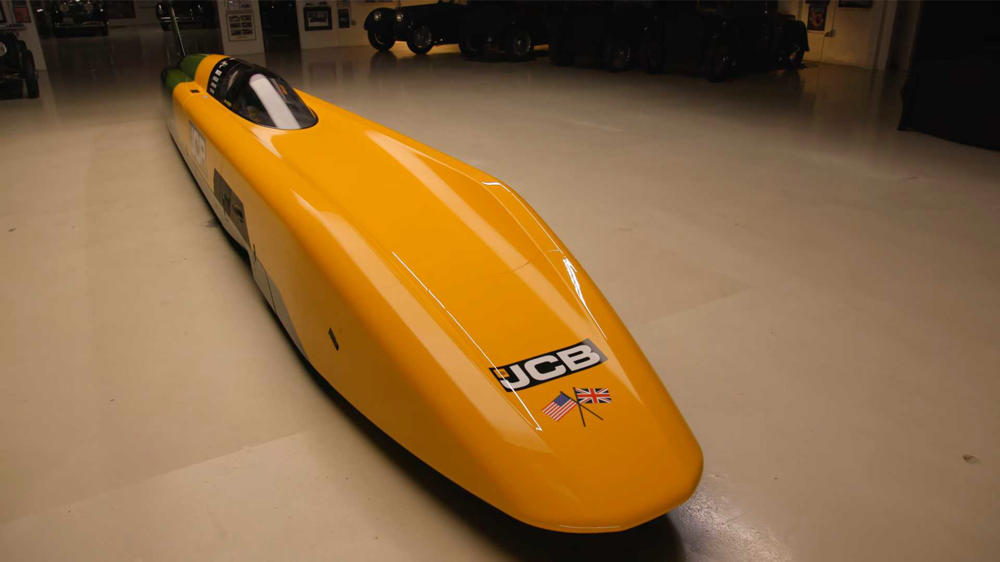
A backhoe loader hitting 400 mph sounds like something dreamed up after an exceptionally long lunch. Yet the latest episode of Jay Leno's Garage features a hydrogen-powered machine that's done pretty much that, using engines developed from JCB construction equipment. The result is a 1,600-hp land speed record holder that makes some of the world's fastest supercars look pretty ordinary. Better still, the engineering behind this thing is nuts. Jay Leno Meets The 406-MPH JCB Hydromax Jay Leno opens the episode behind the wheel of a JCB backhoe loader, although he has no plans to start a landscaping business. Instead, he's introducing the JCB Hydromax, the world's fastest hydrogen-powered car. Joining him are JCB engineering director Ryan Ballard and Andy Green, the British driver responsible for pushing this extraordinary machine beyond 400 mph. In August 2026, the JCB Hydromax recorded a two-way average of 406.320 mph at Utah's Bonneville Salt Flats. Green completed one measured run at 400.623 mph and another at 412.135 mph, establishing a new FIA hydrogen-powered land speed record. The previous hydrogen combustion benchmark stood at 185.5 mph, set by BMW's H2R in 2004. That's quite an improvement for technology borrowed from machinery normally associated with digging holes. Green knows a thing or two about ridiculous speeds. He drove the jet-powered ThrustSSC to 763.035 mph in 1997, becoming the first person to break the sound barrier on land. He also piloted JCB's Dieselmax to a 350.092-mph diesel land speed record in 2006. Twenty years later, he's back with another JCB record holder, although this one trades diesel for hydrogen. Two Backhoe Engines Produce 1,600 HP And Massive Torque The JCB Hydromax uses two turbocharged 4.8-liter four-cylinder hydrogen combustion engines, one powering the front wheels and another driving the rear. Each engine produces approximately 800 hp, compared with roughly 74 hp in its construction-equipment application. That's more than ten times the original output, achieved with extensive modifications and approximately 50 psi of turbocharger boost. Each engine also produces around 1,100 lb-ft of torque, enough to threaten the racing transmissions with an extremely expensive retirement. Engineers solved the problem by doubling rotational speed before the gearboxes, effectively halving the torque they must handle. Two separate six-speed transmissions drive the axles, while an electronic control system keeps everything synchronized. Remarkably, the rear engine survived all 49 development and record attempts without replacement. Ballard explains that hydrogen combustion leaves the engine oil exceptionally clean because there's no carbon-based fuel producing soot. The engines' heavy-duty construction also helps, although nobody should mistake surviving 49 runs for a guarantee of eternal mechanical happiness. Keeping everything cool requires equally unusual engineering. The JCB Hydromax uses ice-water cooling systems alongside direct water injection, consuming approximately two gallons of distilled water in just 70 seconds. A high-speed run burns roughly four pounds of hydrogen, with water vapor coming from the exhaust rather than carbon dioxide. Even The Tires And Brakes Were Engineered For 400 MPH Power is only half the problem when you're traveling at 400 mph, though. JCB worked with Goodyear on specialized land speed tires, developing them from an existing 320-mph design. Testing required a massive roller rig in Charlotte, North Carolina, capable of simulating speeds approaching 450 mph. The tires run at approximately 135 psi to limit sidewall flex, making conventional passenger-car tire pressures look positively relaxed. Stopping the roughly 2.5-ton Hydromax presents another challenge. Two parachutes provide the primary braking system, but JCB also developed carbon racing brakes capable of stopping the car independently from over 400 mph. Temperatures could approach 3,600 degrees Fahrenheit during an emergency stop, potentially leaving the wheels surrounded by enough heat to make a blast furnace jealous. The Hydromax's racing career appears finished, with the car now touring the United States. However, its engineering has a more practical purpose. JCB is developing hydrogen combustion engines for construction machinery, where quick refueling and long operating hours matter considerably more than breaking speed records. The infrastructure and cost challenges remain substantial, but the Hydromax demonstrates what's mechanically possible. After all, reaching 406 mph with engines descended from a backhoe is a fairly convincing way to get everyone's attention.

 Liked by Gabriel Turner, Victoria Harris



 Liked by Gabriel Turner, Victoria Harris

