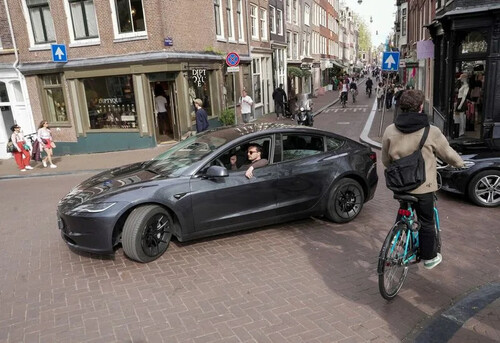
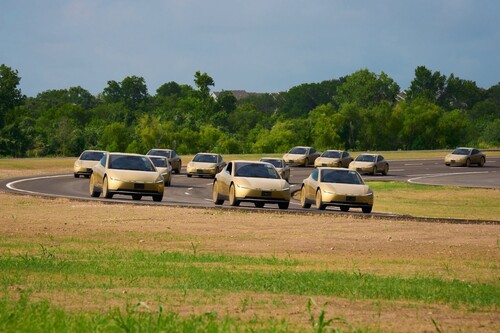
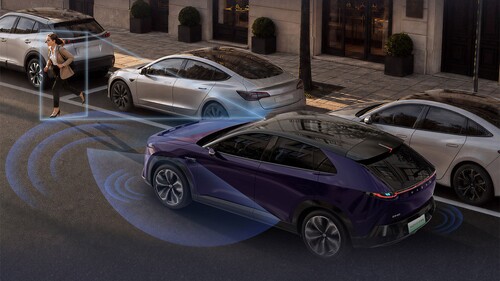
Britain's first self-driving taxis have finally arrived. After years of testing and development, Uber and British AI company Wayve started offering autonomous rides to the public on Thursday.The companies are set to be joined in the coming months and years by a flurry of rivals in a race to capture one of the world's most lucrative taxi markets.A Silicon Valley promise for two decades, progress on the technology has been slower than hoped but autonomous rides are now available in dozens of cities across the world. While driverless cars will soon be available across Britain, London is the first city they will operate in.AdvertisementAdvertisementI was one of the first journalists to experience the service ahead of Thursday's launch, with a nine-minute journey through Westminster in one of Uber and Wayve's 15 modified Ford Mustang Mach-E electric cars that will operate inside the M25.I've tried driverless taxis in San Francisco that come without safety drivers, and this is when it really feels like the future has arrived. But for now in London, the cars have safety drivers ready to take the wheel in emergencies.Ultimately, the idea is that the cars will be empty, offering a degree of privacy (and silence), although the companies are not putting a timeline on this, and some regulations still need ironing out.The cars serve as part of Uber's wider fleet. This means when you order a ride as normal through Uber, there's a chance you'll be paired with a self-driving vehicle, although you can decline one if you'd still prefer to have a human at the wheel. You can't specifically request to drive in an autonomous vehicle, although Sarfraz Maredia, Uber's robotaxi chief, said this would be an option in the future.The modified cars still have a safety driver ... for nowGetting beepedThe first challenge to navigate is getting in. One common irritation of driverless taxis is that they often pull up in the wrong place, up the road, forcing you to lug yourself and your shopping up a hill or across a junction.AdvertisementAdvertisementWayve's car did a good job of coming to a stop right where it had been ordered, something that Alex Kendall, the chief executive, said was the result of developing a more adaptable AI system than some rivals' rule-based alternatives.Once the car arrives, you have to press a button in your Uber app to unlock the car (to prevent random strangers hopping in). The rear seats have a bright touchscreen inviting you to press it to start the journey, with a live map of your route. The safety driver delivers a spiel about how the car works before setting off, which did prompt an irritated beep from the impatient driver behind us.As for the drive itself, for the most part, the experience is remarkably mundane. For a technology so widely hyped, there is no eureka moment, it just … drives. Acceleration and braking are perhaps a little smoother, but if you were blindfolded you'd struggle to tell the difference.Parked car problemThe car is polite, somewhat deferential and rigorously obeys the speed limit, although Wayve is planning to offer passengers a choice of driving modes, from gentle to aggressive. Getting to this point is obviously a feat of ingenuity that has taken billions of pounds of research and several decades, but the novelty factor itself is fleeting.Uber lets you know that you will be travelling in a driverless car. You can either accept or declineIn my demo ride, a one-mile journey past the Houses of Parliament and Big Ben, the car navigated London's perennial obstacles: temporary traffic lights, busy junctions and pedestrians walking into the street without looking.AdvertisementAdvertisementThere was one telling hiccup: in the run-up to a right-turn on Whitehall, the car instead pulled in behind a parked car in the middle of the road. After a few seconds the safety driver was forced to intervene after it was clear the car was going nowhere of its own volition.Wayve said the incident was rare, but it demonstrates the eternal problem with driverless cars: driving involves a practically unlimited number of "edge cases" that humans handle with straightforward common sense, but machines struggle to manage. Until that changes, there will need to be some kind of supervision, or the ability for remote drivers to intervene.A question of costsBut if autonomous taxis become indistinguishable from their human-driven counterparts, it might be worth asking what all of this is for.Maredia said that some passengers prefer driverless cars, and 140,000 people have joined a waiting list in London, suggesting plenty of demand. Some people may also feel safer getting into a robot car than one with a stranger in the front, while testing has shown that the cars are far less likely to crash.AdvertisementAdvertisementThere's also no tip to pay.The main benefit in the end may be cost. Fares are the same whether your driver is a robot or a human, but self-driving cars are more expensive to operate because of the costs of research, development and the array of sensors and cameras on the vehicles. Uber says over time that may change. "I think it's anybody's guess whether that first milestone is two to three years away or five to seven years away," says Maredia.Wayve, which also plans to put its tech into cars sold to the public, is working with car giants Stellantis and Nissan on mass-producing components that will bring down the cost.If driverless cars are going to change the economy, it is going to take years. For now, there are still some bumps to work out.AdvertisementAdvertisementTry full access to The Telegraph free today. Unlock their award-winning website and essential news app, plus useful tools and expert guides for your money, health and holidays.