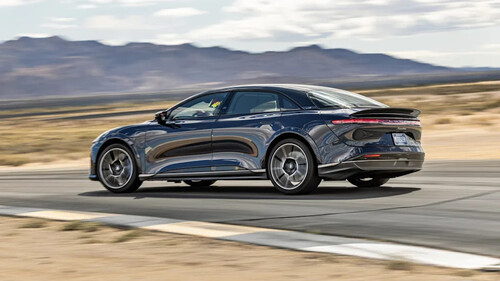
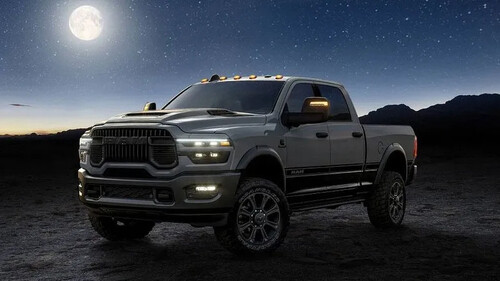
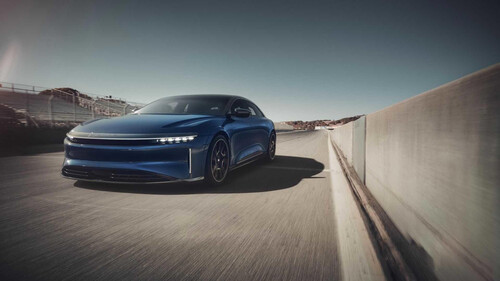
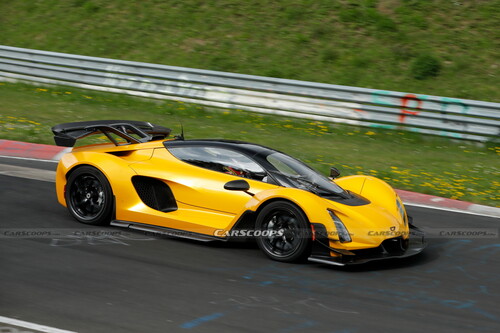
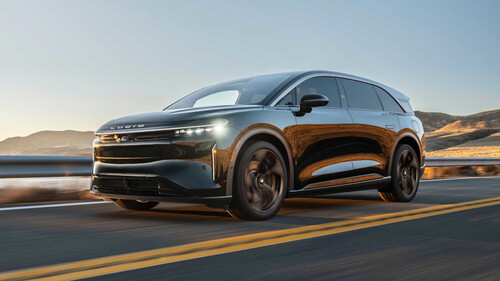
Inside MotorTrend's Epic, All-American Drag RaceWilliam Walker - MotorTrendSeventeen point four seconds. That's how long it took for the, uh, "least quick" car in MotorTrend's World's Greatest American Drag Race to cover half a mile, or nearly nine football fields. We're journalistically prohibited from using the word "slow" in this story, because nothing about a nine-vehicle race boasting 8,302 total horsepower is slow.Getting to the starting line, however, was a marathon rather than a flat-out sprint. When we pulled up to California's March Air Reserve Base in May, the project had been some 15 million seconds in the making. Staff photographer William Walker planted the seed six months earlier when he pitched what eventually would become the cover story for our Summer 2026 issue. To celebrate America's 250th birthday, we corralled a Ford Mustang GTD, Chevrolet Corvette ZR1X, Lucid Air Sapphire, and a Czinger 21C for a high-speed study of what American automakers are capable of. From the outset, we knew that we wanted to—no, were obligated to—lap these giants on a track, hustle them over Southern California's asphalt playgrounds, and line them up for a drag race.William Walker - MotorTrendAs we sought out drag race venues that could handle four vehicles, we realized we were going to end up with way more pavement than we needed. For the past six years, the MT staff has been looking for any excuse to resurrect the World's Greatest Drag Race series, and now we finally had one. It would be a waste to put just four cars on the 250-foot-wide, 13,000-foot-long runway we secured at March Air Reserve Base.AdvertisementAdvertisementWe called in more American firepower to fill out the lineup: a 1,025-hp pickup truck, a Jeep Wrangler wearing a thong as a roof, a stick-shift Cadillac, a stainless-steel wedge, and a sedan that runs sub-three-second 0–60 times for about 10 percent more than the price of the average new car. We also asked for a GMC Hummer EV and a Dodge Charger and didn't get them. Oh, well. The one that we really wanted and couldn't get was an F-16. Our two days at March air base had to come at no cost to you, the American taxpayer, and the bean counters at corporate balked when we asked for a seven-figure sum to put a fighter jet on the starting line. Maybe if enough of you buy mom a subscription for her birthday, we can try again next year.Herding Cars and Copious CrewGetting all nine contenders in the same place at the same time proved surprisingly difficult considering each one is capable of effortlessly driving under its own immense power. We scheduled and pulled the plug on two earlier attempts before we finally managed to bring it all together in early May. The serious work started two weeks before we ever turned a wheel. The really fast cars with super-sticky tires can find any pebble during these things, lifting it off the tarmac and then flinging it squarely at the windshield of whatever vehicle dares to be behind them. Protective Film Solutions in Santa Ana, California, installed XPEL paint-protection film on the front ends of several vehicles, a thin layer of invisible armor to protect us from making uncomfortable phone calls to automakers after the event.William Walker - MotorTrendA week before race day, we shuttled several drag-race competitors to our desert proving grounds for a full shakedown. We then dispatched our four State of American Performance feature cars on a high-speed tour of Southern California, from Chuckwalla Valley Raceway into the San Jacinto and Palomar Mountains, then down to the Anza-Borrego Desert before the full crew converged on March Air Reserve Base in Riverside, California.Big boss Ed Loh brought the Costco cake. Executive video producer Brent Baer mounted Old Glory on the Jeep Wrangler Commando 392, our four-wheeled master of ceremonies. MotorTrend's newest hire, associate testing editor Matt Crisara, was drafted to wear a Tesla Optimus costume to pair with the Cybertruck he was tasked with driving. Former Corvette factory racing pro Andy Pilgrim took the wheel of the 1,250-hp ZR1X.AdvertisementAdvertisementThe scale of things. The transparent volume of an Air Force hangar or the way the runway seemingly stretches to the horizon. Oh, and the size of the production: Between drivers, camera operators, photographers, support crew, and the car-loving Air Force personnel making sure we didn't point our cameras at the wrong hangars, our party numbered 44 people in all. We rolled out to the runway as a group, a column of American power unlike any convoy in American military history.William Walker - MotorTrendMotorTrend's ace video team has not yet cracked the code on how to film a 17-second race in 17 seconds. It takes time to capture the tires scrambling for traction, the cars squatting back on their haunches, the mid-race passes, the narrow finish. This isn't a bad thing if you're sitting in one of the driver's seats and happen to love driving cars fast (this describes everyone sitting in the driver's seats). We run a race, the video team repositions the GoPros, then we race again. The camera operators move to new spots. We race. Over and over and over, 26 takes in all.Almost Nothing Went SidewaysWhen you put together a production like this with so many moving pieces, you head into it expecting something to go wrong. All it takes is one flat tire or a check-engine light to send the whole thing sideways. Thankfully, the cars took the abuse without complaint.Then, late in the day, our video host with the most, Jonny Lieberman, drove the Czinger at nearly 200 mph when he heard four loud bangs. "For a split second it was novel. Then it became terrifying," he said. Lieberman lifts off the gas and, as the engine revs fall, he hears features editor Christian Seabaugh in the Lucid Air Sapphire and pro racer Andy Pilgrim in the Corvette ZR1X calling over the radio that there's a fire under the car.William Walker - MotorTrendBut when Lieberman gets the Czinger stopped, there's no smoke or fire, and the multimillion-dollar hypercar drives fine. It takes a couple minutes to piece together what happened. At speed, the Czinger's immense downforce pushed the underbody strike plates into contact with the ground. The violent hits and accompanying sparks were those strike plates bouncing off landing lights that run down the center of the runway to sit a quarter-inch proud of the pavement. Czinger made them out of titanium for a reason. The car was unscathed, and the steel light housings now have small grooves in them to remember our visit.AdvertisementAdvertisementWe take that as a sign we've shot enough. The video crew has more than a terabyte's worth of footage to turn 17 seconds into ten glorious minutes celebrating America's love of cars, doing things fast, and cars that do things fast. It was a lot of fun. We should do it again next year.Photo credit: William Walker - MotorTrendPhoto credit: William Walker - MotorTrendPhoto credit: William Walker - MotorTrendPhoto credit: William Walker - MotorTrendAdvertisementAdvertisementPhoto credit: William Walker - MotorTrendPhoto credit: William Walker - MotorTrendPhoto credit: William Walker - MotorTrendPhoto credit: William Walker - MotorTrendAdvertisementAdvertisementPhoto credit: William Walker - MotorTrendPhoto credit: William Walker - MotorTrendPhoto credit: William Walker - MotorTrendPhoto credit: William Walker - MotorTrendAdvertisementAdvertisementPhoto credit: William Walker - MotorTrendPhoto credit: William Walker - MotorTrendPhoto credit: William Walker - MotorTrendPhoto credit: William Walker - MotorTrendAdvertisementAdvertisementPhoto credit: William Walker - MotorTrendPhoto credit: William Walker - MotorTrendPhoto credit: William Walker - MotorTrendPhoto credit: William Walker - MotorTrendAdvertisementAdvertisementPhoto credit: William Walker - MotorTrendPhoto credit: William Walker - MotorTrendPhoto credit: William Walker - MotorTrendPhoto credit: William Walker - MotorTrendAdvertisementAdvertisementPhoto credit: William Walker - MotorTrend