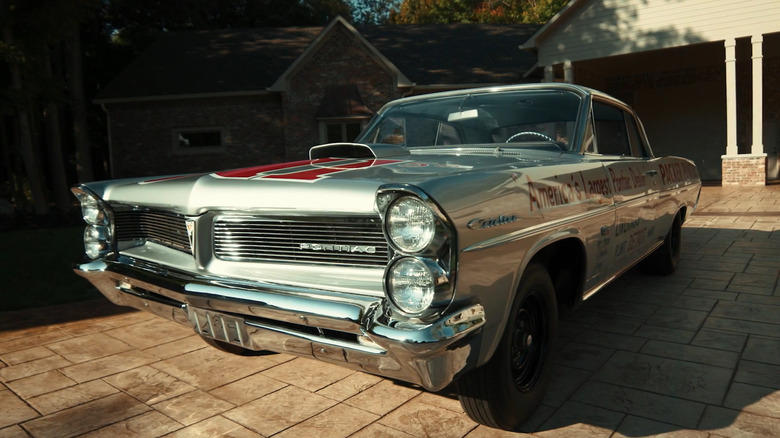
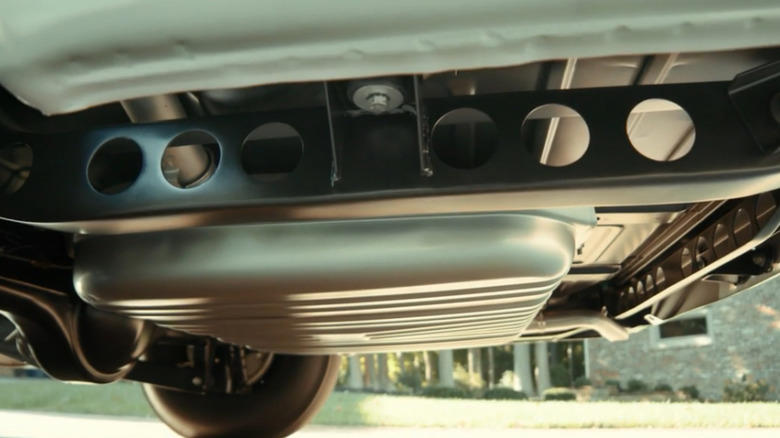
Front 3/4 of 1963 Pontiac Catalina Swiss Chees in sharp lightIt was Colin Chapman – subject of a fascinating biography — who taught automakers that an ideal formula for going faster was to "simplify, and then add lightness." But it's a lesson a lot of other folks took to heart, including the engineers at Pontiac. Faced with trying to homologate the relatively large and heavy Pontiac Catalina for pro drag racing, they went so far as to make holes in the car's steel frame to reduce its mass.The "Swiss Cheese" Catalina earned that moniker because the Pontiac team drilled approximately 120 to 130 holes into its supporting structure. They weren't tiny pin pricks, either. Judging by photos, they seem accurately described as "large-diameter" openings. (As an FYI, the holes in the actual dairy product come from carbon dioxide gas bubbles created by bacteria when the cheese is being made.)Anyway, drilling the Catalina's frame was part of a drastic diet that cut the car's weight by between 270 and 400 pounds — depending on your starting point. The former number is a comparison between the 1962 Catalina and the 1963 version, while the latter is the difference in curb weights between a standard 1963 model (3,725 pounds) and the lightweight variant (3,308 pounds). The result did save weight but often cost drivers time and money in repairs to the weakened frame — even with the body shell adapted to carry more of the load. Moreover, the holes were only part of the process, as Pontiac put the Catalina through a weight-saving regimen on par with Mazda's Gram Strategy for lightness. Putting the Pontiac Catalina on a dietUnderside of 1963 Pontiac Catalina Swiss Cheese showing holes in the frameFor starters, Pontiac had experimented with aluminum body panels in the past, but it used an even lighter-gauge metal than before for the Swiss Cheese car's fenders and hood. Parts such as inner panels, radiator support, and splash shield were made of the same lighter and thinner aluminum as well. Perhaps more surprising is that the brand relied on aluminum for the exhaust manifolds. True, that cut 45 pounds of weight, compared with 72 pounds for the two production manifolds. Yet aluminum's relatively low melting point puts the part at extreme risk of damage or failure if you go much beyond the quarter-mile — which was thought to be just fine for the race-ready Catalinas. The differential housing and brake drums were also made from aluminum.Then there was a long list of features that were cut out entirely. For example, a radio, heater, body sealant, and insulation were all given the old heave-ho. Meanwhile, the Catalina's focus on high-speed sprints meant it had the typical muscle car's disdain for dynamic handling, so engineers saved further weight by ditching the front anti-roll bar entirely. That said, you can, in fact, mod your muscle car to better take on twisty roads if you want.Sadly, the Swiss Cheese Catalina was a one-year wonder. Despite being able to run the quarter-mile in about 12.3 seconds, with a trap speed of 115 mph, this powerful performer came down the line the same year as GM's decision to get out of racing. As a result, only 14 Catalinas got the Swiss Cheese treatment, making them about as rare as they are expensive: one went for $742,500 at a Mecum auction in 2025. Want more like this? Join the Jalopnik newsletter to get the latest auto news sent straight to your inbox, and add us as a preferred search source on Google.



















 +61 others