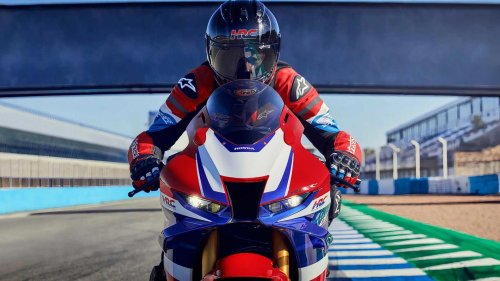
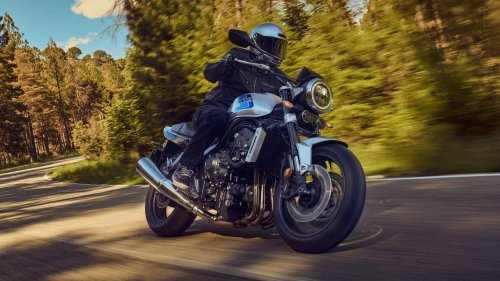
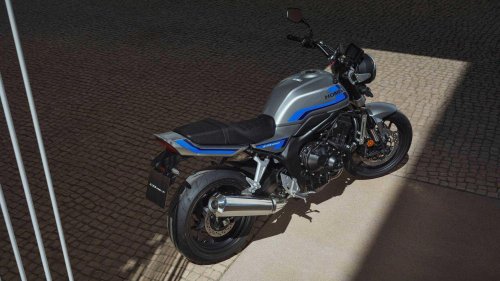
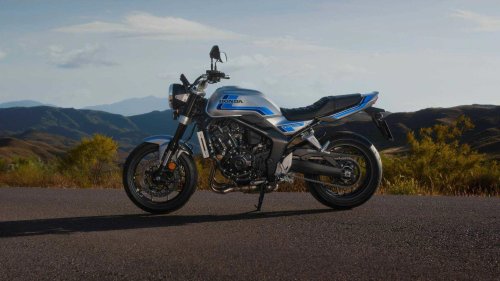
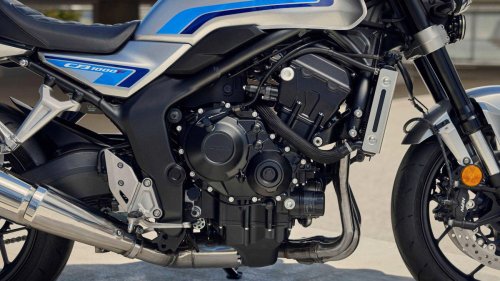
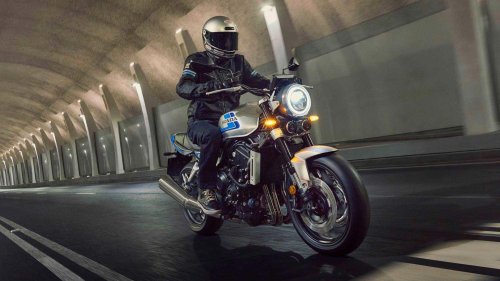
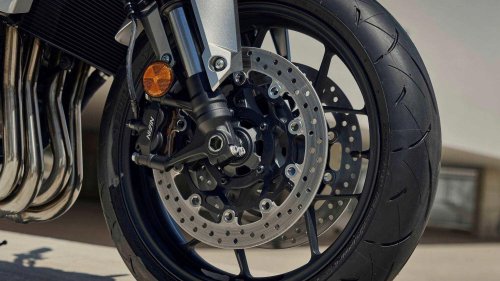
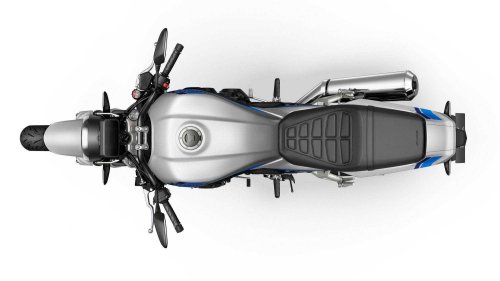
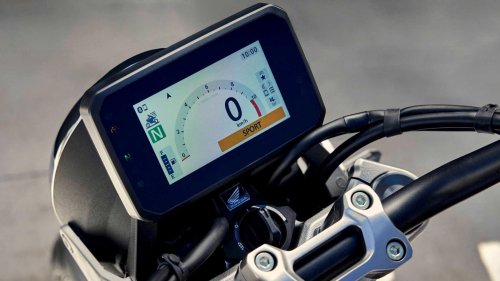
We keep hearing that the inline-four motorcycle space is dying. Yet, Japanese giants keep surprising us with new machines with the said engine configuration. The latest surprise in the US comes from the largest two-wheeler brand in the world: Honda. The CBR-maker has launched its much-anticipated new inline-four retro bike here. And in typical Honda fashion, the base price seems scarcely believable for the equipment on offer.As a refresher, the CB model in context first debuted in the first months of last year as a concept. Then, the production version was shown, followed by an official launch in Europe and Britain. Now, it’s entered America as part of Honda’s MY26 lineup. A Lowdown Of Honda’s Inline-Four Motorcycle Lineup Honda Powersports Before we dive in, here’s a lowdown on Honda Powersport’s inline-four lineup. You can divide the lineup into two parts: the easy-going part and the enthusiast-only part. The easy-going range starts from the CB650R and CBR650R. Both of these have received price cuts in 2026, with the naked sitting at $8,699 and the sports bike at $9,199. Next up is the CB1000 Hornet SP priced at $10,999.Honda Then, we enter the enthusiast zone. The CBR600RR kicks things off with its $11,499 MSRP, followed by the CBR1000RR sitting at $17,099. Rounding things off is the flagship CBR1000RR-R Fireblade SP, which has a whopping $28,999 base price. As for the new kid on the block, it sits firmly in the company’s easy-going inline-four range, right above the 650s (CB650R and CBR650R) and right below the CB1000 Hornet SP. Honda Has Launched The CB1000F In America For 2026 Honda In case you haven’t guessed already, we’re talking about the new CB1000F. This made plenty of headlines upon its reveal overseas, and now, Honda has brought it to the US for 2026. The F caters to the niche retro bike segment, evident from its dialed-down engine tune (more on that in a bit) and a simple old-school design language. At the same time, many of the mechanical components remain simple and come from the CB1000 Hornet (non-SP).All that part-sharing has helped Honda price the CB1000F shockingly well. It has a base price of $10,599, which makes it the most affordable 1000cc inline-four machine today. More importantly, the MSRP is exactly the same as the F’s arch-rival (the Yamaha XSR900), while being considerably cheaper than other retro rivals like the $12,899 Kawasaki Z900RS and the $15,395 Triumph Speed Triple. A Classic Design And Modern Components Make The CB1000F Worth Considering Honda Ideally, a liter-class inline-four motorcycle for around $10,500 hints that there’s serious cost-cutting all over. But that’s not the case here. The CB1000F has the makings of a capable motorcycle with quality bits all over. That starts with the design, which takes inspiration from the iconic CB750F. So you get a round headlight with dual horns below, flanked by an angular fuel tank cover—like the 80s.Honda This blends into a long, bench-type single-piece saddle and a ducktail-type rear with a boxy tail lamp. A small bummer is the lack of color options in the US. There’s only Wolf Silver Metallic here, while Europe gets two more options (Wolf Silver Metallic Gray Stripe and Graphite Black). With that out of the way, let’s dive into the nitty-gritty mechanicals. Powered By A CBR-Derived 1000cc Engine Tuned For Tractability Honda At the CB1000F’s heart is the same 1000cc inline-four engine we see on the CB1000 Hornet. This is based on the 2017 CBR1000RR, featuring a 76 mm bore, 55.1 mm stroke, and an 11.7:1 compression ratio. However, there are loads of internal tweaks to boost tractability over the Hornet SP. Most notably, the camshafts for exhaust and intake valve timing are different, the intake funnel length is longer with a smaller diameter, and a new airbox matches the shape of the tank.Honda All that results in an output of 122 horsepower and 76 pound-feet—both considerably higher than the XSR900. These also kick in at 9,000 RPM and 8,000 RPM, respectively, where the former is 2,000 RPM sooner, and the latter is 1,000 RPM later than the Yamaha. Moving on, Honda states the six-speed transmission has new ratios for the third, fourth, fifth, and sixth gears. This helps the bike sit at 60-65 mph at lower revs than the Hornet SP, boosting fuel efficiency to 42 MPG. Adjustable Showa Suspension Paired With A Steel Chassis Honda Like the engine, the steel diamond chassis comes from the CB1000 Hornet, but with some tweaks. The subframe and swingarm are different here, paired with a CB1000F-specific rear shock linkage. Speaking of which, the suspension comes from Showa. It comprises 41 mm USD forks (with full adjustability) and a rear monoshock (with preload and rebound adjustability). These join hands with 17-inch cast aluminum alloy wheels, where the front houses dual 310 mm discs and the rear a 240 mm disc. All three rotors have Nissin calipers. Tips The Scale At 471 LBs Honda Since you don’t get any aluminum chassis or typical weight-saving measures, the CB1000F is a bit porky. It tips the scales at 472 pounds wet, which is around 45 pounds more than the XSR900 but ~five pounds less than the Z900RS. Other dimensions are easy-going, though, comprising: Seat height: 31.3 inches Wheelbase: 57.2 inches Tank capacity: 4.2 gallons Rake: 25 degrees Ground clearance: 5.31 inches Cornering-Enabled Electronic Aids Keep You Safe Honda This comes as a surprise. Even though the CB1000 Hornet SP doesn’t have a six-axis IMU, Honda has thrown that in on the less powerful and less sporty CB1000F. That lets you enjoy three levels of cornering traction control, cornering ABS, engine brake control, and power. Topping things are five ride modes, where three are preset (Standard, Sport, Rain) while two User modes let you fine-tune the settings.In addition, the cockpit comprises a five-inch TFT instrument cluster. This has different view modes with day and night settings, along with Honda’s RoadSync app connectivity as standard. Keyless ignition, LED lights, and backlit switchgear round off the package. If you want more, Honda’s accessories bring bits like a quickshifter, centerstand, and a variety of cargo options. Interestingly, the headlight cowl and bar-end mirrors sold in Europe are not available here.Source: Honda Powersports