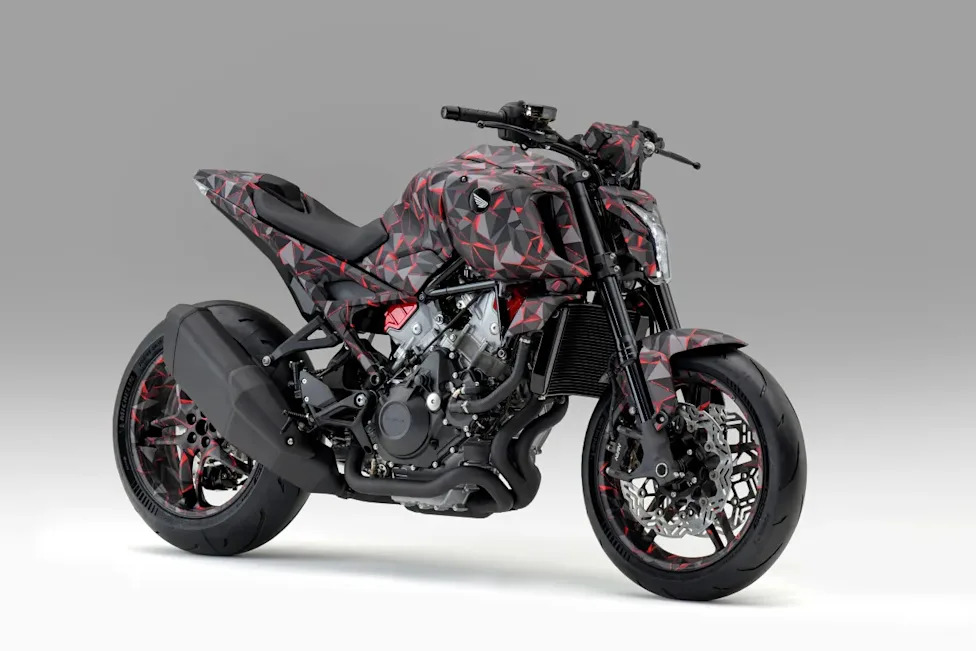
Honda's Boosted V3R Just Left a Paper Trail in Australia, and It's Not Even Using a TurboSomewhere in the paperwork filed with IP Australia's design registry, wedged between office-chair patents and cutlery diagrams, ten grayscale line drawings of a motorcycle just handed us the clearest look yet at the production version of Honda's electrically boosted V3R. No unveiling, no keynote, no confetti. Just a design number, a couple of names, and a stack of orthographic views that read like the ultimate spec sheet if you know what to look for.Garage-worthy EDC gear, on sale this week.This isn't a leak. It's a legal filing, and that distinction matters. Design 202612345 was lodged with IP Australia, and it claims priority from an earlier Japanese application filed under the international convention system. Translation: Honda locked in its design-protection clock in Japan first, then used that same priority date to register the design in Australia, and presumably other export markets too, before anyone outside Honda's studio saw the finished shape.The Filing, Number by NumberHere's what's actually on the public record. Design 202612345 lists Honda Motor Co., Ltd. as the current owner, with the product described simply as "Motorcycle" under Locarno classification 12-11, the bucket reserved for motorcycles and mopeds. It was filed in Australia on March 26, 2026, and registered on July 13, 2026. The priority claim traces back to Japanese design application 2025-019994, filed October 2, 2025, weeks before Honda showed anything publicly at EICMA. The named designers are Hongyup Song and Hiroshi Nitta. None of that reads like marketing copy, because it isn't. It's the paper trail governments require before granting exclusive rights to a shape.What the Drawings Actually ShowFlip through the ten representations attached to the filing and the bike looks unmistakably like the V3R 900 E-Compressor Prototype Honda parked on its EICMA stand in Milan back in November 2025. The perspective views show a compact tail section perched over a single-sided swingarm, exposed trellis-style frame sections rather than plastic cladding, underslung mirrors, and bodywork wrapped tight around what is clearly a V-configuration engine rather than the inline-four architecture Honda uses on its other naked bikes. Nothing about the registered shape suggests Honda softened the prototype's proportions for production, which is unusual. Concept bikes almost always get value-engineered before reaching a showroom floor; this one looks like it survived the process largely intact.The Engine Doing the WorkDesign filings don't specify mechanicals, that's not what they're for, but Honda has already put the powertrain on record. At EICMA 2025, Honda described the V3R prototype as running a 900cc, water-cooled, 75-degree V3 engine paired with what it calls the world's first electronically-controlled compressor built for a motorcycle. That phrase is doing a lot of work, and it's worth unpacking, because it's genuinely different from either a turbocharger or a conventional supercharger.A turbocharger spins on exhaust gas energy, so boost builds as revs and exhaust flow build, and fades at low rpm or during a closed throttle. That's turbo lag. A mechanical supercharger is belt- or gear-driven off the crankshaft, so boost tracks engine speed directly, which is more predictable but wastes power spinning the compressor even when you don't need the air. Honda's compressor is driven by its own electric motor instead of gas flow or a belt, which lets the engine's computer spin it up independently of what the crankshaft or exhaust are doing. Honda's own language is that boost can be delivered "irrespective of engine rpm," which in practice means usable torque low in the rev range without waiting for a turbo to spool or an engine to reach a speed where a mechanical charger earns its keep. Honda's stated target is a 900cc engine that performs closer to a 1200cc unit while keeping the packaging and efficiency of a middleweight.Honda Hasn't Done This Since the Early 1980sIf the V3R reaches production with forced induction intact, it will be Honda's first factory turbocharged or supercharged street motorcycle since the CX500 Turbo arrived in 1982, followed a year later by the larger CX650 Turbo. Both were genuinely ambitious for their era: turbocharged and fuel-injected at a time when carburetors were still the norm, but also heavy, expensive to build, and hampered by exactly the lag Honda's new electric compressor is designed to eliminate. Both were discontinued within a few years, and Honda quietly walked away from forced induction on two wheels for more than four decades. Its turbocharged Formula 1 program was untouchable in the late 1980s, and the aftermarket never fully gave up on strapping compressors to Honda engines either, but motorcycles got left out of that conversation until now.Honda isn't alone in circling back to boosted bikes. Forced induction has quietly become a recurring theme among manufacturers chasing big power from smaller, lighter engines instead of just adding displacement, as anyone who has watched a supercharged Kawasaki take on a Porsche 911 Turbo S already knows.This Wasn't the Only News That DayThe V3R prototype wasn't the only headline act at Honda's EICMA 2025 stand. It shared billing with the CB1000GT sports tourer and, more notably, the Honda WN7, Honda's first production electric motorcycle. The V3R and Honda's first EV sharing a launch date isn't a coincidence worth over-reading, but it does say something about where Honda is spending its two-wheeled R&D budget right now: electrifying the low end of its range while using electrification to squeeze more performance out of a combustion engine at the top. Honda has also been filing patents suggesting the electronically-controlled compressor isn't a one-bike experiment; the same technology has surfaced in filings covering touring and supersport platforms, hinting that the V3R could end up being the first model in a family rather than a standalone flagship.What the Filing Doesn't Tell YouIt's worth being clear about what a design registration doesn't guarantee. Design 202612345 protects the shape, not a promise to build it by any particular date. Its current registration runs through March 2031 and can be renewed in five-year blocks out to a maximum of March 2036; that window exists to protect Honda's intellectual property, not to signal a launch year. Honda's own EICMA statement said only that it "will continue development for mass production," corporate language that commits to nothing more specific than continued work. Honda has a habit of showing fully-formed prototypes years ahead of production, it's running a similar playbook right now with the Honda 0 SUV concept Max Verstappen was recently seen testing in Japan, so patience is the only realistic expectation here. Anyone expecting a V3R on dealer floors this year, or even next, is reading more into a registry filing than the filing actually says.What the filing does confirm is that the styling enthusiasts have spent months guessing about from renders and patent sketches is close to locked in. Whenever the V3R does land, expect a naked bike that looks almost exactly like the machine Honda already showed off, powered by an engine architecture unlike anything else currently sold on two wheels.



















 +74 others