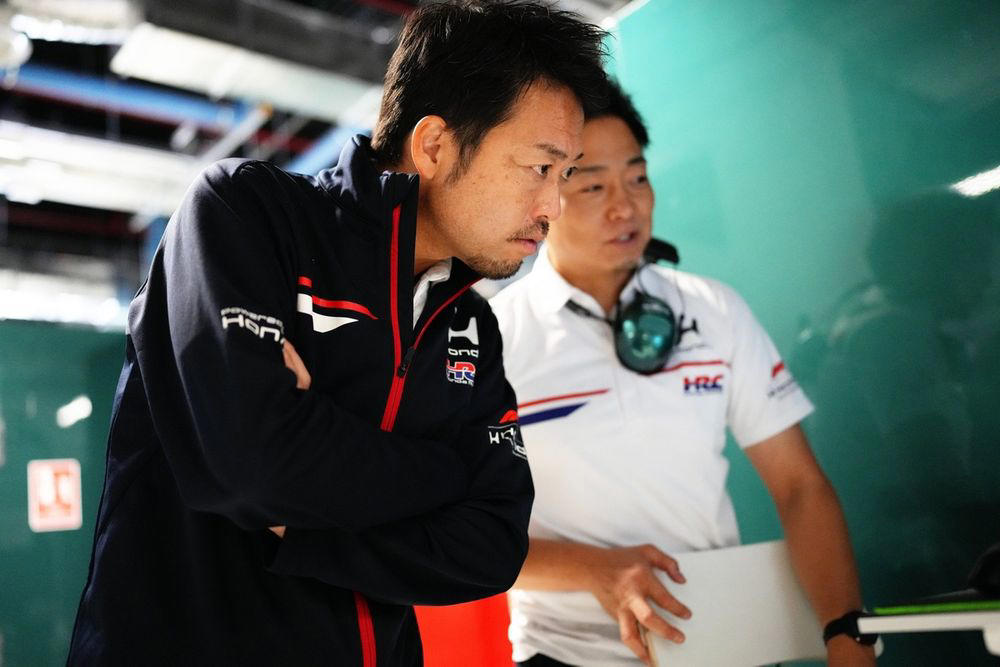
Immediately after the Brazilian Grand Prix, Honda was still unable to fully explain Lance Stroll's DNF. The Canadian was forced to retire for the 14th time, equalling the all-time record for the most retirements in a single Formula 1 season. Ahead of the race weekend in Las Vegas, Honda has gathered more information about the battery failure, with chief engineer Shintaro Orihara explaining when asked by Autosport about the problem: "After Brazil, we have done some inspection on the battery and we found, as expected, what happened. "It's a kind of expected issue. We thought we applied a countermeasure for Brazil, but that was not enough to prevent a battery issue from happening. "Then for this event, we brought another countermeasure to get better reliability. I can't explain the exact details of it, but after the Brazilian GP, we did the inspection and found out what happened." The Japanese engineer immediately added that he was not sure whether the additional measure introduced for Las Vegas would be enough to prevent a repeat of the problem. "The countermeasure we brought to this event will probably, how to say, not fully prevent it. We still need to get a complete picture and understanding." Orihara also revealed that the battery will be one of the areas Honda changes for next year. The Sakura-based manufacturer will no longer rely solely on countermeasures, instead seeking to address the problem more fundamentally. Shintaro Orihara, Honda Racing Corporation Trackside General Manager and Chief Engineer "But for 2027, we will update the structure inside the battery to have better reliability. We're still working on it in Sakura, but they realised that they need to improve reliability of battery for next year. "And we need to keep bringing countermeasures for this year as well, to have good reliability and to accumulate more mileage on the car." The word 'structure' could theoretically refer to several aspects, but when asked for clarification, Honda confirmed that it concerns "the internal structure of the energy store to increase robustness and overall reliability". The need for this change had already become apparent before Stroll's retirement in Brazil, although Orihara explained that the lessons learned from the latest failure can still be used to improve the 2027 power unit. "For our 2027 battery, we developed another structure, but we can still learn something from this year's issue to improve our reliability," he said. "So it was not directly leading [to the change for 2027], but in some areas, we can learn from this year's reliability. That's why we keep bringing countermeasures to improve our reliability. That will help us for next year as well." Previous combustion breakthroughs no longer work under 2026 rules While the battery change is primarily intended to improve reliability, Honda's focus in terms of outright performance remains on the internal combustion engine. Fernando Alonso, Aston Martin Racing, Arvid Lindblad, Racing Bulls Orihara has already explained in an interview with Autosport that improving energy management or efficiency is of little use if the ICE is significantly lacking in outright power, which is why that remains the key focus for 2027. The chief engineer acknowledged in Las Vegas that combustion works somewhat differently under the current regulations than it did previously, meaning Honda could no longer use some of the tried-and-tested solutions from the previous cycle. This initially sent the manufacturer down the wrong path. "Under the previous regulations, we found what we call rapid combustion. That gave us a lot of performance under those regulations," Orihara admitted. "We started our development for this year, so for this regulation, with the rapid combustion as well, but then we realised that we needed to improve combustion further beyond the rapid combustion. "Still now, we are on the way to overcome rapid combustion. That is what we are focusing on now and for the future. Rapid combustion gave us good performance, but sometimes it's challenging to manage the combustion itself. "The main difference under this regulation is that we no longer have a cylinder pressure sensor. Under this regulation, we need to find some other combustion style to get more performance and that's an area we are working on to improve." Finally, Orihara acknowledged that Honda's outright peak power is at the required level at times, but that controlling it and delivering it consistently remains particularly challenging. "If we have good control, we can keep that peak power in a wider range. But if we don't have good control, we just get peak power, but without that wider range, there’s less torque delivery or torque accuracy. So yes, we need to improve combustion control and combustion performance under this regulation."

 Liked by Adam Lavoie, Ethan Harris



 Liked by Adam Lavoie, Ethan Harris