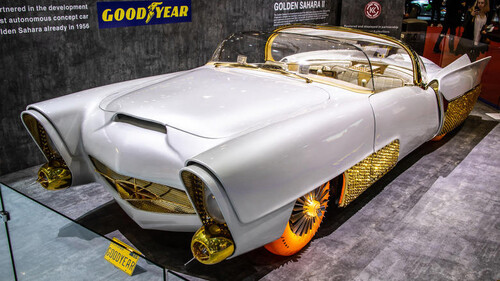
Goodyear/YouTubeCar design has evolved tremendously since the Benz Patent-Motorwagen (widely considered the first passenger car) debuted in the late 1800s. However, the only parts of a car that make contact with the road — the tires — look like black rubber circles to this day. During the 1950s and '60s, when American car designs were dripping with extravagance and futurism, tire manufacturer Goodyear saw an opportunity to hop on that bandwagon and lend the humble car tire a major visual evolution.In 1961, Goodyear debuted a translucent tire that could be dyed different colors and illuminated from within — think ambient lighting for tires. The main ingredient behind this innovation was neothane, a polyurethane-based material developed by Goodyear chemists William Larson and Anthony Finelli. Unlike conventional black rubber, neothane could be molded into translucent tires. Goodyear then added dyes to create different colors, then fitted wheels with 18 small light bulbs that illuminated the tires from the inside. The result was a set of tires that glowed brightly at night in colors like yellow, red, green, or blue.Goodyear spent roughly a decade developing, testing, and showing off its glowing tire technology, including public runs through downtown Miami and Manhattan. However, despite all the work that went into them and the swathes of attention they received, Goodyear's glowing tires failed to go into production due to safety and performance issues, as well as prohibitive manufacturing costs.AdvertisementAdvertisementRead more: 10 Of The Largest Private Car Collections In The WorldGoodyear's vision for its glowing tiresGoodyear/YouTubeWhile the glowing tires obviously look striking and futuristic, Goodyear envisioned some functional advantages for them as well. The tire glow could improve visibility in poor weather and potentially even function as brake lights or turn signals, with the driver controlling the illumination from a panel near the steering wheel.On paper, neothane carried some advantages over conventional tire manufacturing too. The process comprised pouring melted neothane into molds and then baking them at 250 degrees Fahrenheit. This was much lower than the temperatures used in manufacturing normal tires. Since they were fashioned from molds, neothane tires also didn't need the complex layering that went into conventional tire construction, further simplifying the manufacturing process.Goodyear began publicly demonstrating the glowing tires in the early 1960s, with showcase cars including a Dodge Polara, Chrysler Silver 300, and the futuristic-looking Golden Sahara II (pictured). The company displayed these cars in places like Miami and Manhattan, where the glowing tires naturally attracted a lot of attention.AdvertisementAdvertisementThe Golden Sahara II particularly became the most renowned showcase for the glowing tires. Built by custom-car legends George Barris and Jim "Street" Skonzakes, the Golden Sahara II already looked like something from a science-fiction movie, so the glowing tires felt like a natural fit. Goodyear later supplied new illuminated tires when the Golden Sahara II was restored, allowing the car to return to the spotlight at the 2019 Geneva International Motor Show.Why glowing tires failed to break into the mainstreamGoodyear/YouTubeWhile Goodyear's glowing tires possessed a few upsides over conventional ones, they ultimately didn't translate into a roadworthy replacement for rubber. Among the biggest hurdles was that neothane struggled with wet-weather traction, and testing showed that the material could become unstable at speeds above 65 mph. It also had poor resistance to the heat generated under hard braking, and at 150 pounds each, neothane tires were very hefty — tire changes would've been a proper workout. Under severe conditions, neothane tires could even soften and deform, making them unsuitable for normal road use.The translucent material presented the problem of road grime and wear quickly clouding the tires and reducing their visual effect. Moreover, the illumination system added fragile bulbs, wiring, and electrical connections to an area already exposed to dirt, vibration, and the stresses of driving. That meant more maintenance than a conventional tire, and a potential fire hazard if any of the wires degraded over time and sparked.The final nail in the glowing tires' coffin was cost. Even if Goodyear could solve the problems associated with their traction, durability, and heat, neothane and the associated lighting hardware were simply too expensive to manufacture as a mass-market tire. Therefore, after 10 years of investment and demonstrations, Goodyear ultimately abandoned the prospect of putting its glowing tires into production.AdvertisementAdvertisementWant more like this? Join the Jalopnik newsletter to get the latest auto news sent straight to your inbox, and follow us or add us as a preferred search source on Google.Read the original article on Jalopnik.