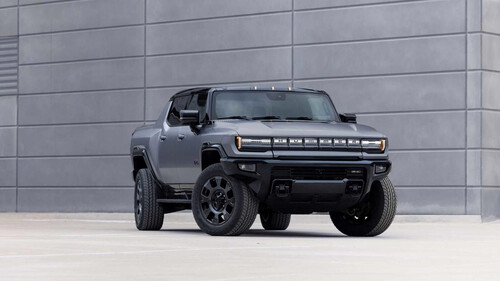
Autoblog and Yahoo may earn commission from links in this article.Shopping the top end of GMC's showroom used to be simple: you bought a Denali if you wanted luxury, or an AT4 if you wanted dirt. Now, electrification has split the luxury-truck calculus wide open. Sitting side-by-side on the showroom floor are two flagship EVs built on the same Ultium BT1 platform, wearing the same GMC badge, and carrying near (or sometimes over) six-figure price tags—the GMC Sierra EV and the GMC Hummer EV.GMCView the 2 images of this gallery on the original articleAdvertisementAdvertisementWhile sharing a core chassis, 800-volt charging architecture, and road-dominating presence, GMC has tuned these two heavyweights for wildly different missions. The Hummer EV is a boundary-pushing halo vehicle with removable sky panels, up to 1,200 horsepower, and rock-crawling ambitions. The Sierra EV takes a more calculated approach, turning that massive battery capability into nearly 480 miles of usable range and a clever MidGate that gives it unmatched bed flexibility. To see which execution makes the smarter use of their shared foundation, we pitted them against each other across power, range, hardware, and everyday livability.Related: Road Ethos Launches: The New Automotive Lifestyle Site You Should ReadLet's talk about the architecture firstGeneral Motors is currently executing one of the broadest EV rollouts in the industry, spanning everything from high-volume, accessible models like the Chevy Bolt EV to six-figure flagships like the Cadillac Escalade IQ. What ties them together is GM's Ultium technology, but the big boys—the Chevy Silverado EV, Cadillac Escalade IQ, GMC Hummer EV, and GMC Sierra EV—all share a dedicated heavy-duty foundation: the BT1 platform.Kristen BrownBT1 is a purpose-built, body-on-frame EV platform designed to handle massive scale. Packed into its structural frame are double-stacked Ultium battery modules offering over 200 kWh of usable capacity, an 800-volt charging architecture capable of 350-kW DC fast speeds, adaptive air suspension, and bidirectional V2H power capabilities.GMCWhile the Sierra EV and Hummer EV share this underlying skeleton—along with four-wheel drive, four-wheel steering, available MultiPro tailgates, and absurd horsepower figures—GM executed them with radically different goals in mind. One offers an SUV variant while the other stays truck-only, and their hardware diverges sharply from there to target two entirely different buyers.Who are their ideal buyers?If you look at the web pages for either of them, they're fairly similar. Both have marketing images of the EVs climbing over rocks or looking tough at a construction site. Either EV appeals to a rough-and-tumble kind of person, and ideally, they're someone who wants their car to reflect that. But a deeper look into the offerings, software, and vision for each one reveals something conflicting. The Sierra EV, then, is designed for traditional luxury truck owners who want maximum utility, high-end appointments (especially in Denali trim), and usable daily practicality without drawing overwhelming stares at every intersection. It's built for someone who actually needs a flexible truck bed and wants to road-trip long distances without charging anxiety.GMCThe Hummer EV, though, is more fun because it caters to those who liked the OG gas-only Hummers. It's geared toward early adopters, weekend thrill-seekers, and luxury buyers who view their truck as a halo toy or lifestyle vehicle. It prioritizes wild capabilities, extreme styling, and raw performance over day-to-day usability or efficient range management. It's large and in charge; it's loud and it's proud—and that's why buyers like it. Though it's still useful, too.AdvertisementAdvertisementRelated: Can an EV Work for Families? Here's How the 2026 GMC Hummer EV Worked (and Didn't) for Mine.Configuration and pricingThe GMC Sierra is, unsurprisingly, only built as a 4-door crew cab pickup truck with a 5'11" bed. And no, you can't have it in a two-door like the good old days—it's a four-door truck only. But that's a good thing, because the rear seats fold down completely to allow for more cargo space and utility, but I'll get deeper into that later. You have three flavors to choose from: the Elevation, which is the base model. Then the AT4 is the mid-grade, off-road-focused trim, while the Denali is the top-tier, ultra-luxe trim. The price range is quite wide, too, with a starting price of $62,400 to $101,195 for a fully-loaded Denali with the largest battery option, though the starting price for the Denali is $69,700.GMCThe Hummer EV follows a similar pricing pattern. There are also two main trims: the 2X (dual motor) and the 3X (tri-motor), with a few special editions thrown in, like the Carbon Fiber or Omega edition. The base price is much, much higher than the Sierra, with a baseline of $97,200 for the 2X and $105,300 for the 3X. I had the 3X model with the largest battery option, and that was closer to $132,000, which goes to show how pricey it is. Unlike the Sierra EV, though, the Hummer EV can be configured as an SUV with an identical starting price. Both are expensive, depending on how you configure them, but the Sierra is much more attainable for those looking for all-electric utility.2026 GMC Hummer EV SUVKyle EdwardAs the pickup, the Hummer can have the same MultiPro Tailgate with built-in step, load stops, and work surface setup. But the Sierra EV has those cool folding rear seats I mentioned before, which gives way to what GMC calls the "MidGate." When the rear seat folds 60/40, and the midgate drops down, extending bed length from ~6 ft to over 11 feet into the cabin. The tall ceiling gives you a plethora of vertical space, too. The Sierra EV also has a fixed panoramic sunroof that spans across the entire roof, which my toddlers adored, while the Hummer EV had removable sky panels that can be stored in the frunk.Interior layout and offeringsBecause the GMC Sierra leans more into the luxury truck space as opposed to a militaristic off-roader, the interior of the Sierra EV is a lot fancier. Both interiors are open, clever, and very tech-forward, but the Sierra takes it to a new level. Instead of a 13.4-inch screen like the one in the Hummer, the Sierra comes with a larger 16.8-inch multimedia screen with an 11-inch driver display screen. Ironically enough, the Hummer has a larger driver display at 12.3 inches. The Denali trim of the Sierra has open-pore wood accents, laser-etched detailing, stitched leather seating, and acoustic glass designed to keep the cabin whisper-quiet on long highway stretches.Kristen BrownView the 2 images of this gallery on the original articleAdvertisementAdvertisementOn the other hand, the Hummer EV is still fancy, but GMC tried a lot harder to make it feel like the Hummers we all grew up with. I liked the blocky grab handles, industrial air vents, and heat-shield-style bronze accents. It's littered with Apollo 11 lunar Easter eggs—including a Sea of Tranquility topographical map on the speaker grilles and a boot-print graphic on the dead pedal. It also swaps delicate carpeting for rubberized vinyl flooring with removable inserts, making it easy to wash out after a day on the trails, paying homage to the Humvee military vehicles the OG Hummer was based on.Related: 2026 GMC Sierra EVPerformance, range, and chargingThey're large SUVs and trucks, but they're no slouches. The Sierra EV's base horsepower is 605 horsepower with 605 lb-ft of torque; the extended range battery (available on the Elevation or Denali trim) brings the horsepower up to 645 horsepower and 785 lb-ft of torque, and the max range battery (Denali only) increases the pony power to 760 horsepower and 785 lb-ft of torque. Because the torque is so high on the extended and max range setups, the towing capacity is a very respectable 12,500 lbs. Kristen BrownSince the Hummer EV is more expensive, it comes with, well, more. Horsepower-wise, the GMC Hummer 2X comes with 570 horsepower, while the tri-motor boosts the horsepower up to 830 horsepower for the SUV variant (that's the ceiling for the SUV), while the pickup version can get up to 1,000 horsepower. If you pay for the Watts to Freedom package with the maximum-range battery, you get over 1,200 horsepower and a 0–60 time of under 4 seconds. The towing capacity for the Hummer EV ranges, too, depending on whether it's the 2X, 3X, SUV, or pickup. As for the SUV, the limit is 7,500 lbs. The 2X pickup can tow up to 12,100 lbs, and the 3X Pickup can tow between 8,500 and 10,600 lbs, depending on which package it's built with.AdvertisementAdvertisementThere are lots of options as far as range is concerned for both EVs. The Sierra EV's base range is 283 miles, 410 miles with the extended-range battery, and up to 478 miles with the max-range battery. Though, my tester had a maximum range of 522 miles at a full charge. The Hummer, thanks to its taller, wider frame and heavier tires, doesn't have as high of a range range (that reads funny). For the base 2X model, you get 311-319 miles. For the 3X model, depending on whether or not it's built with the largest 24-module battery, it ranges from 314 miles to 381 miles on a full charge. With the Extreme Off-Road Package, the 3X can go 359 miles before needing a charge.GMCSince they both have GM's insane 800-volt DC fast charging architecture, both can charge very quickly when hooked up to a fast charger. The Sierra EV's peak charging rate is 350 kW, which can add 100 miles of range in just 10 minutes. The Hummer EV pickup has the same peak charging rates and speeds, while the SUV's peak is 300 kW. Which, when compared to other large EV SUVs, is still very fast.Off-road capabilityThe GMC Hummer EV was built from the ground up as a trail-slaying apex predator, prioritizing extreme terrain capability over highway efficiency (just like the days of old, but better). Equipped with available 35-inch (or optional 37-inch) mud-terrain tires, aggressive approach and departure angles, and heavily armored steel skid plates protecting its underbody, the Hummer EV doesn't just look the part. Its marquee feature, Extract Mode, utilizes the adaptive air suspension to lift the truck an extra six inches, allowing it to clear massive boulders or forge deep water crossings that would strand nearly any other production vehicle. Coupled with GM's UltraVision camera system—which offers up to 18 different camera views, including underbody cameras with built-in washers to monitor tire placement over rocks—the Hummer EV is essentially a factory-built rock crawler disguised as a luxury halo truck. The battery is sealed against water, too, so you don't have to worry about that. The GMC Sierra EV, by comparison, approaches the dirt with a far more measured, practical philosophy. In its off-road-focused AT4 trim, the Sierra EV gains a factory lift, all-terrain tires, underbody protection, and specialized drive modes, but it deliberately stops short of the Hummer's extreme rock-crawling theater. Instead, the Sierra EV is tuned for high-speed stability on dirt roads, mud, snow, and overland fire trails. Its narrower track and more aerodynamic bodywork make it significantly easier to maneuver through tight tree lines where the ultra-wide Hummer would struggle to squeeze past. While both vehicles share the game-changing four-wheel steering system and CrabWalk capability—allowing them to maneuver tight trail switches or diagonal obstacles with surprising agility—the Sierra EV prioritizes usability, utility, and towing stability over looking like you're ready for another war. AdvertisementAdvertisementRelated: I Used the 2026 GMC Hummer EV to Commute. Here's How It WentBoth are extremely family-friendlyBecause they're so large, there's more legroom in the rear of both EVs than most families would even know what to do with. My toddlers loved being in the back of both because of the large windows, tall ride height, rear-facing A/C vents, and open visibility. But they loved the Sierra the most, because of the large sunroof and how fun it was to climb up into it. As a parent, though, the Sierra EV was a lot more annoying for me to get their car seats into. It had two lower LATCH points that were very easy to find, access, and secure, but the top tether was quite the pain, and not in the way that you'd expect. The rear seats of the 2026 GMC Sierra EVKristen BrownThe Hummer EV pickup had a top tether point that was a large metal hoop (for the lack of a better term) that was bolted to the truck's frame behind the middle headrest. You had to move the top tether for the seat through the headrest of the outboard seat, and attach it behind the middle headrest. The SUV's top tethers were on the backs of the seats. The Sierra EV had a similar setup to the Hummer EV pickup, but instead of a metal hoop, they were on the backs of the folding chairs. Which may sound like a win, but it made it tricky once it came time to remove the seat. To access the top tether point, you have to slightly fold the seats. In order to do that, there has to be a bit of slack, or you won't be able to fold the seats to even access the top tether to unlatch the car. Because there has to be slack to access it, it means the seat doesn't fit as snug as it should.My toddlers' car seats installed into the GMC Hummer EVKristen BrownIf you plan on sticking the seats in and leaving them, then you won't have an issue. But if you're like me and have to move seats from car to car on occasion, prepare to be annoyed. Very annoyed. Other than that, both have an insane amount of vertical space, legroom, and overall cargo space. I never once found myself in a situation where I didn't have enough space.Final thoughtsBoth of these EVs are humongous, attention-seeking, surprisingly useful, and family-friendly—if wildly expensive—machines that unfortunately get a bad rap simply because of their obnoxious footprint. Yet beneath their polarizing scale lies a masterclass in platform engineering. General Motors took the exact same BT1 foundation and created two distinct personalities: one that's the vehicular equivalent of roid rage, and another that channels electric power into thoughtful pickup utility.AdvertisementAdvertisementIf your goal is to command the room, crawl over boulders, and take the roof off on sunny days, the Hummer EV will help you make that statement (and loudly). But if you want a luxury truck that turns GM's Ultium battery architecture into maximum usable range, executive highway comfort, and unmatched bed flexibility, the Sierra EV isn't just the smarter execution—it's the best full-size electric truck on the market today.This story was originally published by Autoblog on Jul 30, 2026, where it first appeared in the Car Buying section. Add Autoblog as a Preferred Source by clicking here.