- GM has many patents on applying variable-compression tech to automobile engines.
- It has figured out a way to add the tech to a longitudinal engine while also providing the ability to lengthen the motor’s expansion stroke relative to its compression stroke.
- A GM patent, first spotted by CarMoses, shows how a longitudinal variable-compression engine could be made easier to service.
GM engineers spend a lot of time thinking about engines, and the company’s patent-to-production pipeline is hard evidence. Cylinder deactivation and sliding camshafts? GM has brought its own versions of both to production. Making truck V-8s bigger and more powerful without completely sacrificing efficiency? Coming right up. Their next target may be applying existing fuel-saving tech to a wider array of engines.
Another Variety of Variable Compression
A few engineers in particular have been tinkering with ways to adopt a variable-compression ratio, and specifically how the necessary hardware can be packaged with a longitudinal engine. Related patents go back about a decade. (Nissan already sells a variable-compression engine of its own, the somewhat disappointing VC-Turbo, but that one is designed for transverse front- and all-wheel-drive applications.)
In a previous patent filing, GM outlined how it would locate the control shaft, necessary for varying compression in its design, up above the crankshaft. The compression variability—approximately 7:1 to 11:1—comes by way of a special connecting-rod linkage. The connecting rod attaches to one end of a center link that’s mounted on the crankshaft, and the other end of the center link connects through a control rod to the control shaft. The design also includes a phaser that adjusts the control shaft’s rotational timing relative to the crankshaft, thus controlling the piston’s movement and varying the compression.
And one bonus compared with Nissan's system, which uses valve timing to achieve the Atkinson-cycle effect, GM’s arrangement would allow for the expansion stroke to be longer than the compression stroke—up to 40 percent longer—which has potential efficiency benefits. Note that Honda has commercialized a similar extended-expansion engine concept, which it calls EXlink, that’s used in household cogeneration units that supply both electricity and hot water.
Variable Compression, but Make It Serviceable
Now comes an innovation that could push a variable-compression longitudinal engine closer to reality. A recently published U.S. patent application shows how GM could make this happen. In a nutshell, it would replace the center link with a two-piece assembly assembled around the crankshaft. One part would connect to the piston rod, and the other to the control rod.
The description also says the bolts used to make up the connection would be accessible from below the engine, likely with the oil pan removed. GM also explains that placing the control shaft above the crankshaft makes room for the engine’s mounts or the vehicle’s steering or four-wheel-drive equipment that normally sit below a longitudinally oriented engine.
GM says this design would allow conventional lubrication of the connecting rods. Together with the two-piece center link, that could mean the GM design is both easier to service and less prone to bearing-related problems.
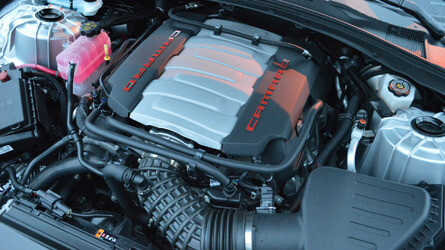
The patent drawings show a gas inline-six, a gasoline engine layout GM doesn’t currently use, but that’s not evidence that such a configuration is in the offing. The same concept could be applied to something like the L3B 2.7-liter four-cylinder—the one with sliding cam sleeves—that’s used in Chevy and GMC half-ton trucks and could find its way into a new Camaro or Buick sedan.
➡️ Skip the lot. Let Car and Driver help you find your next car.
Ever since David was a wee Car and Driver intern, he has kept a spreadsheet listing all the vehicles he’s driven and tested. David really likes spreadsheets. He can parallel-park a school bus and once drove a Lincoln Town Car 63 mph in reverse. After taking a break from journalism to work on autonomous vehicles, he’s back writing for this and other automotive publications. When David’s not searching for the perfect used car, you can find him sampling the latest in gimmicky, limited-edition foodstuffs.