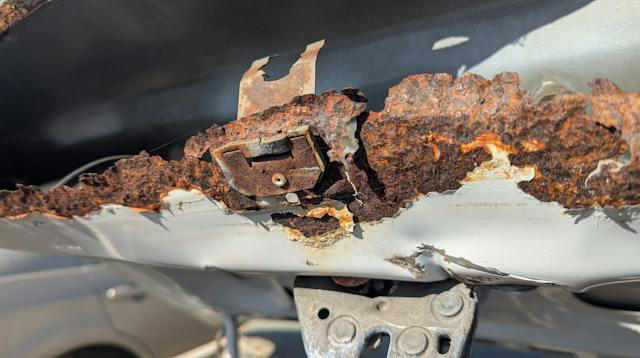
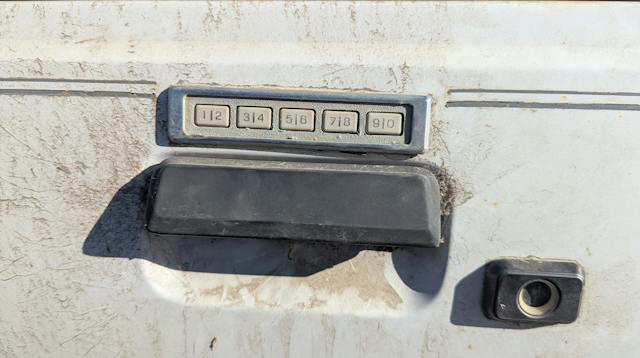
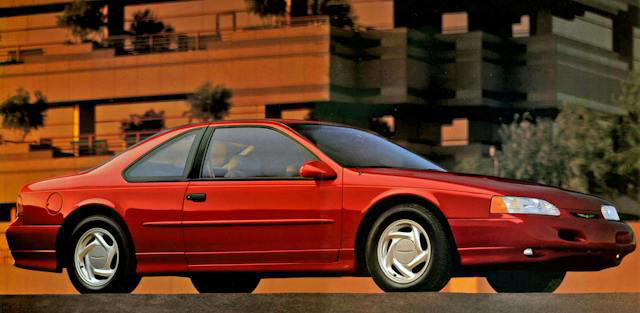
The Ford Thunderbird went through 11 generations during its half-century production run. At the beginning and end of that period, it arrived in showrooms as a sporty two-seat convertible, while in between those bookends it manifested as everything from a four-door sedan to a two-and-a-half-ton behemoth of a coupe. Today’s Final Parking Space is an example of the only T-Bird that could hold its own against its European rivals on a road course, found at the Pick-n-Pull in John Steinbeck’s California hometown. The Thunderbird Turbo Coupe was built for the 1983 through 1988 model years, and the 1987-1988 models with manual transmissions are the best performers of that ninth generation. That’s what we’ve got for today’s FPS subject: a genuine late Fox Thunderbird with three pedals, 15 pounds of intercooled boost courtesy of an IHI turbocharger, and just about every expensive option available other than the power-draining automatic transmission. This is the second Thunderbird we’ve had in this series, after a massive 1969 Two-Door Landau with a 360-horse brute of a 429 engine in a San Francisco Bay Area boneyard last year. In recent years, most of the Thunderbirds you’ll find in self-service junkyards will be of the 1989-1997 tenth-generation MN12 variety, with a sprinkling of cars from the early 1960s through the Fox-body era. I have yet to photograph a 2002-2005 T-Bird in a car graveyard, but it’s bound to happen eventually. Before you get your hopes up about rescuing this car from the crusher, be aware that it’s very rusty. California cars tend to corrode very little… unless they live within a few blocks of the Pacific, where salt kicked up by crashing waves finds its way into the fog every morning and settles on parked cars. They rust from the top down, the opposite of their counterparts in the Midwest, and I’ve seen some horrifically rusty cars in junkyards near the California coast. That’s what we’ve got here. This car sat outside near the ocean for many years, gradually building up a coat of lichens and moss as diluted brine trickled down its flanks. This Ford supported a whole ecosystem of lichens and the creatures that live among them, probably for decades. Plugging its VIN into the California Smog Check History site shows that its most recent emissions test was more than 20 years ago. The build tag tells us that this car was assembled at Lorain Assembly in Ohio. The paint is Oxford White and the interior is done up in Raven cloth and vinyl. The engine is the 2.3-liter SOHC straight-four best-known for its use in the Pinto, but with much more power thanks to what amounted to the same intercooled turbocharging rig that went into the previous year’s Mustang SVO. This lightweight engine made 190 horsepower and 240 pound-feet, serious stuff for a 3380-pound car in 1987. If you got the automatic transmission behind this engine, though, you gave up 40 horses and 40 pound-feet. With its MSRP of $16,805 (about $51,006 in 2026 dollars), this car had more power than and weighed exactly the same as a new BMW 633CSi, which listed at $46,965 ($142,547 after inflation). Sure, the pricey Bavarian coupe had an independent rear suspension and more snob appeal, but a Turbo Coupe with a good driver could walk away from it on a race track. In 1987, American Ford shoppers could pay a mere $11,835 ($35,921 in today’s money) for a new Mustang GT hatchback with 225 horsepower and 300 pound-feet from its 5.0-liter Windsor V-8, but that car was unsophisticated and cramped next to its Turbo Coupe big brother. But what about a new Merkur XR4Ti for $17,832 ($53,123 now)? This was no Detroit car trying to beat European coupes at their own game; this was a genuine German-built machine with a slightly less powerful version of the Turbo Coupe’s engine. Because this car had no knock sensor, the driver had to know to select the fuel type before standing on the throttle. This car was built with the Electronic Equipment Group, a $365 option package ($1108 after inflation) that included the keyless-entry feature. The power moonroof was standard equipment on the 1987 Turbo Coupe. It didn’t quite reach 140,000 miles during its career. The following generation of Thunderbird was built on the larger MN12 platform, shared with the Lincoln Mark VIII. There was a Super Coupe version, equipped with a supercharged Essex V-6 that made a bit more horsepower and a lot more torque than the turbo 2.3 engine in its predecessor. Unlike the Fox Thunderbird, this car had an independent rear suspension. Sales weren’t what Dearborn had hoped for, but that was caused more by the American cultural shift to trucks than by any fault of the tenth-gen T-Bird. Now with computers. Jackie Stewart liked it. Shouldn’t the guy next to the car be riding a mythical bird instead of a horse? Looking to purchase a car? Find your match on the MSN Autos Marketplace

 Liked by Caleb Green, Ryan Nelson














 Liked by Caleb Green, Ryan Nelson