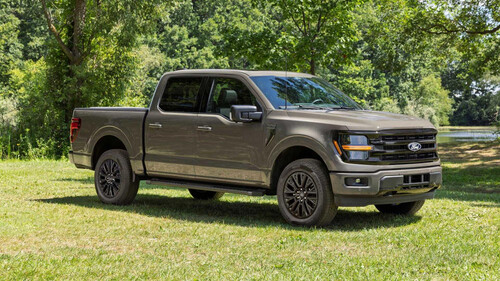
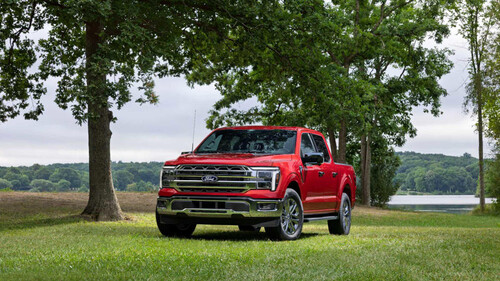
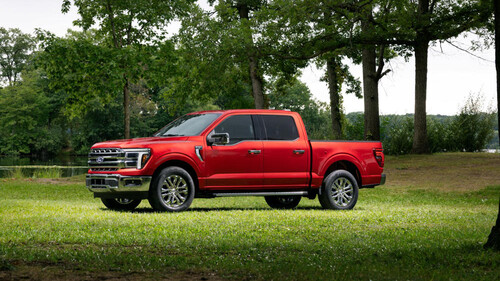
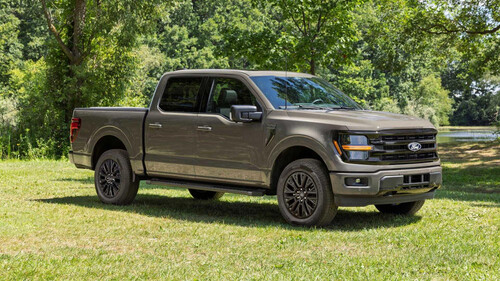
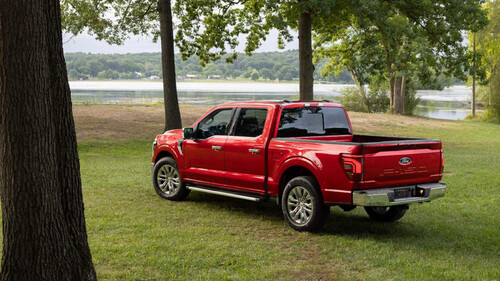
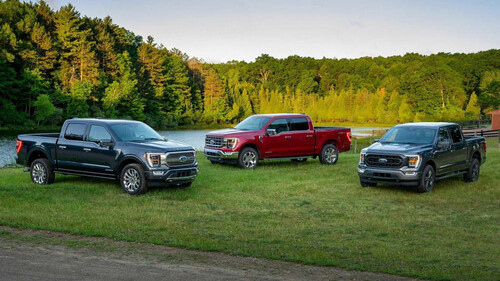
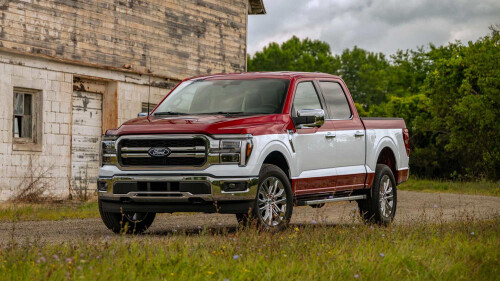
Ford Motor Co. posted $2 billion in third-quarter net income on slightly lower revenue behind steady F-150 pickup sales and less severe losses in its electric vehicle unit.
The automaker also pointed to record revenue for its software services and parts business, and its burgeoning energy storage division, as high points for the period, which followed a $1.3 billion loss related to EVs in the second quarter. Its third-quarter net income represented a 16 percent decline year over year.
“Q3 shows a leaner, more fit industrial system and focused portfolio can grow profits amid rising cost pressures, intensified competition and macroeconomic uncertainty,” CFO Sherry House said on an Oct. 28 call with reporters. “Our focus now is to make this progress repeatable.”

Keep up with product planning news with Automotive News' regularly updated database.
Future Product database: 5-year vehicle timelines
Future Product guide: Our 10-week series on future products by brand
The automaker’s adjusted earnings before interest and taxes rose 3 percent to $2.7 billion on revenue of $49.5 billion, down 2.3 percent from the year prior. Ford raised the low end of its full-year earnings guidance by $500 million, projecting $10.5 billion to $11 billion.
The company’s core gasoline business saw sales decline largely because of the discontinuation of the Escape and Lincoln Corsair to retool the Louisville Assembly Plant for the new Universal EV platform. Increasing material costs and the war in Iran also bit into the bottom line.
Ford copes with challenges
Rising oil prices because of the Middle East conflict are driving up logistics costs, House said. Additionally, costs for commodities including copper, steel and aluminum are increasing at a year-over-year clip of $2.5 billion — higher than the previously anticipated $2 billion.
If F-Series demand is any indication, consumers are not flinching at higher gas prices, House said.
“We have seen a customer that has remained incredibly resilient in the truck area, and that is both in retail as well as in fleet,” she said. “We have not seen any (sales) decreases in the F-Series.”
On the inventory side, costly disruptions from last year’s fire at aluminum supplier Novelis are “largely behind us,” House said. F-150 output also was hampered in late September by a temporary supplier issue that Ford said it contained quickly.
Ford reimagines production for Universal EV platform
“We’re going into 2027 in a real good situation with our truck business,” CEO Jim Farley said on a call with analysts, adding that overall profitability next year is expected to be in line with 2026 results.
That gives Ford more confidence as it gears up to launch the next-generation F-150 in 2028 and pins its EV hopes to the new platform arriving late next year, starting with the midsize Fathom pickup.
Ford’s EV business lost $1.1 billion, a 25 percent improvement from a year earlier, and the automaker said it remains on track to break even on EVs by 2029.
The key part of that equation is the Fathom and Ford’s reimagining of the industrial system around it — “the heart and soul” of the company, as Farley described it.
The automaker is taking what it has learned from fast-growing Chinese automakers and capturing it in the Universal EV platform. That includes unicasting to require significantly fewer parts, advanced driver-assist and electrical systems developed in-house for big cost savings, more efficient gearboxes and motors, and lower-cost batteries built in Michigan with technology from partner Contemporary Amperex Technology Co.
“Every part of this project had to be world-class, Chinese cost efficiency in order to convince ourselves we would be fully competitive,” Farley said.