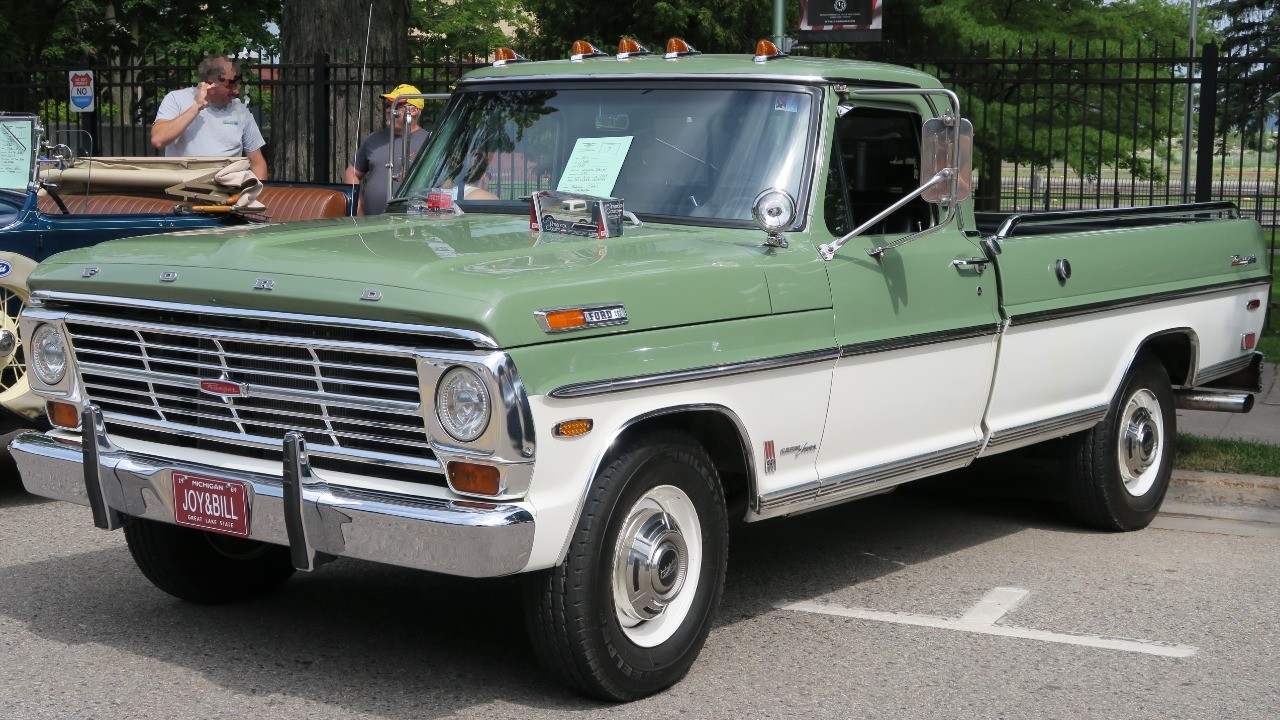
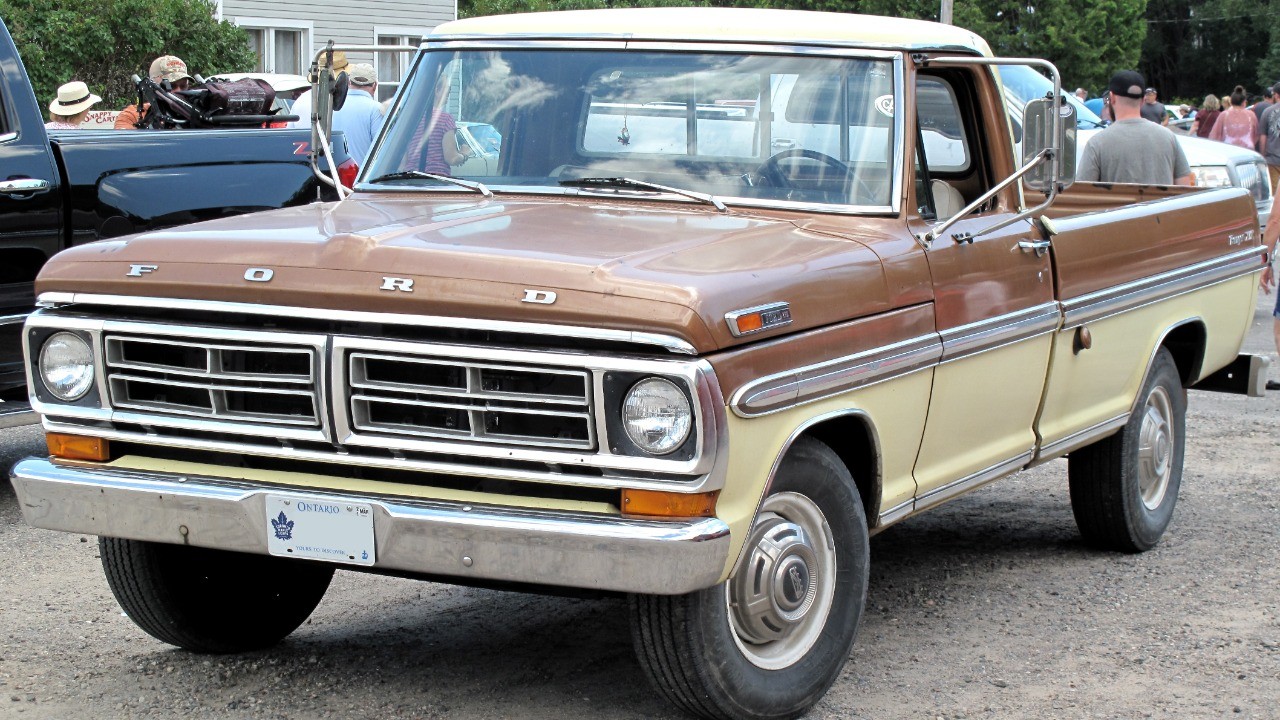
Ford sold its 1967 to 1972 pickups with a simple promise: “Works like a truck. Rides like a car.” The Ford F-100 and its bigger F-250 brothers delivered on it, with wider cabs, more V8 choices and plusher trims than the trucks they replaced. Enthusiasts call this generation the “bumpside.” The name comes from the raised ridge that runs down each flank, nearly from the headlights to the taillights. Ford built the design for six model years, and the details changed often. Grilles, trims and engines moved around from one season to the next. That variety is the fun part. These 10 are our picks for the bumpsides that turn heads, from a plain work truck to a two-tone Ranger XLT. The verdict on each is our opinion, while every year, engine and price below comes from the records. 1. 1967 Ford F-100 4×4 The first bumpside year brought a cab three inches wider than before, mounted on a heavier frame. Ford offered the half-ton F-100 with four-wheel drive, rated for up to 5,600 pounds gross vehicle weight. That made it a real working tool for ranchers and anyone who left the pavement. Under the hood, buyers had three main choices for 1967. According to CJ Pony Parts’ fifth-generation F-100 guide, the 240 six made 150 hp and the 300 six made 170 hp. At the top sat the 352 “Interceptor” V8, with 208 hp and 315 lb-ft of torque. The 352 lasted only this one year in the bumpside, which gives a 1967 V8 truck its own small claim to fame. At the same time, the cab got quieter and roomier. Padded sun visors, a heater, two-speed wipers and a latching glovebox came standard. Our take: a 1967 F-100 4×4 stands taller than its two-wheel-drive siblings, and that stance draws a crowd. After all, it looks ready for work, because it was. If you find one with its original drivetrain, keep it that way. A lifted bumpside is common, but an honest factory 4×4 is far more interesting at a show. 2. 1967 Ford F-100 pickup The plain two-wheel-drive F-100 was the heart of the lineup. In 1967, Ford asked $2,237 for a base model, according to CJ Pony Parts. Buyers could pick a Styleside bed in 6.5- or 8-foot lengths, or the old-school Flareside with its exposed rear fenders. Ford offered three trim levels at launch: Standard, Custom Cab and Ranger. The Ranger added bucket seats, carpeting and an optional center console, which was a big step up for a pickup in 1967. That is why a bright 1967 F-100 works so well today. After all, the flat hood, the simple grille and the long body ridge look clean in a single bold shade. Ford’s paint palette changed from year to year, so a correct period color helps a truck stand apart from the restomod crowd. In our view, the base 1967 truck is the purest bumpside of all. It has no extra chrome to hide behind, only good proportions. Those simple lines also make it easy to judge a body’s condition before you buy. A short-bed Styleside with a six is easy to live with, cheap to maintain and fun to drive around town. 3. 1968 Ford F-100 Ranger Federal rules changed the look of the 1968 trucks. Side marker reflectors were now required, so Ford built them into the hood emblems and added them to the rear of the bed. As a result, they are the quickest way to tell a 1968 from a 1967. In fact, the bigger news was under the hood. Ford dropped the 352 and added two new FE V8s, a 360 rated at 215 hp and a 390 rated at 255 hp, per CJ Pony Parts. In addition, 1968 brought a revised rear suspension and the first factory-installed air conditioning for the F-Series. Before that, dealers fitted the air. Meanwhile, the Ranger package sat at the top of the range. It brought a nicer interior and more brightwork outside, and in 1968 it pairs well with the new V8s. Interestingly, the base price fell to $2,198 that year, so buyers had more room in the budget for options. Our take: a 1968 Ranger with air conditioning and a 390 is the bumpside to drive across Texas in July. It looks dressed up without trying too hard. If you shop for one, check the build data for factory air, because it makes summer driving far more pleasant. 4. 1968 Ford F-100 Custom Cab The Custom Cab sat between the base truck and the Ranger. It gave buyers a better-trimmed interior without the Ranger price. That middle choice is easy to appreciate today. Ford also played with packages that year. CJ Pony Parts notes the 1968 Explorer Special, a trim that bundled popular options at a discount. In Canada, the Explorer used the Custom Cab trim and grille while leaving out items such as the radio. That shows how much the middle trim anchored the lineup. For that reason, a Custom Cab also makes a perfect base for a period-correct V8 build. The 360 and 390 FE engines joined the options list for 1968, and both fit the truck’s easygoing character. We covered one notable example in our story on when Ford introduced the F-100 Custom Cab 390. In our view, the Custom Cab is the smart buy among bumpsides. It has enough chrome to look special in traffic, yet it does not carry the Ranger premium. Find a straight 1968 Custom Cab with clean body ridges and you have a truck that draws compliments at every gas station. Pay close attention to the cab corners and floors before you buy. 5. 1969 Ford F-100 Ranger 390 For 1969, Ford gave the bumpside a new grille and one more engine. The 302 Windsor V8 joined the list midway through the year. However, the big-block 390 FE remained the top choice, with 255 hp according to CJ Pony Parts. Pairing that 390 with the Ranger trim created the most muscular half-ton of the year. It had the torque to tow a boat and the interior to make the drive pleasant. Meanwhile, Ford launched its “Job-Engineered” specials in 1969. The Contractor Special, Heavy Duty Special and Farm and Ranch Special each added work equipment for a specific customer. The Ranger buyer, by contrast, wanted comfort and style. With the base truck listed at $2,230 for 1969, a Ranger 390 marked a serious step up. That made the Ranger 390 the bumpside equivalent of a muscle car with a bed. Our take: a 1969 Ranger 390 is the truck you buy to be noticed. It sounds strong at idle, pulls hard from a stop and looks sharp in two-tone paint. Expect it to cost more than a six-cylinder truck, and make sure the engine numbers match the paperwork before you pay a big-block premium. 6. 1969 Ford F-250 Ranger Camper Special Ford had a package for buyers who wanted to haul a camper. The Camper Special option added heavy-duty cooling, camper pre-wiring and a larger alternator. In other words, it prepared a three-quarter-ton truck to carry a slide-in camper for long trips. On the F-250, Ford offered an 8-foot Styleside bed, which suits that job well. Naturally, the F-250 was the base. With two-wheel drive, Ford rated it for up to 8,100 pounds gross vehicle weight. Pairing the Camper Special with the Ranger trim gave buyers a comfortable cab for long highway miles. CJ Pony Parts also points out that F-Series trucks were once sold as campers through Ford dealerships. Today, however, a Camper Special badge is mostly a conversation starter. It tells a story about family vacations, national parks and highway runs with a camper on the back. In addition, the heavy-duty parts make these trucks good candidates for towing a small trailer today. We love a 1969 F-250 Ranger Camper Special in an original green or blue. It rides a little stiffer than an F-100, but it feels solid and confident on the highway. If you buy one, check the frame and springs carefully, because many of these trucks spent decades carrying heavy loads. 7. 1970 Ford F-100 V8 First of all, the 1970 trucks are easy to spot. A mid-cycle update brought a new grille with wraparound front turn signals, along with new side marker lights. Ford also enlarged the fuel tank to 19.5 gallons, up from 18, according to CJ Pony Parts. Next, the trim names changed. The base truck became the Custom, the Custom Cab became the Sport Custom, and the Ranger carried on. At the top, Ford added the new Ranger XLT. Base price for 1970 rose to $2,384. As for power, buyers had three V8s that year. The 302 made 205 hp, the 360 made 215 hp and the 390 made 255 hp. Any of them suits a 1970 F-100, and the 360 offers a good balance of torque and simplicity for daily use. In our view, the 1970 grille is the best-looking front end of the whole generation. The turn signals wrap around the corners and make the truck look wider and lower. A two-wheel-drive F-100 with a V8, a long bed and stock wheels is a timeless shape. Keep it close to factory and it will turn heads without help. 8. 1971 Ford F-100 302 V8 The 1971 bumpside got new grille inserts, a new steering wheel and fresh colors. Ford also added an AM/FM radio option that year, a sign that pickups were becoming daily drivers. In addition, federal emissions and fuel vapor controls arrived. The 302 Windsor V8 made the most sense for many buyers. CJ Pony Parts lists it at 205 hp and 300 lb-ft, which is plenty for a half-ton truck. It also shares its basic design with many other small-block Fords, so it is easy to maintain. By comparison, the 240 six dropped to 140 hp for 1971. The 300 six stayed on the list at 165 hp for buyers who wanted torque without a V8. Base price climbed to $2,647, the highest of the generation. We looked at its long-lived appeal in our story on why the 1971 Ford F-100 remains one of the most recognizable classics. Our take: a 302-powered 1971 F-100 is the easiest bumpside to own. It drives smoothly, and parts are everywhere. Pick one with a manual gearbox if you want a little more engagement on back roads. 9. 1972 Ford F-250 Ranger XLT The Ranger XLT was the luxury pickup of its day. According to CJ Pony Parts, it brought wood-veneer inserts, full carpeting and a sound-absorbing headliner. That was a long way from a bare-bones work truck. The XLT sat above the regular Ranger, a name Ford had used for its dressed-up package since 1965. For 1972, the final North American year of the generation, Ford made power brakes an option on the upper trims. It also offered the Northland Special cold-weather package, with an engine block heater, a larger battery, an upgraded alternator and a limited-slip rear axle. Meanwhile, F-250 4×4 trucks gained a stronger Spicer front axle rated at 3,300 pounds. An F-250 Ranger XLT in two-tone paint looks like the truck a successful rancher drove to town on Saturday. Also, the extra chrome and the heavy-duty stance work well together. We revisited the final year in our feature on how workhorse roots gave the 1972 Ford F-100 its reputation. In our view, this is the most desirable bumpside for comfort. It feels the most finished of the generation. Look for intact wood-grain trim and original upholstery, because those pieces are hard to replace. 10. 1972 Ford F-250 Camper Special The last bumpsides rolled out for 1972, and the Camper Special remained on the menu. It kept the heavy-duty cooling, the camper wiring and the bigger alternator. Ford also offered the F-250 with a crew cab during this generation, a sign of where pickups were heading. Base price for 1972 was $2,550, slightly lower than the year before. For that, buyers got a truck that could haul a camper, tow a trailer and carry the family. SlashGear notes that this generation introduced the 302, 360 and 390 V8 options as well as the F-250 crew cab and the F-250 “highboy.” A 1972 Camper Special makes a fitting end to this list. It shows how far the bumpside came in six years, from a simple work truck to a long-distance hauler. Our take: a 1972 F-250 Camper Special is a fine choice if you want a classic truck that still does real work. Prices remain reachable, too. SlashGear’s look at F-Series nicknames cites Classic.com data showing more than 500 fifth-generation sales over five years, with an average price just under $28,500.