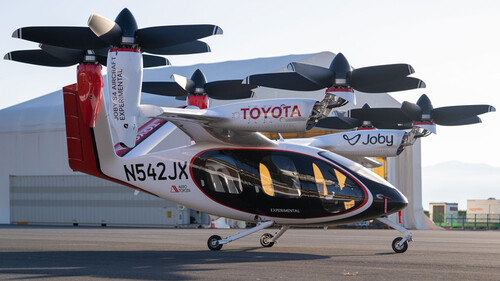
FDOTFlorida has nearly $200 million that it is supposed to spend on expanding electric vehicle charging infrastructure across the state, but in an effort to waste that money and own the libs at the same time, the Sunshine State's government feels that a better use of those funds would be to spend it on flying cars. I know this may sound like a contrived plot point from a movie about right-wing pig-headedness, but it is very much a real plan.Other states around the country have used their share of federal EV charging money to install plugs along their roadways and at their businesses; Florida has been sitting on its money, hands and balls for years at this point. Government officials say there's a very good reason for this: the private market has already done enough to serve "everyday vehicles," according to the Miami Herald. Because of that, Florida wants to put that money to good use and throw it a product that is barely a thing and almost certainly never will exist in any meaningful way.The Florida Department of Transportation plans to build what it has dubbed an "Aerial Highway Network, The Herald reports. This vaporware will theoretically serve as a place for flying cars to charge, take off, and land. While it might seem like a waste of both time and money to throw $197 million at flying taxis when that money is supposed to go to actually useful things — like EV chargers for Floridians who own or want EVs that actually exist — the state promises that it's actually worth it.AdvertisementAdvertisement"The Florida Department of Transportation will not waste taxpayer dollars and spend it on everyday passenger vehicles," the FDOT document, obtained by The Herald, reads. "Instead, FDOT's proposal...takes an innovative and strategic approach to offer the greatest benefits to Floridians by supporting a new emerging mode of transportation."Read more: The Largest Commercial Jet Engine On Earth Also Has Large And Unique ProblemsFlight riskFDOTFlorida's government has a childlike view of flying cars, taxis and other eVTOLs, saying they'll help to ease highway traffic congestion. I suppose now would be a good time to point out that they'll only really fit between two to four people each, and this infrastructure will still take up valuable space. The only way to actually cure congestion is better public transportation, but that conversation is so far outside the realm of possibility for Florida, it's not even worth having.The state is estimating the proposed 32 take-off, landing and charging pads it's going to help fund will cost about $5.6 million a pop. There's no word on where they're going to be built, but FDOT has said its goal is for them to show up at airports, luxury apartment buildings, golf courses and military bases. Obviously, these are all places that are frequented by average, everyday Floridians.AdvertisementAdvertisementThere's some odd funding scheming going on here, as well, as the Miami Herald explains:In an even more unusual move (beyond flying cars), Florida appears to plan to pony up the matching half of the federal grant from its own coffers, rather than allowing private companies to pay, like other states have done for their EV chargers.Federal National Electric Vehicle Infrastructure (NEVI) funds typically cover 80% of an eligible project's cost, and the recipient – the gas station or, in this case, flying car companies – has to come up with the 20% to match. It seems that instead of leaving that match burden to the private sector, the state of Florida is potentially offering to cover that matching share itself for some projects. FDOT did not immediately respond to a request for clarification.For whatever reason, the U.S. government is very interested in eVTOLs. As we covered back in March, the FAA approved height test flight programs across 26 states (including Florida) for air taxis. Clearly, Trump's regulators are cooking up something, and it's going to take a little bit of time to figure out just what that is.Florida wants this badlyKrblokhin/Getty ImagesThis isn't anything new for Florida, though. FDOT says it has been planning to get air taxis off the ground since 2021, and it has spent the past three years on public engagement around the project. The home of Walt Disney's frozen head has already built the country's first aerial testing site at FDOT's SunTrax facility in the middle of Florida, according to The Herald. It's a 475-acre proving ground that is also meant to test self-driving cars, and a number of flying taxi companies have already been selected to work with FDOT on its pilot program.Obviously, the $197 million in funding that was given to Florida under the Biden administration was never meant for this crap. It was supposed to accelerate EV adoption and make the transition from gas to electric that much easier for buyers. The government of Florida isn't interested in that woke junk. I'm not joking. Don't believe me? Believe The Herald:Some state leaders have cast EV charging infrastructure as "woke" spending in recent years (and launched a website to say it.) While other states pushed back against the Trump administration to keep using NEVI money for traditional chargers, Florida stayed quiet and stopped publicly posting its EV charger deployment plans. The state's flying-car pivot only came to light after the Miami Herald filed a records request in January, which went unfulfilled until the newspaper's lawyer got involved.FDOT argues that the 4,998 DC fast charging ports in the state are more than enough. Somehow, Floridians have the second-highest number of electric vehicles in the country, but it's still behind the national average on chargers per vehicle. Unfortunately, it doesn't look like any more are going to be built anytime soon. I hope everybody in Florida loaded up on their motion sickness pills, because it's time to take off.AdvertisementAdvertisementWant more like this? Join the Jalopnik newsletter to get the latest auto news sent straight to your inbox, and follow us or add us as a preferred search source on Google.Read the original article on Jalopnik.