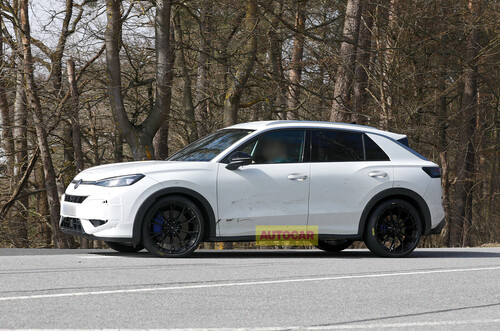
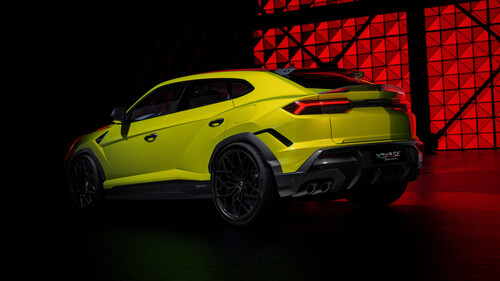
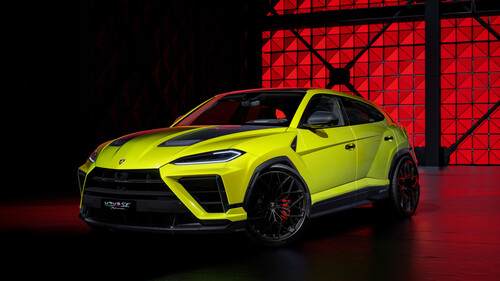
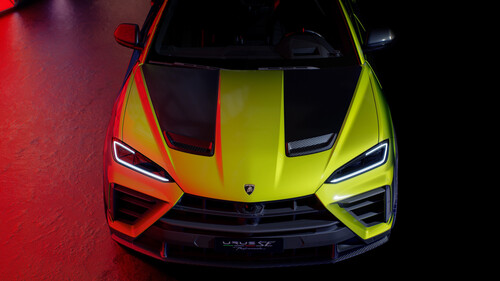
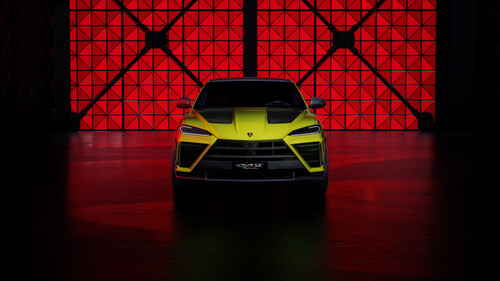
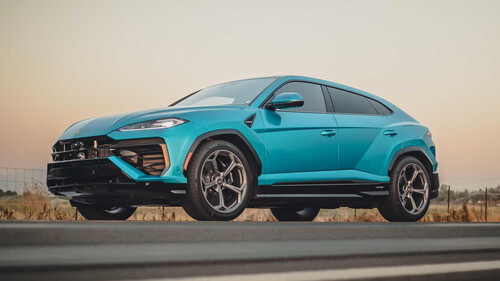
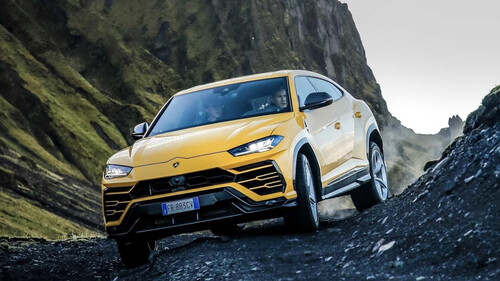
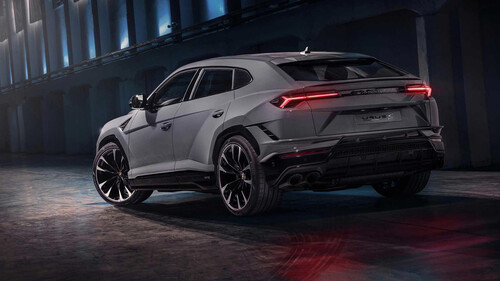
The Lamborghini Urus Performante SE Is a MonsterLamborghiniThe Lamborghini Urus's superpower has always been the fact that it is a great daily driver. Lambo's supercars require their users to sacrifice practicality and comfort for their performance and drama. But behind the cartoonish aggression of its look-at-me styling, the super-SUV has room for four and, in its softest drive mode (Strada), a pliant ride that makes it a fine long-distance companion.Which is why the 2023 Urus Performante was a rare misstep from a brand that normally understands its customer base so well. The turned-up, even-higher-performance variant of the Urus did get a fractional increase in power and a marginal reduction in weight, bringing the bragging rights of the most impressive numbers. But the Performante also swapped the standard Urus air springs for lower, firmer steel coils—a change that removed the plushness of the regular car's suspension. The Performante could carve its way around a race circuit better than any 4800-pound SUV had any right to, a point Lamborghini made with the unlikely launch venue of the Vallelunga circuit near Rome. But it was also compromised in a way that made no sense for its typical road-only-duty cycle.LamborghiniSo it's no surprise that the 2027 Urus SE Performante now sits on air springs, although using a different dual-chamber system to the ones beneath the regular Urus SE. As with the last Performante, the new one gets a small increase in power, with its plug-in hybrid powertrain now making a quoted peak of 801 hp when the twin-turbo V-8 and electric motor are delivering their all—that representing an increase of 12 hp over the standard SE. Torque goes up, too, from 700 to 738 lb-ft.AdvertisementAdvertisementThe SE Performante is also claimed to be 70 pounds lighter than the SE, the largest part of that reduction coming from a part-titanium exhaust system from Akrapovič. But that number needs to be put into the perspective of an overall weight of 5450 pounds on Lamborghini's numbers. So 650 pounds more than the nonhybrid Performante, that difference due in large part to the mass of the sizable 5.9-kWh hybrid battery.LamborghiniR&T's first drive of the SE Performante in prototype form came at Porsche's Nardò proving ground in Italy on a variety of surfaces, including a skidpad, a gravel track modeled on a rally stage, and the demanding 3.8-mile handling track. The experience proved that this remains an SUV capable of delivering performance well in excess of what is ever likely to be asked from it by future buyers.The air suspension is the defining change. Lamborghini's engineers had plenty of numbers to quote—apparently the SE Performante has a 55 percent reduced roll gradient compared to its predecessor in its firmest setting—but the most noticeable difference is the ability to adjust behavior through the switchable dynamic modes. The punchiest setting (Corsa) delivered flat cornering and a strong sense of connection between front tires and steering wheel, especially in faster turns on the handling track, but still allowed enough wheel travel to absorb the handling circuit's bigger curbs when struck at speed.LamborghiniBy contrast, Strada mode was obviously softer, even if the smooth surfaces within the Nardò complex mean waiting to find out how it deals with the rougher edges of the real world. But, on first impression, the level of compliance felt similar under gentle loadings to the regular Urus SE and much better than the old, steel-sprung Performante.AdvertisementAdvertisementThe prototype I drove on Nardò's handling track was riding on the 22-inch Bridgestone Potenza Race semi-slicks, these being an upgrade over the regular Pirelli P Zero tires. While few owners are likely to tick that box—Lambo execs reckoning the vast majority will opt for the 23-inch rims that wear the sport tires—the aggressive rubber does unlock the SE Performante's full potential to generate lateral and longitudinal grip.LamborghiniThis felt otherworldly for something this size and mass, the Urus lapping the handling track quickly enough to keep a Huracán pace car honest. But while the new Performante felt stable and lashed-down in faster corners, I was left in no doubt of the forces involved in getting so much car to turn into slower ones: It definitely felt less nimble than what I remembered of the lighter, nonhybrid version.The prototype's multitude of active systems worked together to fight off the understeer that should be inevitable in something so tall and heavy, informed by a "6D" sensor that combines a three-axis accelerometer with the measurement of roll, pitch, and yaw. But it also felt as if it would benefit from a final polish before the production version is signed off on.LamborghiniOn the handling track, I found that the inputs of the active rear steering, torque-shifting differentials, and stability control sometimes seemed to be competing with each other, making it hard to hold a chosen line in longer corners even with constant throttle and steering inputs. The Performante is hugely fast, but dynamically it felt more like a hammer than a scalpel.AdvertisementAdvertisementOf course, brutality is an entirely appropriate trait for an 800-plus-hp Lamborghini, and Nardò also gave me the chance to confirm the presence of the new SE Performante's additional urge over the old car. As with this powertrain's other applications—with less powerful versions in the Porsche Cayenne Turbo E-Hybrid and the Audi RS Q8, as well as the regular Urus SE—electrical assistance has eliminated any hint of turbo lag to give instant responses, regardless of the number showing on the tachometer.LamborghiniAccelerating hard at basement revs made the Urus feel like it was packing an engine with 16 liters of capacity rather than four. And the chance to play on Nardò's skidpad proved the prototype had plentiful torque for full-power, tire-smoking drifts. Like the last Performante, the new car has a Rally mode, one that allows significant yaw angles on loose surfaces before intervening to prevent spins.Lamborghini claims an identical 3.3-second 0-to-62-mph time for the SE Performante and the previous version, proving both can accelerate pretty much at the limit of the tires, but the new car's 10.8-second 0-to-124-mph time is 0.7 second faster. Subjectively, the difference felt even greater than that: Making a launch-control start on Nardò's main straight, the prototype felt relentless through the first three ratios of its eight-speed automatic transmission, acceleration only starting to tail off deep into fourth gear as the physics started to turn really hard.LamborghiniLamborghini claims a 194-mph top speed, but even Nardò didn't offer enough space to confirm that. The exhaust note through the Akrapovič muffler has also been given a more aggressive note than the Urus SE's.AdvertisementAdvertisementThe SE Performante's purpose is to be the ultimate Urus—the one that will make owners of the regular car feel jealous and inadequate—but without any of the harshness that compromised its predecessor. Based on a first drive in a not-quite-finished car, that seems to have been delivered.We all know that few buyers, if any, will actually take it on a race circuit—not least as the prototype's Bridgestone tires were being swapped after two stints on Nardò's handling track, which would carry a retail cost of north of $2000. But I suspect at least some future owners will make their choice on the basis of the unlikely feats the SE Performante is capable of.You Might Also LikeIf You Can Only Own One Car, Make It One of TheseThese Are the Most Popular Cars by State