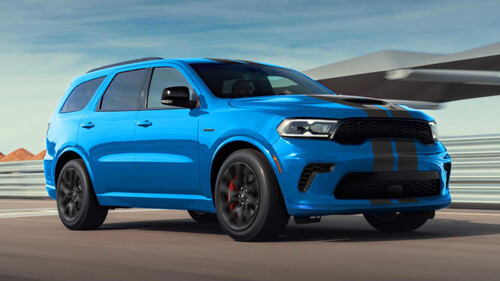
Dodge Brought Back Gas Engines to the Charger. How’s the Model Doing Now?AutoblogAmos KwonWed, September 23, 2026 at 4:30 PM UTCAdd us on GoogleAutoblog and Yahoo may earn commission from links in this article.Would a Charger By Any Other Name Sound as Sweet?Dodge's return to gasoline power has given the new Charger much-needed range and relevance, but it has not instantly turned the model into a sales success. The all-electric Charger Daytona remains the weak link, while the new turbocharged Sixpack models are positioned to do most of the volume work.StellantisThe important distinction is that Dodge did not put a gas engine into the Charger Daytona. Daytona remains the battery-electric branch of the Charger lineup. What Dodge brought back for 2026 is the gasoline-powered Charger Sixpack, sold alongside the EV rather than replacing it. This is big news for Dodge muscle car lovers, and it's a hard pivot back to what made the brand great, minus two cylinders, that is. So, how are sales of the Charger Sixpack doing now?A Necessary Course Correction2023 Dodge Charger SRT HellcatDodge made a bold break with the past when it ended production of the HEMI V8-powered Charger and Challenger and introduced the redesigned Charger first as an EV. The Charger Daytona arrived with two electric motors, all-wheel drive and headline power figures ranging from 496 horsepower in R/T guise to as much as 670 hp in the Scat Pack with PowerShot. It promised huge performance, Fratzonic muscle car sounds, and classic but modernized looks. What it didn't account for was the utter lack of interest in an electric muscle car.AdvertisementAdvertisementThe fully-electric Charger Daytona Scat Pack is rated at a claimed 3.3 seconds to 60 mph, and it can cook many old-school V8-powered muscle cars. But Dodge buyers aren't just about raw acceleration numbers. It's the look, the feel, the sound, and the smell that draw the enthusiasm and the passion. The old Charger's appeal combined accessible V8 power, a big cabin, rear-drive dynamics, old-school mechanical character, and pricing that made it approachable.2027 Dodge Charger Daytona Scat Pack 4-doorDodgeDodge was asking shoppers to accept a heavy, expensive EV with a synthetic "Fratzonic Chambered Exhaust" soundtrack and real-world range compromises. It was a difficult sell just as the U.S. EV market cooled and the federal EV tax credit ended. It was, to say the least, bad timing of an odd product. It was the answer to a question nobody asked, apparently. Did the Charger need a facelift, a cabin redesign? Yes and yes. Did it need electric power? No. The world wasn't ready for it, and the original gas Charger and Challenger's following didn't want it.Sales bombed. Dodge reportedly sold 7,421 Charger Daytonas in the U.S. during 2025, but volume fell sharply late in the year, with only 346 sold in the fourth quarter. In the first half of 2026, U.S. Daytona volume was reported at 534 vehicles, down from 4,299 in the equivalent period a year earlier. Another report citing S&P Global Mobility said January 2026 sales totaled just 80 Charger Daytonas, a 65 percent year-over-year decline. It's hard to overstate the failure here.The Sixpack Tries to Bring the Faithful BackStellantisDodge's answer is the Charger Sixpack, powered by Stellantis's 3.0-liter twin-turbocharged Hurricane inline-six. It is not the V8 revival many loyalists wanted, but it is a conventional internal-combustion Charger with gasoline refueling, an eight-speed automatic transmission and standard all-wheel drive. It's the car that should've originally been sold alongside the the EV so as not to lose transmission with Dodge devotees.DodgeThe 2026 Charger R/T uses the standard-output Hurricane, making 420 horsepower and 468 pound-feet of torque. The Scat Pack gets the high-output version, producing 550 hp and 531 lb-ft. Dodge says the Sixpack Scat Pack can reach 60 mph in 3.9 seconds, while the R/T is targeted at 5.0 seconds. Those are more than respectable numbersAdvertisementAdvertisementMore significant than the specification sheet is the pricing. The gas-powered Charger R/T starts around $49,995 for the coupe and $51,995 for the sedan, while the Scat Pack sedan begins at roughly $56,995. That puts a gas Charger back closer to the territory of a V8 Mustang rather than forcing every Dodge performance customer toward a roughly $75,000 EV. That's a huge difference for car buyers, and it makes the gas Charger supremely appealing.Is the Gas Charger Selling?It is still too early to declare the Sixpack a hit in retail-sales terms, because the gas Charger rollout has been staggered. Production of the 550-hp two-door Scat Pack began in December 2025, while the R/T and four-door Sixpack models followed in the first quarter of 2026. That means current registration and sales totals include a limited initial supply rather than a full year of availability.Still, the early signals suggest Dodge made the right product decision. The first allocation of Sixpack Scat Pack models reportedly sold out in less than 24 hours, and Stellantis CEO Antonio Filosa said combustion versions are expected to account for 90 percent of Charger production. Read that again. 90 percent. It's hard to overstate the importance of the gas Charger and how quickly loyalists are returning to the model. That is an unusually direct acknowledgment that the gas-powered cars—not the Daytona EVs—are likely to carry the new Charger franchise.The Bigger V8 Problem RemainsSThe Sixpack is not a complete return to the old formula that made the Dodge muscle cars legendary. Yes, the 6-cylinder power is impressive, but the new Charger lacks a naturally aspirated Hemi V8, and its starting price remains much higher than that of the old entry-level Charger. The good news is that Dodge has confirmed that a supercharged HEMI V8 engine (with upwards of 700 horsepower) is returning to the new-generation Dodge Charger lineup, although no timeline has been announced.AdvertisementAdvertisementFor now, the Ford Mustang retains the advantage because buyers can still get the pony car with a far less expensive, but still powerful, turbo four-cylinder model, while the least-expensive Sixpack begins around $50,000. That's creeping up on the V8-powered Mustang GT's territory, and that car needs no introduction to the muscle car faithful.Final ThoughtsYou could say that the return of the gas-powered Charger has saved the brand, but it's too early to tell. Rather, Dodge has created two distinctly different products under one badge: the Daytona for EV shoppers and the Sixpack for customers who still want internal-combustion muscle. The V8 could still return, and that would be something. The market's early verdict is pretty clear: the gas model will likely matter more in both the short and the long term.This story was originally published by Autoblog on Sep 23, 2026, where it first appeared in the Features section. Add Autoblog as a Preferred Source by clicking here.