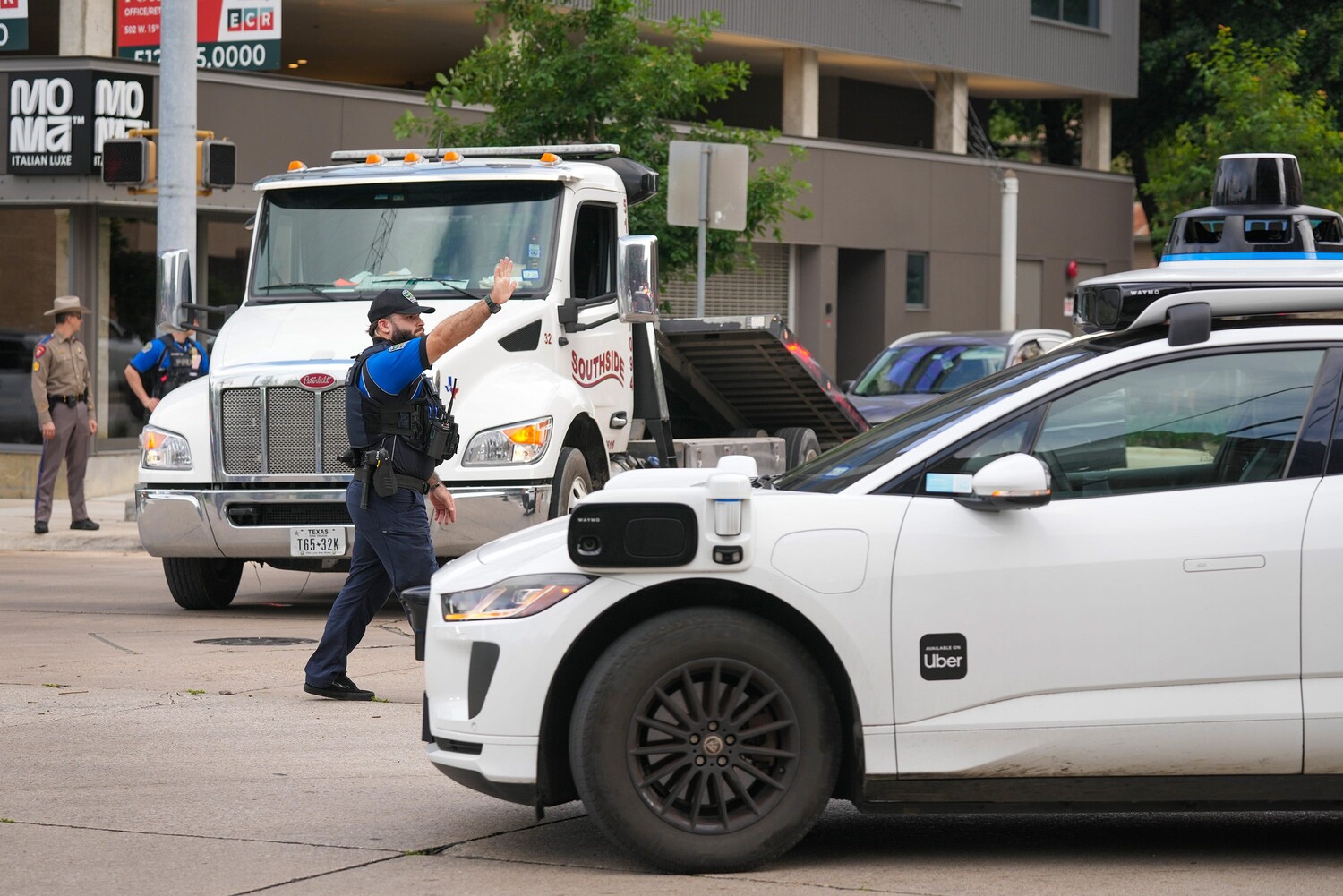
A Waymo Ojai drives along Tecolote Road before serving customers. Following a pair of incidents in the Bay Area, California’s Department of Motor Vehicles has indefinitely restricted autonomous vehicle company Waymo from operating or testing its driverless cars on California freeways. The move does not affect the recent rollout of Waymo in San Diego because the company’s vehicles currently operate only on surface streets in the neighborhoods where the Waymo picks up riders. The suspension comes after an incident on Interstate 280 in San Francisco, captured on video, showing a Waymo vehicle attempting to drive around California Highway Patrol cars that were trying to slow traffic. The DMV also cited an incident where three Waymo vehicles entered a construction closure on Highway 101 near Burlingame. The freeway restrictions went into effect on Nov. 11 “and will remain in place until Waymo demonstrates to the Department that it has taken effective corrective actions to address the deficiencies that precipitated the restrictions,” the DMV said in a statement. The agency went on to say it has determined the company’s driverless cars on freeways “pose an imminent hazard to public safety due to recurring incursions” into active construction zones. “Safety is at the foundation of everything we do,” a Waymo spokesperson said in an email to the Union-Tribune on Tuesday, adding that the incident on the Highway 101 construction zone did not involve any injuries. As for the DMV’s restriction, the Waymo spokesperson said that in “alignment with our safety-first principles,” the company has restricted its vehicles from operating on freeways “across our other operating markets to evaluate our performance.” That means all cities where the Silicon Valley-based company serves customers through its ride-hailing services, such as Phoenix, Denver, Miami and Austin, Texas. “We are working with the California DMV and other state officials diligently and responsibly to resume freeway operations,” the Waymo representative said. As per the DMV restriction, before Waymo’s freeway operations resume, the company must provide sufficient evidence to the agency that its vehicles can safely detect and respond to construction zones, emergency vehicles and other roadway situations. Once that evidence is submitted, the DMV will review the company’s corrective measures before deciding on whether freeway operations will resume. The DMV restriction will remain in place until then. Though it did not involve freeway operations, a recent video of a Waymo car in San Diego drew attention. An Instagram post showed one of the company’s vehicles backing through a crossing gate on downtown train tracks. After months of testing on San Diego roads, Alphabet-owned Waymo officially launched its robotaxi service to customers earlier this year in an area that covers in excess of 40 square miles, going from Barrio Logan in the south to La Jolla Shores in the north. Waymo does not provide service to San Diego International Airport because the local authorities have jurisdiction over which ride-hailing services are allowed to pick up passengers. Autonomous vehicle ride-sharing has run into opposition from the San Diego Metropolitan Transit System and the agency’s Taxicab Advisory Committee. MTS CEO Sharon Cooney’s objections include calling for local governments — rather than the state — to have a say over autonomous vehicle deployment, as well as safety concerns and potential economic harm to cab drivers. San Diego City Councilmember Sean Elo-Rivera, who is also the chair of the Taxicab Advisory Committee, welcomed the news of the DMV restriction, calling it a “common sense decision.” “Autonomous vehicles are an amazing technology, but that does not mean they have free rein on San Diego streets, turning our residents into lab rats for Big Tech experiments,” Elo-Rivera said. The DMV issues testing and deployment permits, sets rules for vehicle equipment, and tracks collisions and traffic safety. The California Public Utilities Commission licenses companies that use autonomous vehicles to transport members of the public and oversees robotaxi pilot programs. Waymo has long touted the safety of its technology, pointing to a 95% reduction in serious-injury-or-worse crashes compared to human drivers, according to a study the company conducted from recording 270 million fully autonomous miles. ©2026 The San Diego Union-Tribune. Visit sandiegouniontribune.com. Distributed by Tribune Content Agency, LLC.