Madeleine Lee · 28 days ago@madeleinelee15Diamond For the Rough: How Mitsubishi Turned the Pajero Into a Desert Legend Liked byPost commentRelated PostsMitsubishi’s Facelifted Triton Could Steal The New Pajero’s Best Ideas 15 · Logan Roy · 1 months ago2027 Mitsubishi Eclipse Sportback Will Come Only In $39,740 Loaded Trim, Unlike $30K Nissan Leaf TwinLogan Girard · 16 days agoMitsubishi Pajero Hybrid May Put a US Montero Return Back in Play 73 · Alexander Anderson · 1 months agoMitsubishi's new EV costs $8,000 more than the Nissan LEAFMorgan Labelle · 17 days agoNew 2027 Mitsubishi Pajero’s Australian Pricing Hints at What a U.S. Model Might Cost 21 · Sophie Turner · 1 months agoMitsubishi Eclipse Sportback EV Starts at $37,745Victoria Clark · 17 days agoNew Mitsubishi Pajero’s Australian Pricing Hints at What U.S. Model Might Cost 57 · Chloé Green · 1 months agoBYD’s Racco Kei EV jumps out of Japan, prepares for launch in Sri Lanka and MacauThomas Leblanc · 17 days ago1998 Mitsubishi Pajero Evolution for Sale With 73,000 Miles Shown 59 · Amélie Poirier · 1 months ago5 Reasons to Buy the 2026 Mitsubishi Outlander Plug-In HybridIsabelle Lewis · 21 days agoMitsubishi Pajero Price Hints at What a U.S. Montero Might Cost 46 · Lauren Hill · 1 months agoI Need Something More Mature Than My Mitsubishi EVO! What Should I Buy?Emily Bouchard · 21 days agoIn America, a Bull Bar Is a Look. In Australia, It’s Just Another Factory Option 48 · Jacob Macdonald · 1 months agoNo-Reserve 1995 Mitsubishi Minicab Is a Yellow, 5-Speed Kei Truck With Just 26K MilesParker Anderson · 22 days agoMitsubishi Is Turning The Pajero Into A Family Of SUVs, And One’s Coming For The RAV4 27 · Claire Green · 1 months agoNissan Bets The Farm On Hybrids In North America 80 · Adam Lee · 23 days agoMitsubishi’s New Pajero Undercuts The Toyota Land Cruiser By Thousands 47 · Mia Fortin · 1 months ago5 Turbocharged 4-Cylinder Engines That Leave Their V8 Rivals In The Dust 56 · Daniel Rogers · 23 days agoWill Mitsubishi Bring a New Montero Stateside? Why the Brand Needs to Make It Happen 71 · Noah Scott · 1 months agoThe 10 Coolest Cars for Sale on Motorious This Week 43 · Charlotte Hall · 24 days ago





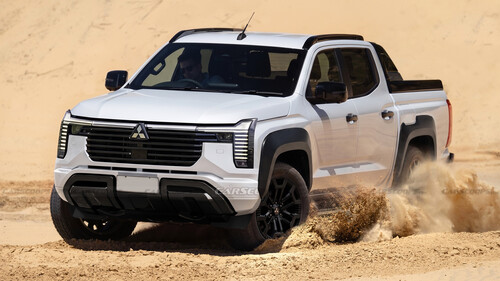

























![459 hp, 0-60 in 3.9 sec, and AWD – meet Mitsubishi's new-age electric EVO [video]](https://cdn.topcarnews.net/en/69622/thumb/id/aHR0cHM6Ly9pMC53cC5jb20vZWxlY3RyZWsuY28vd3AtY29udGVudC91cGxvYWRzL3NpdGVzLzMvMjAyNi8xMC9taXRzdWJpc2hpX2FzeF92cmUuanBnP3c9MTUwMCZhbXA7cXVhbGl0eT04MiZhbXA7c3RyaXA9YWxsJmFtcDtzc2w9MQ/df09dac7018f01bb4b02a95fa8fc92c8.jpg)