The Dacia Sandero is set for a generational change, and with the fourth iteration of the model, Renault’s subsidiary Dacia also plans to introduce a battery-electric version of its bestseller. So far, so good. Now, Autocar has reported on some vehicle details, citing insider information. According to the British publication, the fourth generation of the Sandero will retain the dimensions of the current model — most notably its length of 4.10 metres. This is because the next Sandero is expected to be based on the “RGMP Small” platform, previously known as CMF-B. And this apparently also applies to the electric version.
Currently, the “RGMP” platform only supports models with internal combustion engines and hybrids. The equivalent for electric vehicles within the Renault Group is the “RGEV Small” platform, which underpins models like the Renault 5. Note the subtle difference in letters, which can be easily overlooked. In any case, Autocar reports that the electric Sandero will also use the combustion/hybrid platform, though it will need to be adapted for this purpose. Dacia’s engineers are said to be accepting technical compromises to make this work, and creating space for an electric motor and a battery mounted in the underbody. The carmaker’s engineers are also purportedly taking the opportunity to reduce the vehicle weight by around 100 kg to improve efficiency.
Autocar also managed to leak some details on the main components: the electric Sandero is expected to feature the 78-kW electric motor known as the Shanghai e-Drive and adopt the 44-kWh LFP battery from the entry-level Renault 5. The publication estimates the range at just over 249 miles (around 400 km). However, none of these details has been officially confirmed.
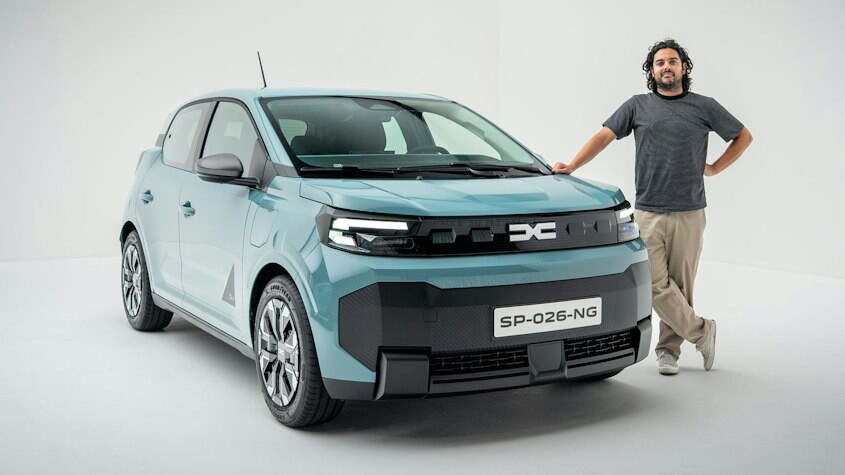
In terms of the timeline, the new Sandero is reportedly set to be unveiled in spring 2028. Production in Morocco is scheduled to begin in April, with sales starting in summer 2028. At that point, the E-Sandero would be the second electric vehicle in Dacia’s lineup, following the smaller A-segment electric car, the Spring. The latter was introduced in its second generation this year and switched to the aforementioned RGEV platform. It is produced alongside the Renault Twingo E-Tech in Slovenia.
Earlier this week, it also became clear that Dacia is considering bringing the Renault Bridger, an electric vehicle developed for the Indian market, to Europe as its own derivative. The Bridger is smaller than the Sandero but slightly longer than the Spring. According to insider information via Autocar, the production version, like the E-Sandero, will be based on the “RGMP” platform, which has not previously been used for electric vehicles. The insiders state that the reasoning behind this new consideration is that Dacia needs to electrify its model range more quickly and reduce the brand’s CO2 emissions at a faster pace.
Dacia has already announced plans to launch a total of four electric vehicles by 2030. These include the Spring and the E-Sandero. Additionally, Dacia is reportedly planning to introduce an electric microcar called the Hipster in Europe starting in 2027.
autocar.co.uk