Key Takeaways
- The CPCA expects China's overall passenger vehicle retail sales in November to come in at 1.63 million units, down 1.1% from October.
- November NEV retail penetration is projected to rise to 70.6%, driven primarily by an accelerated contraction in internal combustion engine vehicle demand.
The China Passenger Car Association (CPCA) estimates China's passenger new energy vehicle (NEV) retail sales at around 1.15 million units in November, putting monthly penetration on track to surpass 70% for the first time.
Overall passenger car retail sales are projected to come in at about 1.63 million units in November, slipping 1.1% month-on-month as the broader auto market continues to operate at a subdued level, according to a forecast report released by the CPCA on Thursday.
Based on these figures, China's NEV retail penetration rate is expected to hit 70.6% in November, topping the previous record high of 67.5% set in October and serving as the primary pillar supporting the current auto market.
Backed by new model launches, NEV order backlogs remain ample and retail performance has shown relative resilience, the CPCA noted. However, penetration crossing the 70% threshold stems more from an accelerated contraction in internal combustion engine (ICE) vehicle market share than an expansion in aggregate demand.
Promotions around the "Double 11" shopping festival provided a modest boost to market sentiment but struggled to generate sustained momentum, while the smooth transition of trade-in subsidy policies offered a floor of support for the market, according to the CPCA.
A November automaker survey by the CPCA showed that while most leading carmakers set ambitious year-end sales targets at the beginning of the month, overall progress by mid-month lagged significantly behind normal seasonal schedules, particularly for ICE vehicles.
With retail dealers facing poor profitability and showing low willingness to help automakers meet volume targets — compounded by limited user demand — November target completion rates will likely remain low despite clear intentions from manufacturers to push inventory onto dealers.
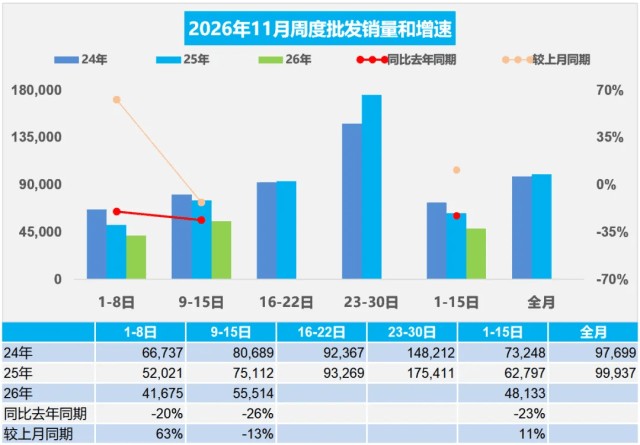
In terms of weekly trends, passenger vehicle retail sales averaged 37,000 units per day during the first week of November (November 1-8), weighed down by demand pulled forward during automakers' end-of-October sales push.
In the second week (November 9-15), daily retail sales rebounded to an average of 45,000 units as "Double 11" promotional campaigns rolled out and previously accumulated orders converted into actual sales.
During the November 1-15 period, China's passenger NEV retail sales stood at 447,000 units, down 13% year-on-year but up 7% from the same period in October, bringing NEV retail penetration during the first half of the month to 73.2%, according to data released by the CPCA on November 18.
As promotional campaigns wind down, the CPCA expects the market to return to a normal pace in the third week of November (November 16-22), with average daily passenger vehicle retail sales projected at about 46,000 units, a 35.2% year-on-year decline.
During the fourth week (November 23-30), a crucial window for year-end volume pushes, both dealer inventory loading and customer deliveries are expected to accelerate. Average daily retail sales are projected to climb to a monthly peak of 87,000 units, though this still represents a 23.4% drop from a year earlier.
The sluggish performance of the auto market is not merely an issue of short-term promotional pacing, but rather the combined result of weak macroeconomic consumption and diminishing marginal returns from stimulus policies, the CPCA said.
Total retail sales of consumer goods in China rose 1.0% year-on-year in the January-October period, while retail sales in the automobile category fell 15.5% over the same timeframe, data from China's National Bureau of Statistics showed. In October alone, the year-on-year decline in auto retail sales widened further to 21.4%.