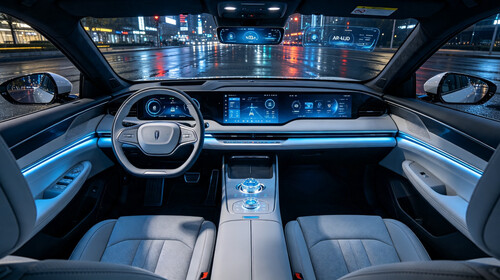
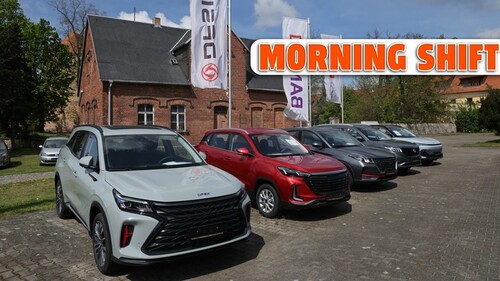
Gasgoo Munich- "Turn on the air conditioning." With that Vietnamese command, the car's AC hums to life, pushing cool air through the vents. It's a daily ritual at Chery dealerships in Hanoi. Step inside, and customers often ignore the steering wheel or rear legroom at first. Their priority? Testing a local voice command to see how fast the system reacts.That's no exaggeration. In Vietnam, many mass-market models from foreign brands are stuck in the basics: streaming music via Bluetooth or relying on phone navigation. Native voice interaction is notably behind. A fluid, localized smart cockpit has become the ace up Chinese automakers' sleeves — and a mandatory checkpoint for anyone walking into the showroom.In-car intelligence was once a premium lever for foreign brands, allowing them to charge thousands extra for a navigation system. Now, Chinese smart cockpits are shipping abroad with vehicles, reaching markets worldwide. Exporting alongside cars captured the easy gains of the first half. The second half — a contest of raw technical strength and ecosystem clout — has only just begun.AI-generated illustration; Source: DoubaoForged by domestic competition, ready to fight globallyThe prowess of China's smart cockpits didn't appear out of thin air. It was forged in the crucible of hyper-competition at home.In China, users are the ultimate judges. A lagging touchscreen draws instant online complaints; a voice assistant that stumbles on dialects gets roasted in comment sections. Even slightly jerky animations get dissected in slow-motion comparisons. Under this intense scrutiny, the domestic cockpit supply chain has been pushed to become the toughest in the world.Data from Gasgoo Institute's "Smart Cockpit Industry Report (2026 Edition)" shows penetration in domestic passenger vehicles has topped 80%, becoming standard in new-energy models. With hardware and software configurations expanding and per-vehicle value rising, the report estimates the domestic market will hit 330 billion yuan by 2030. By both penetration and volume, China sits at the global forefront.For the "brain" of the smart cockpit — the domain controller — pre-installation penetration has breached 50%, rapidly migrating from high-end models to the mainstream family segment.Data from the first half of 2026 puts Desay SV in the lead with 693,700 units and a 14.9% share, beating runner-up Bosch by 7.3 percentage points. Bosch held 7.6% with 356,200 units, followed closely by Huawei at 7.2% with 335,000 units — a gap of just 0.4 percentage points. ECARX took 6.4% with 298,900 units, while local players like FINEST, Autolink, and ADAYO also secured spots in the top ten.Chinese firms occupy the majority of the top ten list, signaling a gradual shift as domestic suppliers break the long-held dominance of foreign companies.Desay SV, a leading domestic Tier 1 for automotive intelligence, covers four major areas: domain control platforms, display systems, interaction systems, and overall solutions. Its products are in mass production. In the first half of 2026, it led installations in cockpit domain control, center screen integration, and instrument cluster integration. Its IPU domain controllers have entered the supply chains of nearly every top domestic brand, including BYD, Geely, Li Auto, XPENG, and Xiaomi.Neusoft Corporation has dug deep into the 100,000 to 200,000 yuan mainstream family market. Leveraging large-scale delivery and software-hardware integration, it serves multiple domestic and joint-venture automakers, making it a primary supplier for cockpit domain controllers in this price bracket.ECARX gained volume through the Geely ecosystem and is now expanding to external clients, flexibly choosing between Qualcomm and SiEngine chips based on needs. Huawei took a cross-industry approach. Its HarmonySpace stands out with consumer-electronics-grade fluidity and cross-device synergy. With the "Harmony Intelligent Mobility Alliance" taking shape, Huawei now forms a top-tier triumvirate alongside Desay SV and Bosch.The chip sector is far more concentrated. Data from the first half of 2026 shows Qualcomm commanding absolute dominance with 3.4 million units and a 71.4% share; its 8155 and 8295 chips are practically standard in mid-to-high-end models. Huawei ranked second with 355,100 units (7.5%), followed by SiEngine, AMD, and MediaTek with 5.2%, 5.1%, and 4.8% respectively. Domestic vendors like SiEngine Tech are climbing the ranks across different price segments.Software and operating systems are evolving along multiple parallel paths. HarmonySpace, Banma Intelligence, ThunderSoft, and various in-house OEM solutions each have their focus, creating a diverse competitive ecosystem.Domestic substitution has moved beyond isolated breakthroughs. With the exception of cockpit domain chips, where Qualcomm still leads, local supply chains are mature in core areas like center screens, HUDs, AR-HUDs, digital instruments, and voice interaction. Domestic firms lead most of these niches.Local players have seized control of the display segment. In the HUD market, ADAYO Multimedia alone holds nearly 30%, with E-Lead and New Vision following; the top ten is mostly domestic. The faster-growing AR-HUD sector is even more firmly in local hands — the top six firms command over 80% of the market. This high-end feature is trickling down to mainstream price points. Globally, the cost control and mass-production capability of China's supply chain allows automakers to offer AR-HUD in export models, creating a technological gap against joint-venture brands.The center screen and instrument cluster markets are also led by local vendors like Desay SV, BYD, and ADAYO. The abundance of supplier options gives automakers significant flexibility in configuring hardware for export models.In voice interaction, iFlytek and AISpeech together claim nearly 70% of the market, with the top five suppliers holding over 90%. Their accumulation of expertise in multilingual support, dialect adaptation, and large-model interaction is the capital Chinese models are using to conquer different regional markets overseas.The differentiated competition forged by intense rivalry in hardware, chips, and software has pushed the upper limits of experience while driving down the cost of intelligence. These capabilities honed in the domestic arena are the foundation for cockpit companies going global.Pits remain, but breakthrough speed exceeds expectationsChinese cockpits didn't wait for perfection before heading abroad. They laid down a mature domestic technology base first, then adapted to local market needs, taking root through trial and error.Vehicle exports are the direct engine of this expansion. CPCA data shows China's auto exports hit 8.32 million units in 2025, a 30% annual increase. Following that wave, Chinese smart cockpit solutions have rolled out in bulk overseas.The global expansion of Chinese cockpit vendors has stratified into tiers.The most common path is bundled exports alongside Chinese automakers, focusing on Southeast Asia, the Middle East, and Russia. Some leading firms have established local R&D and service hubs in Europe and Southeast Asia to handle compliance and ecosystem adaptation. A handful have gone further, breaking directly into the global project supply chains of international automakers, transforming from followers into independent global technology suppliers.In July 2026, iFlytek signed a new five-year strategic partnership with Chery, explicitly making "multi-language export" a core business. iFlytek's voice solution will be installed directly on Chery's export models — a landmark case for a domestic voice AI vendor riding the wave of vehicle exports.Image source: iFlytekVietnam is where this strategy is paying off most visibly. Customs data show China became Vietnam's second-largest vehicle supplier in the first five months of 2026, with imports jumping over 60%. The experience gap created by localized cockpits helped Chinese brands rapidly tear open the market.Russia is another core market. Data from the General Administration of Customs and CPCA shows China exported 583,000 vehicles to Russia in 2025, ranking second among destinations.But Russia has its own barriers. Navigation requires Yandex Maps, voice must adapt to the Alice assistant, and ecosystems need local tools. Many early automakers ignored this, doing only simple translation. The result was widespread navigation drift and voice failures, crushing initial reputations.The industry eventually found a formula: Chinese technology base plus local ecosystem adaptation. Deep integration with Yandex Auto allows automakers to keep their own systems while Yandex provides the interfaces for navigation, voice, and music. This solution is now widely used in models destined for Russian-speaking regions.Mature markets in Europe and the U.S. have even higher thresholds — only those with genuine capability break in. Local software firms like Kotei have moved from single-project cooperation to full-ecosystem support. Munich now hosts over a dozen Chinese R&D centers. Brands like SAIC MG and Chery aren't just selling cars; they are embedding locally across technology, production, and branding.Huawei's HMS for Car is taking the route of independent technology export, without relying on vehicle bundling, opening its cockpit ecosystem to automakers worldwide. Partnerships with Great Wall Motor, Changan, and Avatr have landed in over 70 models across Southeast Asia, the Middle East, and Europe, saving automakers significant time and cost on overseas adaptation.Following vehicle exports is just the entry-level phase. Penetrating the global R&D supply chain of European luxury brands is the true proof of hard strength. PATEO is a representative example.PATEO was an early mover in overseas markets, pursuing a dual-track strategy: supplying Chinese brands' exports while breaking directly into the global development of European luxury models. Its most significant achievement? Securing the core smart cockpit solution for a Porsche global project.Such deep cooperation was once hard to imagine. The underlying communication protocols and basic software platforms for Volkswagen Group's high-end models were long monopolized by German suppliers. Domestic Tier 1 firms were mostly limited to HMI interfaces, upper-layer applications, and system integration, barred from touching the core foundation.Image source: PATEOPATEO made a breakthrough on this project. According to the "China Solutions to the World" 8th Gasgoo Awards, the project — targeting Porsche's global lineup — achieved the first full-stack independent development of Volkswagen Group's core protocol system and basic software platform. It delivered over a dozen core protocols and capabilities, covering the complete technical chain of vehicle communication, fault diagnosis, power management, and edge AI.This solution achieved full-stack engineering mass production, from communication protocols to basic software platforms. It broke the long-term monopoly of foreign suppliers and filled a gap for domestic Tier 1s in systematic engineering practice within Volkswagen Group's high-end platform software.The final product features a Qualcomm 8295 chip, integrating generative AI and full-link interaction. It brings experiences proven in China — such as wake-free voice control, 3D real-time vehicle control, and multi-device connectivity — into luxury models, while meeting global automotive reliability and privacy compliance standards.This wave isn't just about local players. The China R&D teams of traditional foreign Tier 1s like Bosch and Continental are also refining cockpit solutions through rapid iteration in the Chinese market, deploying them overseas alongside Chinese vehicle exports.Take Bosch. Its smart cockpit business supports over 20 Chinese brand models exporting to Southeast Asia, the Middle East, and Europe. As one of the few service providers with headquarters-level certification for Google Automotive Services (GAS), Bosch's China team offers one-stop overseas ecosystem adaptation, significantly shortening entry cycles for automakers.More notably, Bosch's 8295 cockpit domain control solution and full-link AI interaction logic — developed in China — are being integrated into its global product system to serve international brand projects. Bosch has explicitly stated its strategy: "Innovate in China, serve the global market."Continental Group is on a similar path. Its AR-HUD solution, refined by the China team for cost control and volume delivery, is now synchronized with the global product system for automakers worldwide. This model — local development, global reuse — is becoming increasingly common among foreign Tier 1s.The past saw technology flowing into China; now, it's reversing. Interaction logic, functional design, and domain control solutions proven in China are increasingly being incorporated into the global R&D systems of these firms. "China innovation, feeding back the world" — this is another thread of the Chinese cockpit industry's expanding influence.But for all the buzz, the real test lies ahead. Data security compliance, local ecosystem adaptation, and building overseas service networks — each is a formidable barrier.Compliance is the first gate. Cockpits involve data collection, vehicle communication, and OTA upgrades, all subject to strict regulation globally. EU certifications, cybersecurity laws, and data control requirements are complex and constantly evolving, making it easy for development cycles to fall out of step.The depth of localization determines whether users buy in. Language translation is just the baseline. Maps, payments, entertainment, and charging networks all need seamless integration with local service providers. Obscure details like minority language recognition, accent adaptation, and logic for special road conditions can ruin a car's reputation in minutes.Even harder to overcome are the cultural barriers. Traditional overseas automakers and Tier 1s demand extremely strict project processes and quality control. Chinese companies, used to rapid iteration, must adapt to more rigorous, longer cycles. In high-end automotive electronics, trust in "Made in China" must be earned slowly, project by project.Conversely, these barriers are also moats. Whoever masters the system of compliance, local ecosystems, and global supply chains first will secure a long-term advantage. And rapid trial-and-error with flexible iteration? That's exactly what Chinese companies do best.The real second half is about more than just productsThe globalization of Chinese cockpits has only completed the first half. In the next wave of in-car AI transformation, whether Chinese solutions can capture technological leadership in mainstream global markets will determine the industry's long-term standing.The industry's underlying logic is shifting. Traditional cockpits rely on assembly-line modular architectures, where acoustics, recognition, semantics, and execution operate separately. End-to-end large models are shattering this hierarchy, turning the cockpit into a unified intelligent interaction entity. This isn't just about stuffing a large model into the head unit; the logic of human-vehicle interaction must be rewritten from the ground up.This trend is already taking hold in China. The center of gravity in cockpit competition is moving from single hardware specs to a comprehensive contest of software-hardware synergy, system integration, AI capability, and ecosystem fusion.Si Luo, CEO of Banma Intelligence, breaks down the next-generation smart cockpit into five layers, with the core change concentrated in the "Agent" layer. The old voice assistant was a passive responder — a "tool" that only acted when spoken to. The new cockpit agent actively identifies needs, decomposes tasks, and coordinates services to get things done, behaving more like a dedicated butler who understands you.The Society of Automotive Engineers of China's "2025 Automotive Smart Cockpit Technology Trends" report also notes that by 2030, cockpits will enter a stage of advanced cognitive intelligence. End-to-end AI agents will enable context reasoning and multimodal fusion, shifting the human-vehicle relationship from "human adapting to the car" to "car adapting to the human."Chinese companies are standing in the first tier of this transformation. SAIC has launched AI-native models with Volcano Engine; Seres has incubated the AIVA in-car AI; Huawei continues iterating its Celia cockpit agent; and Volkswagen has laid out its full-domain AI cockpit. The battle for the in-car intelligent agent is fully underway.Image source: QualcommOver the next three to five years, cockpit evolution will focus on three directions. First, understanding humans better through multimodal perception to proactively adjust the environment — shifting from passive response to active care. Second, greater capability, upgrading from executing single commands to handling complex needs by automatically managing search, filtering, navigation, and booking. Third, seamless integration, bridging home, office, and entertainment scenarios to make the cockpit an extension of the user's digital life.As technology iterates, the rules of competition are changing too.Value is migrating toward software and services. AI model capability, ecosystem richness, OTA iteration speed, and personalized service will be the real differentiators.Export models will also shift. While current cockpit exports mostly follow vehicles, more Chinese vendors will soon supply overseas mainstream automakers directly, following the path Bosch and Denso took to become global Tier 1s.The core of the endgame is standards and ecosystem clout. If a solution becomes the industry standard, you control the rules of the game. If Chinese cockpit solutions hold enough global share and enough international automakers adopt Chinese technology routes, China's software, hardware, and AI interaction norms will naturally become de facto standards.In areas like in-car large model interfaces, agent capability definitions, and vehicle-cloud collaboration frameworks, Chinese companies have the opportunity to move from rule-followers to co-builders of global standards.Of course, the road to globalization won't be smooth. Geopolitical fluctuations, technical barriers, and local competition are long-term variables. The current growth driven by vehicle exports is just the first wave of dividends. The global contest over technology, ecosystems, and standard-setting — the second half — has only just begun.Focus on the 2026 8th Gasgoo Awards and "China Automotive Industry Innovation Case Library"The "Gasgoo Awards," initiated by Gasgoo, upholds the mission of "discovering good companies, promoting good technology, and empowering industry people." Focusing on the "Top 100 New Automotive Supply Chains in China," it deeply covers core tracks including ADAS/AD, smart cockpits, smart chassis, automotive-grade chips, automotive software and AI, powertrain electrification and charging/thermal management, body and interiors, new materials and advanced manufacturing, and embodied intelligence and cross-border technologies. We are dedicated to discovering and selecting outstanding enterprises and frontier technologies to establish industry benchmarks and lead the high-quality development of China's auto industry.Meanwhile, leveraging a supply chain database covering 320,000 enterprises and years of research from the Gasgoo Awards, Gasgoo has officially launched the "China Automotive Industry Innovation Case Library." The library aims to systematically record the innovation process of China's auto industry, accumulate practical experience, and create a vital window showcasing Chinese automotive innovation to the global market. Moving forward, the library will focus on "China Solutions to the World," systematically presenting the innovation practices of Chinese enterprises in intelligence and electrification, promoting Chinese technology, experience, and supply chain capabilities to go global, and aiding the joint development of the global automotive industry.This case library addresses the core concerns of overseas OEMs, Tier 1s, and investment institutions, diving deep into core tracks like intelligent driving, e-drives, cockpits, and thermal management. We systematically categorize leading companies in each field. Through detailed profiles of enterprise scale, organizational structure, and cost composition, we reveal the strategic planning of domestic firms in R&D response mechanisms, dynamic adjustment strategies, and global layout. This answers the questions of "Who does it best" and "Where are the standardized modules," while providing an objective, data-based reference for supply chain companies building factories overseas, localizing technology, and avoiding cross-cultural conflicts — accelerating the integration of Chinese technology into the global automotive system.