- China's NEV retail sales totaled 1.109 million units in October, marking the 10th consecutive month of year-on-year decline.
- NEV exports surged 144.7% to 582,000 units, driving a 9.8% increase in wholesale sales despite domestic weakness.
China's retail sales of passenger new energy vehicles (NEVs) totaled 1.109 million units in October, down 13.7% year-on-year but up 2.3% from September, marking a tenth consecutive month of annual declines.
NEVs accounted for a record 67.5% of passenger vehicle retail sales in October, according to a monthly report released by the China Passenger Car Association (CPCA) on Monday.
The final sales figure was below the CPCA's preliminary estimate released on November 4, which put October NEV retail sales at 1.148 million units, down 10% year-on-year, with a penetration rate of 67.8%.
In the first 10 months of the year, China's passenger NEV retail sales totaled 8.87 million units, down 12.9% year-on-year.
Battery electric vehicles (BEVs) continued to outperform plug-in hybrids. BEV retail sales totaled 770,000 units in October, down 5.3% year-on-year but up 0.6% month-on-month.
Plug-in hybrid electric vehicle (PHEV) retail sales totaled 226,000 units, down 37.2% year-on-year and 2.8% month-on-month.
Extended-range electric vehicle (EREV) retail sales reached 114,000 units, up 1% year-on-year and 31.2% month-on-month, driven mainly by Xiaomi (HKEX: 1810) and Leapmotor (HKEX: 9863).
Across the broader market, passenger vehicle retail sales totaled 1.643 million units in October, down 27.1% year-on-year but up 1.5% from September. That was also below the preliminary estimate of 1.693 million units.
Retail sales in the first 10 months totaled 14.98 million units, down 22.3% year-on-year. The CPCA said October's most striking feature was weakness during a traditionally strong selling season, with the month falling well short of its usual seasonal performance.
Persistently high oil prices continued to accelerate the shift from gasoline vehicles to EVs, but tighter subsidy eligibility requirements dampened first-time purchases among consumers without cars, leaving the A00 minicar and A compact segments sluggish, the CPCA said.
NEV retail sales by domestic Chinese brands fell 15% year-on-year in October, while mainstream joint-venture brands posted 69% growth and luxury brands saw a 45% decline.
Domestic retail sales of A00-segment battery electric vehicles from Chinese brands fell sharply under the impact of subsidy policies.
Domestic brands held a 68.2% share of NEV retail sales in October, down 2.6 percentage points from a year earlier. EV startups accounted for 23.9%, up 1.2 percentage points, while mainstream joint-venture brands increased their share to 5.9%.
Passenger NEV exports by automakers reached 582,000 units in October, up 144.7% year-on-year and 3.9% from September, accounting for 62.8% of total passenger vehicle exports.
NEV exports in the first 10 months totaled 4.472 million units, up 139.7% year-on-year.
Driven by exports, passenger NEV wholesale sales rose 9.8% year-on-year and 6.2% month-on-month to 1.772 million units in October, accounting for 67.3% of total passenger vehicle wholesale sales.
Cumulative NEV wholesale sales in the first 10 months reached 13.22 million units, up 9.5% year-on-year.
Exports accounted for 33% of automakers' NEV wholesale sales in October, compared with 15% a year earlier.
Export strength offset domestic demand weakness, stabilizing automakers' wholesale sales and profits, the CPCA said. Exports were dominated by mainstream models in the low-to-mid-price range, with A00- and A0-segment battery electric vehicles accounting for 56.4% of battery electric vehicle exports.
By powertrain, wholesale sales of battery electric vehicles rose 18.2% year-on-year to 1.192 million units in October. Plug-in hybrid sales fell 10.8% to 427,000 units, while extended-range vehicle sales increased 19.9% to 152,000 units.
NEV production reached 1.835 million units in October, up 10.9% year-on-year and 10.7% month-on-month. Production in the first 10 months totaled 13.25 million units, up 9.9% year-on-year.
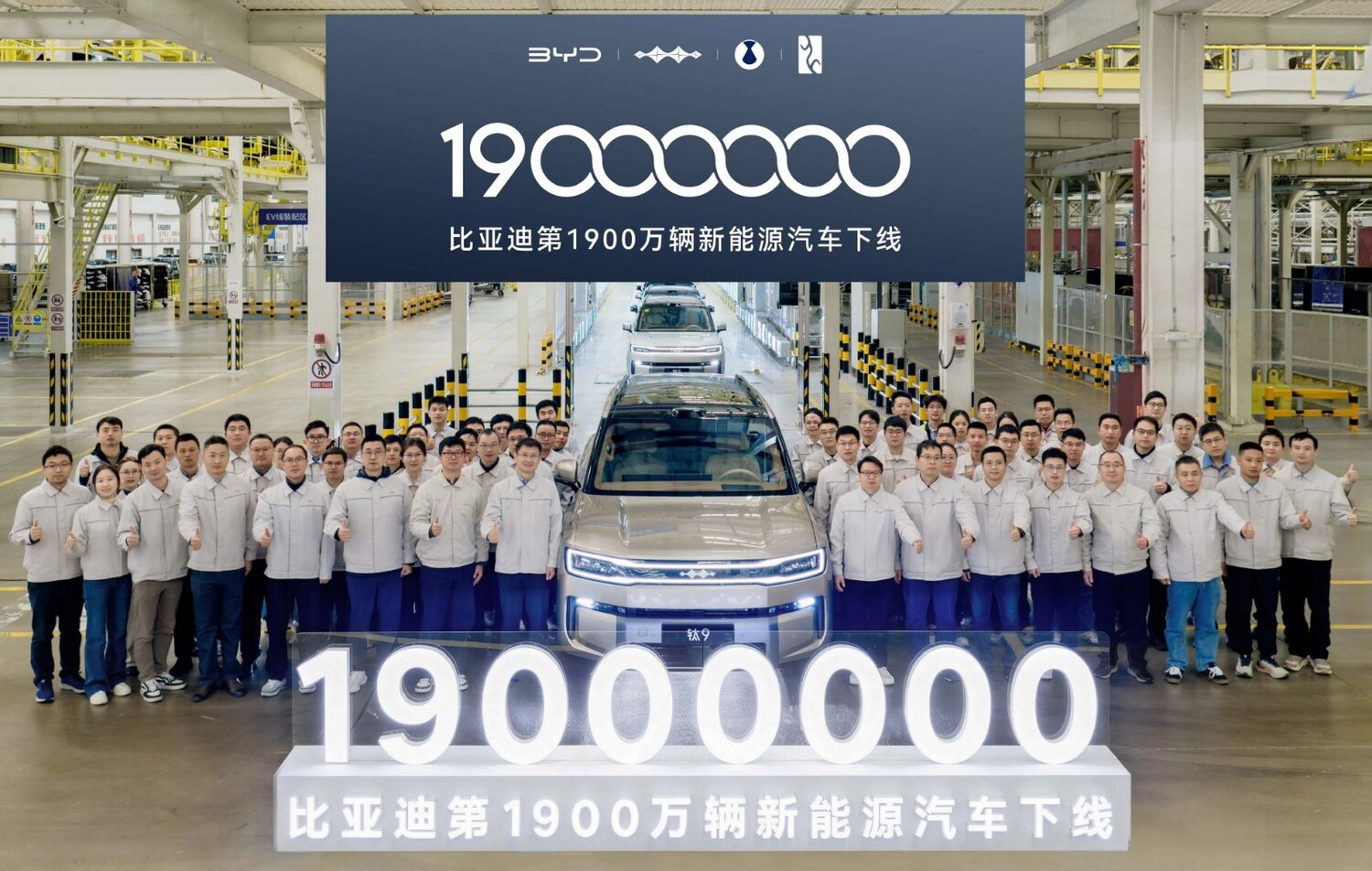
Among automakers, BYD (HKEX: 1211) ranked first in domestic NEV retail sales in October with 250,301 units. Geely Auto (HKEX: 0175) ranked second with 131,708 units, followed by Leapmotor in third with 83,573 units.
Changan Automobile (SZSE: 000625) and SAIC-GM-Wuling ranked fourth and fifth with 68,925 and 67,696 units, respectively. Xiaomi ranked sixth with 50,123 units, followed by Chery (HKEX: 9973) in seventh with 44,747 units.
BYD also led NEV exports with 165,194 units, followed by Chery with 83,843, Geely with 80,119, Tesla China with 59,012 and SAIC Passenger Vehicle with 42,030.
Looking ahead to November, the CPCA noted that the month has 21 working days, 2 more than October. Colder weather and migrant workers returning home are expected to spur vehicle purchases in county and rural markets, supporting a modest month-on-month recovery and a narrower year-on-year decline.
The CPCA cautioned, however, that expectations of lower export tax rebate rates and narrowing windows for shipments ahead of overseas tariff changes had prompted some orders to be delivered early. Short-term support for November exports should not be extrapolated into a sustained uptrend, as it could come at the expense of export momentum in the first quarter of next year.
A sustained recovery in the auto market depends on whether bottlenecks in the vehicle replacement process can be cleared and consumer confidence can stop deteriorating, the CPCA said.
Funding remains available for trade-in subsidies, but their marginal impact is diminishing, serving more to put a floor under demand than to generate additional sales, the CPCA said.