Before I had a job at Road & Track, before I made YouTube videos, before I ever called myself an automotive journalist, I found roads. As the co-founder of the New York Motor Club, I used early versions of Google Earth to find the best roads in our area for spirited weekend drives. Now I do the same job for R&T, planning the driving portion of our Experiences—events that you, dear reader, may come and enjoy alongside our staff.
This story originally appeared in Volume 37 of Road & Track.
When seeking the finest driving roads, it helps to have a strategy for where best to look. Tracts along and around mountain ranges are generally a good place to start browsing, as are areas with lots of lakes and rivers. Following this to its logical conclusion, where might we find the best of the best in driving roads? Around dams. You often find dams in mountainous regions, and dams turn cascading rivers into higher-elevation lakes. Their man-made, nature-conquering essence will almost always come with a garnish of fabulous driving roads. That’s the hypothesis, at least.
Which brings me to Idaho, and the Dworshak Dam, my starting point. Testing the hypothesis also requires a car, and a red, white, and blue example of the new Chevrolet Corvette Grand Sport seemed appropriate given the Fourth of July timing of my trip. At an imposing 717 feet, Dworshak is the third-tallest dam in the U.S., behind Hoover and Oroville. The dam provides hydroelectric power and prevents the downstream town of Orofino from flooding, as it did disastrously in 1948. There are beautiful overlooks from both the northern and southern ends of Dworshak Dam, and crucially, there are stunning, sweeping entrance roads that drop rapidly down to the river. Before 9/11, you could connect both as a loop by driving across the top of the dam itself—about 0.6 mile—but these days, even an R&T business card and a whole lot of begging will only get you to the visitor center.
My ultimate destination is the Post Falls Dam outside Coeur d’Alene, about 140 miles north. In between lie the Saint Joe National Forest and dozens of lakes, rivers, mountains, and waterfalls.
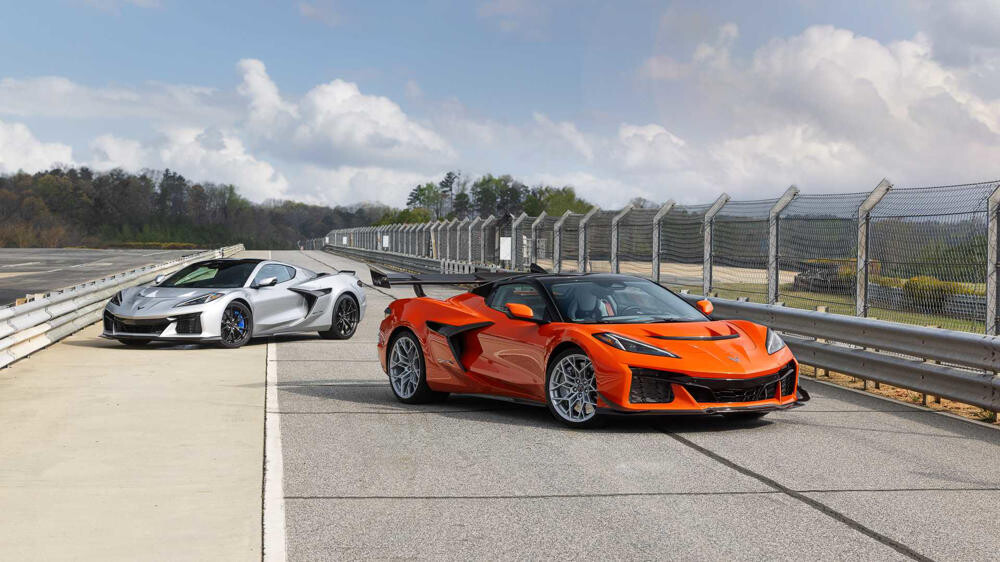
And the car? You could do far worse than the 2027 Corvette Grand Sport. Corvettes, with their celebrated balance of pace, space, practicality, and fun, are already high on my list for the best road-trip cars. The revived Grand Sport, along with all base-model variants for ’27, gets the new LS6 engine, a pushrod 6.7-liter V-8 cranking out 535 hp and 520 lb-ft of torque—a healthy bump of 40 horses and 50 lb-ft over the old 6.2-liter LT2’s maximums, with a more guttural auditory accompaniment one might expect as a side order to the extra displacement.
Historically, the Grand Sport moniker has meant many things. It started in the Sixties, with Zora Arkus-Duntov’s planned C2 homologation race cars, which, by virtue of never going beyond the first five builds, are some of the most valuable American cars of all time. One recently sold at the RM Sotheby’s Monterey auction for $18,705,000. GM brought back the name to close out C4 production in 1996, then revived it for the C6 and C7 generations, pairing wide bodywork with base engines. The performance and balance of the C6 and C7 Grand Sport gave it a Goldilocks position in the lineup, a sweet spot of an upgraded chassis and more-than-adequate power for less money than a Z06. The question to ponder as I meander north on western Idaho’s finest roads is: Does the adage hold true with this new one?
Video by David and Desiree Lai
The Dworshak Dam was completed in 1973 after five years of continuous concrete pouring—a slightly shorter span from when the C8 Corvette landed in U.S. showrooms to today, when I am driving a blindingly white Grand Sport with an overwhelmingly blue interior, descending an empty, high-speed, two-lane mountain road from the dam’s brutalist visitor center toward the roaring Clearwater River on a warm bluebird morning. Over the years, new iterations of the Corvette have added performance. The Z06, the E-Ray, the ZR1, and the ZR1X each boasted shorter quarter-mile times than the base Stingray. Crucially, the chassis is up to the task. These are wildly quick cars, and yet they are not wayward. They are not monsters. At the 2026 Performance Car of the Year test, I remarked that the ZR1 was “like a McLaren 750S but with more rear grip.”
The road doesn’t follow the river for long. I quickly find myself on the Cavendish Highway, climbing rapidly away from the whitewater and over the mountain’s peak to an entirely new climate. The pine trees simply end, giving way to rolling green, yellow, and purple fields of wheat and wildflowers. The road opens and contracts like the lines on an EKG: straight, tight, and technical for a few corners, then straight again. Each hairpin exit offers the opportunity to ride the Grand Sport’s wave of torque to the low but wieldy 6100-rpm horsepower peak. That number is notable on account of it being exactly 200 rpm shy of the Z06’s torque peak. The Grand Sport calls it quits literally when the Z06 gets going.
Video by David and Desiree Lai
The Grand Sport has magnetorheological active shocks and the same-size tire-and-wheel combo as the Z06, the ZR1, and the ZR1X: 275/30R-20 in front and 345/25R-21 in the rear. So, when you’ve got a chassis and tires that can handle 1250 hp, what happens when you dial it back to a mere 535?
Ninety-nine percent of the time, you go the same speed down the road. Lap times are one thing, but out in the broader world morality, if not legality, imposes practical limits on a sports car. I would not complete this trip noticeably faster in a ZR1X. But at the same time, there’s an understanding that this car has more chassis than power. A boomer might call it a “total pussycat.” I think it makes approaching the Grand Sport’s limits on the street a friendlier, more pleasant experience. And the lower-down, meatier torque curve compared with the Z06 means I don’t have to downshift three times to get into the powerband.
I stopped at the Pie Safe in Deary for a mid-morning slice of in-season huckleberry and a cold brew promising rocket-fuel levels of caffeination. It didn’t disappoint, but the next 60 miles of road did. It’s not that they weren’t beautiful. But it was a particularly busy day. So, stuck behind logging trucks, I set the cruise control and pondered how nice a road tripper the Grand Sport is, particularly in convertible guise. It has two decent-size trunks, a roomy driving position (though not as roomy as in the C5–C7 era), clear instruments, and windows that don’t result in buffeting when lowered so you can actually enjoy the outdoors you’ve come seeking.
Heading north on State Highway 3 out of Mashburn, the road dives through deep canyons, but it also offers numerous passing opportunities for me to explore the characteristics of the LS6. The added half liter of displacement is the big story, but that’s not all. The V-8 has a fiercer bark on startup and a smoother idle. The gearchanges from the carryover eight-speed dual-clutch auto seem more refined. And paired with the optional center-exit exhaust, the LS6 has a more even, unified tone, not unlike the improved tenor of the Porsche 911 GT3’s center pipes. And there’s power. Loads of it. This is a spectacularly quick car by any standard. In the narrow-body Stingray, this is a 200-mph powertrain. My winged, wide-body variant hits an aero wall before that speed but offers more stability and grip.
State Highway 97 is the highlight of the trip, as is the community of Coeur d’Alene, which is like a quieter, lower-key alternative to Lake Tahoe in California. This scenic byway hugs the eastern edge of the 25-mile-long Coeur d’Alene Lake, with nooks, crannies, curved bridges, big elevation changes, and the kind of camber normally reserved for theme-park rides. There are homes but very little pedestrian traffic—indeed, early in the morning, little traffic of any kind.
Here is where the Grand Sport’s available carbon-ceramic brakes get a chance to shine. And the steering is far better in the rear-drive car than in the all-wheel-drive E-Ray. Unburdened from transmitting power to pavement, the front wheels communicate each crack, hole, reflector, and surface change beautifully. This particular example has a slightly darty alignment, but the trade-off is telepathic turn-in and beautiful balance on the nose while I trailed off the brake, as I did deep into a downhill, decreasing-radius corner.
The engine doesn’t need to be revved too high to claw out of a hairpin as the Michelin Pilot Sport 4S tires are pushed to the brink of slip and the unmistakable sound of small-block Chevy bounces off the canyon walls. I’d still prefer a round steering wheel to the Corvette’s bizarre square job, but outside of that, the Grand Sport is a car with few foibles. It’s a properly well-rounded machine.
Which makes me wonder, again, whether it’s still the sweet spot. A generation ago, the Z06 was prone to overheating, the ZR1 was a psychotic death missile, and both were far more expensive. The Grand Sport’s mannerisms are a welcome reprieve from it all. But today the Corvette lineup is less compromised and the picture more muddled. A base Grand Sport is $88,495, but this loaded-up convertible carries an MSRP of $141,780 (the coupe tested on the next page was slightly more expensive, at $142,380). Whereas a base 2027 Z06 starts at $123,995 and, should you go easy on the options, could go out the door for less than this drop-top. Spec for spec, though, a Grand Sport is around $30,000 less than the equivalent Z06.
It comes down to use case, budget, and the experience you’re after. Some don’t like the idea of a Corvette being too exotic. Maybe they don’t want a Corvette that shrieks like a Ferrari or a McLaren and prefer a deeper muscle-car growl. Others know that they don’t want to rev the engine to 8000 rpm all the time to get the most out of it. Or they prefer the torque that comes with a pushrod; the LS6 makes 60 lb-ft more than the Z06’s flat-plane LT6, and at 1700 rpm lower down the gauge. In fact, virtually all the good parts of the Z06’s powerband exist above the Grand Sport’s redline. The Z06 sounds crazier and will go faster when pushed, but for a 25 percent discount, the Grand Sport actually feels quicker on the road most of the time and returns a more relaxed driving experience when loafing.
So rather than the sweet spot, ask yourself what is your sweet spot. High or low? Narrow or wide? Big-bore or big-rev? Naturally aspirated or turbocharged? How about rear- or all-wheel drive? You bring the mission; Chevy has your Corvette. The Grand Sport may still be the midpoint of the Corvette spectrum, but the differences up and down the lineup are as much about character as numbers.
The Post Falls Dam is actually three dams, two of which are accessible only via footpaths. And to be honest, the good roads stop at the north end of Coeur d’Alene Lake, where Highway 97 meets I-90, about 30 miles east.
The dam hypothesis, unlike the car, ultimately broke down at the end. But what can I say? Like choosing a Corvette, finding the right drive route is an art, not a science.
Matt Farah is a lifelong car enthusiast who began his automotive career at dealerships, rental agencies, and detail shops before discovering the power of YouTube in 2006, with his channel The Smoking Tire. Farah has a Bachelors of Fine Arts from the University of Pennsylvania, with a concentration in Photography, helping not only create YouTube content but also providing his own photography for his Editor-at-Large position at Road & Track.
He has hosted and produced television series on NBC Sports, G4 Network, SPEED, and Esquire. The Smoking Tire Podcast is #1 in the category every week of the year. Now at 800+ episodes, The Smoking Tire podcast is the definitive guest stop for who’s who in the auto industry. Farah’s Westside Collector Car Storage is a game-changer in luxury, concierge parking that expanded to a second location in 2023.