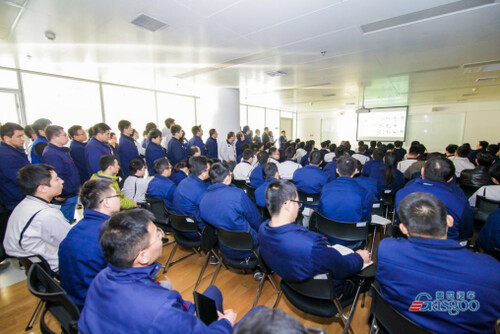
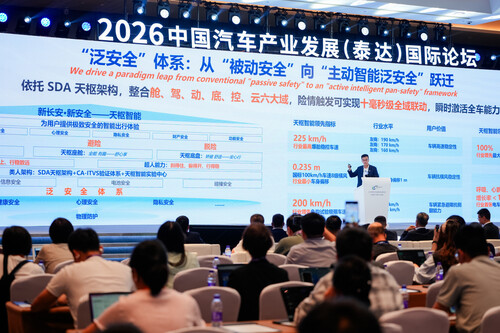
Gasgoo Munich- On September 19, the "High-End Insights" session of 2026 International Forum (TEDA) On Chinese Automotive Industry Development took place in Tianjin's Binhai New Area. Chen Xiaofeng, Vice President of Great Wall Motor's Technical Center and Chief Scientist, delivered a keynote speech titled "Building a New Competitive Edge for Chinese Auto Exports with Systemic AI Capabilities." He systematically outlined GWM's technical roadmap for the second half of the intelligence race and shared strategic insights on how Chinese brands can achieve a global breakout by leveraging their strengths in intelligent technology.Image Source: TEDA ForumFrom Feature Stacking to Intelligent Evolution: Coffee AI OS 4 Builds a Holistic Vehicle Intelligent AgentChen noted that the global auto industry is navigating a transformation unseen in a century. As the new energy transition deepens and the "second half" of intelligence accelerates, vehicles are evolving from mere means of transport into mobile intelligent spaces.Over the past few years, China has achieved breakthroughs in both volume and quality on the intelligent track. By 2025, the penetration rate of L2 driver-assist systems in new car sales jumped to 66.1%, up from 55.7% in 2024, while smart cockpit penetration reached 76.6%, rapidly spreading to the mainstream 100,000 yuan market. AI has bridged the gap from frontier tech to large-scale application. Intelligence has now surpassed traditional metrics like powertrain, chassis, and space to become a decisive factor for buyers.Facing this shift, Chen argues that building sustainable, systemic AI capabilities requires a fundamental reconstruction from the system's bottom layer. Traditional intelligence, he explained, relied on stacking isolated features that responded passively. In an AI-driven era, however, intelligence is moving toward a holistic "vehicle intelligent agent." This agent serves as a unified interface for user interaction, while capabilities in power, chassis, cockpit, and driving are broken down into underlying "atomic" services that can be summoned on demand. The agent interprets scenes and intent in real-time, flexibly allocates resources, and completes tasks in a closed loop."GWM's concept of an AI OS isn't just an operating system with AI features bolted on," Chen said. "It's about sinking foundational AI capabilities into the OS base, integrating the full infrastructure chain of perception, reasoning, and execution, and establishing a computational system where vehicle agents are scheduled and run autonomously." He described its composition as large models + AI subsystems + multiple agents + AI interaction. The system is now very close to achieving L3-level autonomous collaboration among agents.On this foundation, GWM has achieved a three-fold leap. First is the "brain leap," building a "1+N" collaborative architecture where a central brain handles unified intent decision-making, fast and slow thinking coordination, and continuous memory evolution, while vertical expert agents for voice control, media, and mobility execute precise actions. Second is the "architecture leap," which structures the vehicle's capabilities into over 4,000 MCP atomic services open for large-model orchestration, creating a multi-agent framework that unifies the edge and cloud. Chen emphasized safety: "Large models can be creative, but the operating system must never have hallucinations." GWM employs a dual insurance mechanism of sandbox isolation and a vehicle control safety network to ensure innovation remains controllable. Third is the "experience leap," shifting from "users finding services" to "services finding users." Through a unified AI UI panel and conversational interaction, services are accessible with a single sentence. Agents proactively identify potential intent, handle multiple tasks in parallel, and deliver personalized interactions based on a memory system.As the latest generation of the vehicle intelligence system, Coffee AI OS 4 has been officially launched on models like the WEY Gaoshan, the second-generation Lanshan, the V9X, and EVs, with more brands to follow. Chen stated that GWM, driven by the goal of "experience equality," aims to let consumers experience the charm of intelligent mobility sooner. Yet, one underlying logic remains constant: stability, reliability, and fluency are the absolute bottom line. GWM has established a seven-layer user experience metric system, converting over 3,100 historical engineering issues into more than 240 development standards, earning the industry's first "Excellent Level for Smart Cockpit Fluency Performance" certification from TIER.From Hardware Exports to Ecosystem Exports: Intelligence Forges a New Global Edge for Chinese AutosIn the second part of his speech, Chen focused on the global expansion of Chinese autos. He pointed out that overseas perceptions of Chinese vehicles are undergoing a fundamental shift. After testing Chinese intelligent cars, several foreign media outlets have dubbed them "smartphones on wheels," noting that system fluency, voice recognition accuracy, and localization adaptation often surpass local brands. Mainstream German media believe that Chinese vehicles, powered by self-developed chips, end-to-end AI algorithms, and smart cockpit experiences, are not only reshaping local consumer expectations for future mobility but also becoming a key force driving change in the European automotive industry."Intelligence has become the most distinct label and competitive differentiator for Chinese auto exports," Chen asserted. This means Chinese automakers cannot rely solely on cost-effectiveness or shallow technical adaptation. Instead, they must build intelligence into a systemic, reusable core capability for overseas markets to support long-term competition.Reviewing GWM's global journey, Chen divided it into three phases. Phase 1.0, before 2023, was "hardware export"—dominated by homogeneity and price wars, lacking local ecosystem support. Phase 2.0, from 2023 to the present, is "technology export," focusing on localization, though global differences remain vast and local ecosystem needs aren't fully met. Phase 3.0, starting this year, marks "ecosystem export." This isn't just transplanting domestic systems abroad but building a globally reusable vehicle intelligent system based on AI capabilities, gradually seizing the initiative in global ecosystem rules.To this end, GWM independently developed a "1+N+AI" intelligent service architecture: "1" is the system base, "N" is ecosystem expansion, and "AI" is smart mobility. Currently, GWM has deployed multiple products overseas, including the Ora 5, Jolion, and Haval H7, with more models planned. Chen noted that the rapid global rollout of these products results from GWM's unified layout of its intelligent philosophy and "Forest Ecosystem," as well as the consolidation of its global manufacturing and supply chain systems.Finally, Chen proposed three initiatives: first, continuous technological innovation, evolving from OS to AI OS to make intelligence more intuitive; second, standard alignment, providing users with clear expectations and the industry with a ruler, making the "Chinese solution" a global language; third, openness in ecosystems, avoiding "small yards with high fences" and advocating for interconnected win-win scenarios."The rise of Chinese autos—from follower to peer to leader—has no cliffs, only steps," Chen said. He expressed a willingness to work with industry colleagues to bring Chinese manufacturing and Chinese value to global users.