Good stuff
Rides and handles well, outstanding range, futuristic interior
Bad stuff
Dynamics suffer with committed driving, the tech will be too much for some, as will the design
Overview
What is it?
It’s the i3, the saloon sibling of reigning Top Gear Car of the Year, the iX3. BMW has managed the transition to the electrification era more successfully than most, certainly better than its key rivals in Stuttgart and Ingolstadt. But it’s also astutely remained ‘technology open’, which means there’s a new combustion-engined 3 Series for people and territories that still refuse EVs.
You can read our review of that here, but there’s arguably more focus on this, the first fully electric iteration of one of the heartland cars, the 3 Series. Like the Range Rover, Porsche 911 and VW Golf, it’s an automotive lode star.
So what’s the deal here then?
You’re probably familiar with the Neue Klasse backstory. The original was an early Sixties saloon that’s credited with setting BMW on the trajectory it has largely followed ever since. So dusting down that nomenclature for the mid-Twenties electrified portfolio is a statement of intent.
The i3 uses the same new EV-specific architecture and ‘Heart of Joy’ super brain control unit as the iX3. That’s a single central processing unit responsible for drivetrain, braking, charging, energy recuperation and steering. Three other equally high IQ control units handle other functions, marshalling 20 times the computing firepower of old-school systems that bundled all sorts of disparate code together and hoped for the best. The new architecture also simplifies the amount of wiring the car needs; 600m less here.
New functions, performance enhancements and AI-based features are all available as over-the-air updates. As is the modern way.
Yes. It’s called ‘software definition’, right?
Indeed. And as we know from our experience with the iX3, it dramatically speeds up the car’s ‘nervous system’ and makes it far more energy efficient overall. That translates into eye-catching range figures: the i3 50 xDrive claims up to 566 miles (WLTP), which equates to close to 500 miles real world. And that’s a true game-changer for the people who are still hung up on EV’s apparently restricted range.
We’d say 400 miles on a single charge is the sweet spot. Well the i3 clearly smashes that. On a 400kW charger, 800 volt architecture means that it’ll pull in enough juice for another 262 miles in around 10 minutes; even at a lowlier 150kW post, you could still sluice in 100 miles of range in about 15 minutes.
It also has bi-directional charging capability, for 3.7kW vehicle-to-load and vehicle-to-home functionality. So it’s a mobile power bank or home energy storage system. Get those solar panels ordered.
The i3 benefits from BMW’s Gen 6 battery tech. This uses a cell-to-pack design for improved energy density; the cylindrical battery cells are integrated directly into the pack rather than being arranged in a modular fashion. It’s a lighter and more cost-effective set-up. The battery housing itself is a structural component, which improves chassis rigidity.
What does the UK line-up look like?
Two versions arrive imminently, both dual motor. The i3 40 xDrive has a system output of 368bhp, produces 384lb ft of torque, can do 0-62mph in 5.4 seconds and has a top speed restricted to 124mph. BMW claims a range of 441 miles (WLTP) for that one, and around 4.3 mi/kWh. It has an 82.8kWh battery.
The i3 50 xDrive makes 463bhp, 428lb ft, can do 62mph in 4.7 seconds and has the same top speed. BMW claims that headline range figure – the longest of any electric car on sale, at least until the new EQS rocks up – and up to 4.6 mi/kWh. It’s fitted with a massive 108.7kWh battery.
Prices start at £47,925 for the i3 40 xDrive, and £53,425 for the i3 50 xDrive. A more powerful M60 xDrive is due to arrive next year, and at some point there will be a ballistic 1,000bhp quad-motor E-M3.
Rivals for this standard car include the Mercedes C-Class Electric, Hyundai Ioniq 6, Tesla Model 3, Polestar 2 and VW ID.7.
Does the i3’s design differ from the combustion car’s?
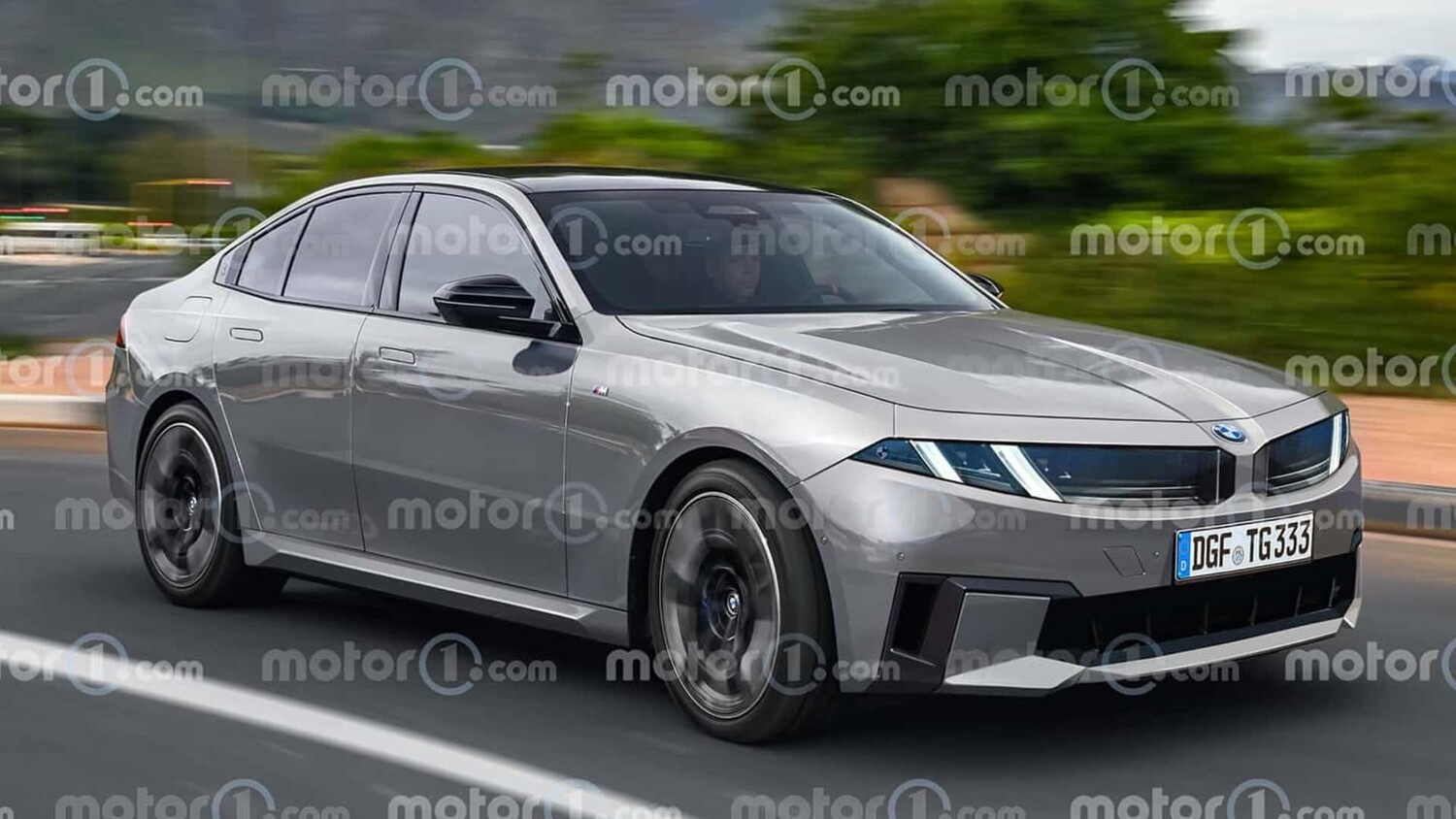
At first glance, they look almost identical. At 4.76m long, the i3 is 5mm longer than the combustion 3 Series, as well as being taller and wider (to the tune of 25mm and 15mm). Front and rear track widths have been significantly increased on both, and the BEV has a longer wheelbase (2,897mm v 2860mm).
The i3 has a notably shorter dash-to-axle ratio; designers call this the ‘prestige mass’ and it can work wonders for a car’s silhouette. Its door seals are also fully hidden. We reckon the new design language suits the electric iteration better, possibly because it was conceived primarily for BMW’s new-gen EVs.
The i3 looks a little stockier and, push come to shove, has superior proportions. But it does also have a higher rear roof-line because the back seats are mounted higher up to accommodate the battery pack, and what BMW calls the ‘Energy Master’ which sits on top of it – this is the control centre for the power supply and the data interface for the battery. Cripes.
Do we like the new look?
One to debate. It’s certainly modern and different, square-cut in some places and with a hint of visual dissonance in others.
In the new BMW design world, SUVs get a vertical treatment of BMW’s double kidney motif, saloons a more visor-like horizontal approach that relies on LED lights to add graphic interest. As on the petrol car, the BMW roundel sits on the bonnet’s leading edge, in a ‘valley’ but ahead of the shut-line. M Sport models also gain a new M Yellow light signature. Like other BMWs, all of this can be dialled up if you go for the Iconic Glow option, though that’s standard on the M Performance models. It illuminates the front end, and involves a welcome and goodbye light animation sequence. Balanced, Relaxed and Excited, apparently. Can’t wait to see that one.
We’re less enamoured of the i3’s rear light signature, another horizontal configuration that draws the eye in and makes the car look taller and narrower. From some angles, it also resembles the 2 Series Gran Coupe. This is not a compliment. We like the flush fitting door handles that extend automatically when the car’s unlocked. Note that the i3 can be specced with alloy wheels sized from 19 to 21 inches; the ICE car stops at 20in wheels.
Anything else to note?
Like various (but by no means all) recent BMWs, the visuals will surely bed in over time. Retro EVs might work for Renault but BMW is defiantly future-focused.
Inside, the i3 gets the latest Panoramic Vision and iDrive, a narrow display that runs right across the width of the windscreen. There’s also a new parallelogram touchscreen, a fresh steering wheel concept, funky materials, and an appreciably futuristic feel.
Come on then, what’s it like to drive?
Smooth. Extremely responsive, but also supremely relaxed – and relaxing – when you’re not in a hurry. Pick up the pace a bit and it’s not quite as happy, but it still hustles and flows in a manner that’s very BMW. Unlike the M350i xDrive, the i3 is passively rather than adaptively damped (although that’s available as an option on the M Sport and M Sport Pro package). You can feel it working harder to control the extra mass, although BMW says the lower centre of gravity and clever software gives it the agility of a lighter car.
It’s about as grown-up as any 3 Series has ever been. Perhaps because it’s an i3 rather than a true 3 Series…
Our choice from the range
What's the verdict?
BMW was unlikely to mess this one up. The i3 is another ingenious new-age EV that ticks all the boxes and finds a few new ones we didn’t even know about. It’s an astonishingly complete proposition.
We still need to verify that amazing range claim, but even if the i3 50 xDrive only delivers three-quarters of the lab claim on a single charge, that should be enough to assuage the chronically range anxious. It also charges quickly, which is an equally important part of the package. We would say that there’s now no reason not to go for the electric version, except that the M350 xDrive petrol remains slightly more engaging to drive.
But there’s not much in it, in truth. And if you’re entranced by technology, then the i3 has you covered. Many times over.