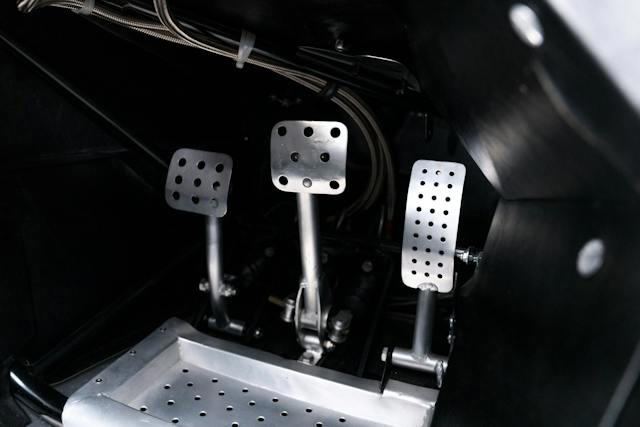
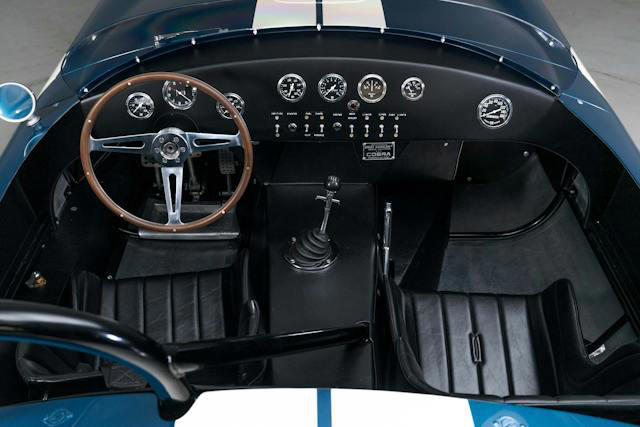
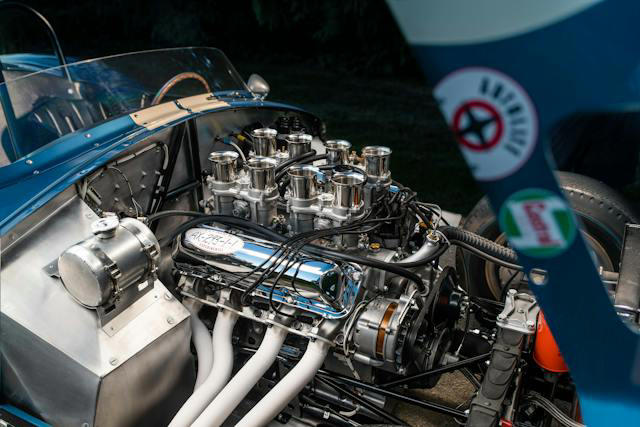
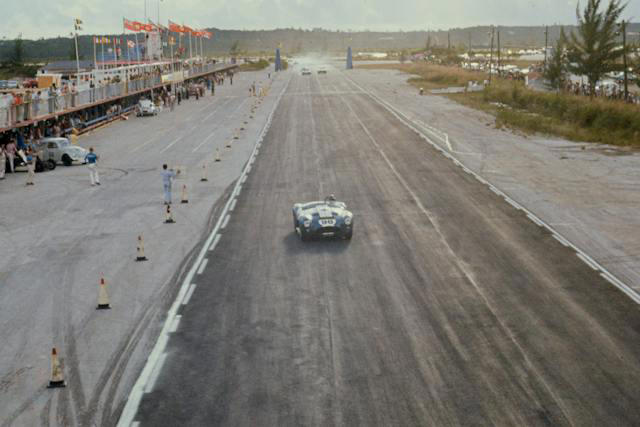
Any time a Shelby Cobra comes to market, enthusiasts perk up. Is it a worm-and-sector 260 car? A 289 with rack-and-pinion? A squat, bulbous 427 S/C? Ooh, an FIA team car? Whoa, a Daytona Coupe? What’s its history? Who owned it? Where did it win? So many questions. A different kind of Cobra is slated to cross the block at Mecum’s Kissimmee auction in January, where it will ask a $25M question. It is the 1964 Shelby 427 Prototype Cobra, first and only of its kind. Despite the car’s limited race history and absence of celebrity ownership, there is a legitimate argument that this Cobra, above all others save perhaps the $43M Daytona Coupe sold last August, may warrant such an estimate. Shelby American’s Venice, California, workshop was a busy place in early 1964. The factory Cobras had just been trounced in the Bahamas by Chevy’s new Corvette Grand Sport, and the team understood a suitable reply was required. Despite Shelby’s skepticism over newfangled aerodynamics, young Peter Brock was already at work building the first Cobra Daytona Coupe (CSX2287), and alongside him, Ken Miles and a bevy of mechanics, including Ted Sutton, beavered away on an altogether different Cobra, a “What if?” roadster bearing serial number CSX2196 that would carry not a 289 V-8 beneath its cowl but an iron-block 427. The Daytona Coupe had already shown well at its debut at the 2000-km Daytona Continental, and by Sebring in March, Miles’ 427 prototype was ready too, though not fully baked. He put it into a tree the day before the race, and the team spent all night repairing it. The next day, the coupe won its class and finished fourth overall, while Miles and John Morton in the roadster, then nicknamed “The Turd,” DNF’d after a series of cascading failures. It was nose-heavy and problematic in turns, but boy, was it fast, and Miles knew he was onto something. More than that, however, he was angry. Shelby had informed him he was never going to race one of the coupes—a car Miles had championed, a car essentially designed and built around him—and few people were more motivated to conquer the world than a slighted Ken Miles. Back in Venice, then, he polished The Turd and committed himself to building a Cobra that would beat not just the Grand Sports, but any other Cobra roadster, too. Miles stripped CSX2196 down to its two main tubes and then rebuilt it using everything learned from the engineering in the Daytona Coupe. Though it lacks the coupe’s slippery shape, it is longer by more than three inches and benefits from the structural rigidity of the coupe’s intricate chassis. Only the six coupes and this 427 prototype roadster were ever constructed as such. Miles revised the suspension, too, by adding more adjustability front and rear through the use of Heim joints on the lower control arms, an advancement later incorporated into some of the coupes. Then he got out the drill. At the time, a standard 289 street Cobra weighed around 2300 pounds. Miles put holes in just about everything he could to lighten the car: the outriggers for the roll bar; the pedals; all the battery and fuel tank mounts; the shock mounts; the brake rotors. Like the Daytona Coupe, the car’s rockers flowed beneath the car to form a flat floor to aid in efficiency, and there was no substructure for the body, which was simply ultra-thin sheet aluminum with a bit of bracing around the edges. And it’s the body that gives CSX2196 its current nickname—the Flip-Top—because of the unique way it opens, with the front bodywork pivoting forward and the rear backward to expose its ornate underpinnings. Although Miles had done his part to slim down the prototype, there was still the matter of that massive iron-block 427. Turns out Ford had his answer, even if the carmaker didn’t realize it. Ford had already cast a pair of experimental aluminum side-oiler blocks, ostensibly 427s with reduced bore sizing to account for steel sleeves in the softer metal, which equated to 390 cubic inches of displacement. One was shipped to Italy to be fitted into the chassis of Daytona Coupe CSX2286, which would run in the prototype class against the Ferraris that June at Le Mans. Perhaps because Ford realized its own small-block GT40s, also running in the class, wouldn’t be able to keep pace with the Daytona Coupe, delivery of other key parts needed to complete it failed to materialize, and 2286 never made the start. Shelby, however, had the engine, and all Miles had to do was ask for it. With the lightweight engine—breathing through enormous Weber 58 IDA carbs and rated around 500 horsepower—now mated to his lightweight chassis and body, Miles’ prototype Cobra tipped the scales at a svelte 1800 pounds. And he was ready to show the world how fast it was. Miles took the car to Nassau that November for Bahamas Speed Week. All the big competitors of the era turned out: The Grand Sports were there, the GT40s were there, the Ferraris were there. And nothing could touch the Flip-Top. Miles sandbagged in the first race and finished second to a Penske Grand Sport, but in the feature, he had an eight-second lead over the field by the end of lap one. Then the rear end ate itself because he’d forgotten to turn on the cooler pump. He’d made his point, though. The car’s power-to-weight ratio was undeniable. Ken Miles knew it, Carroll Shelby knew it, and, most importantly, Henry Ford II knew it, and a month later he hired Shelby to run the GT40 program. Miles went with him, and Alan Mann took over the Cobra Daytona effort that ultimately won the FIA GT Championship in 1965. Cobra 427 roadster production began in 1965, though nothing from the Flip-Top carried over. Its chassis was too expensive and too time-consuming to construct en masse, its engine too specialized. Instead, production cars utilized chassis made with larger, 4-inch tubing rather than the standard 289’s 3-inch tubing, and their engines were iron 427 FE big-blocks. Impressive, yes, but not incomparable. It’s fair to say the Flip-Top Cobra is incomparable. Not only because it was the most sophisticated car ever to come out of Shelby American, but because 60 years on, it has never been wrecked, and it retains nearly every original bit that went into its construction, from its one-off chassis and trick body to its engine and transmission to the suspension and brakes—all of it unique to a singular vehicle. Shelby built six Daytona Coupes. Chevy built five Grand Sports. Ferrari built three 275 GTB Speciales. Ken Miles and a dedicated team of craftsmen built one prototype 427 Cobra roadster, just to make a point. Given the importance placed by collectors on similarly incomparable cars, chassis CSX2196 might soar when its big moment in Kissimmee comes. Looking to purchase a car? Find your match on the MSN Autos Marketplace