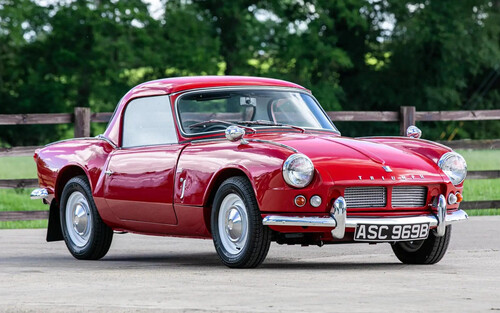
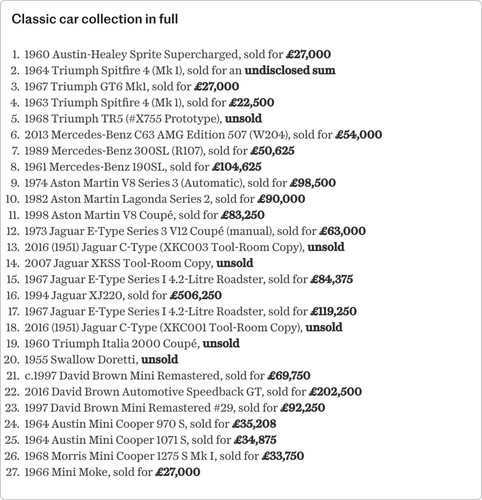
Anthony Hamilton's Silverstone Auction Shows Why Replica Jaguars Struggle to SellTwenty-seven cars, one weekend, and a result that reads like a market survey disguised as a celebrity liquidation.Anthony Hamilton's collection crossed the block at The Wing on 25 July as part of Iconic Auctioneers' BRDC Classic sale, staged a few hundred metres from the stretch of tarmac named after his son. Nineteen lots found buyers. Eight didn't. That much is public record. What's more interesting is which eight.Work through the auctioneer's own catalogue and the pattern is almost embarrassingly tidy. Every single re-creation in the collection went unsold. Both Jaguar C-type tool-room copies — the XKC001 tribute to the 1951 Le Mans winner and the XKC003 car referencing the 1952 Mille Miglia disc-brake experiment — stayed put. So did the XKSS tool-room copy, the one Iconic's pre-sale announcement said was accurate enough that Jaguar Classic used it as a pattern car for its own Continuation programme.AdvertisementAdvertisementThree re-creations offered. Three re-creations unsold. Being good enough for Jaguar to copy your copy apparently isn't good enough for a bidder on a Saturday.The rarity trapThe other five failures are just as instructive, because they were all genuine and several were the most historically interesting things in the room. The TR5 believed to be the last surviving prototype didn't sell. Neither did the Michelotti-bodied Triumph Italia 2000, nor the 1955 Swallow Doretti — the oldest car in the collection and, on paper, the one with the best story. Add the Series 3 Aston Martin V8 and a Mini Moke and you have the full eight.Related ArticlesLEGO's New Jaguar E-Type Is 1,673 Pieces of Everything the Real Jaguar Is Walking Away FromHennessey Teases Project Overlord's Headlights Ahead of an August 3 Reveal, and This Time Records Aren't the PointMeanwhile, look at what did trade: three E-types, three Mini Cooper S variants covering all the 1960s capacities, two Spitfires, a GT6, a supercharged Sprite, a 190SL, an R107 300SL, a C63 AMG, a Lagonda, a V8 Coupé, two David Brown Mini Remastereds.AdvertisementAdvertisementNone of those is rare in the way a one-off TR5 prototype is rare. All of them are liquid. There are dozens of comparable sales for a Series I E-type roadster or a 1275 S in any given year, which means a bidder can price one in about ninety seconds on a phone. Pricing a unique factory prototype requires you to hold an opinion nobody can check.That's the real lesson here, and it applies well beyond Silverstone: in a soft market, buyers pay for comparables, not for singularity. Uniqueness is a liability when you're the only person who has to defend the number.There's a second-order problem specific to the copies. A tool-room C-type, however beautifully executed, doesn't carry a period chassis number, which puts most of the blue-riband historic events its donor design won off the table. Strip out competition eligibility and you're left with a fast, gorgeous, expensive object competing against real cars for the same money. Agreed-value insurance is harder to arrange for the same reason — underwriters price from a comparables file too, and for a one-off replica there isn't one.The car that carried the saleThe 1994 XJ220, chassis SAJJEAEX7AX220647, sold for £506,250 — comfortably the top result. Silverstone Green Metallic, right-hand drive, 3,277 miles, on the cherished plate 220 C.AdvertisementAdvertisementNote the arithmetic, because it matters to anyone bidding. Iconic's premium on the collectors' car lots is 12.5%. That £506,250 headline works back to a £450,000 hammer. If you're setting a ceiling in the room, set it on the hammer and let the premium land where it lands — not the other way round.The XJ220's backstory explains why this car was cheap for so long. Iconic's catalogue lays out the sequence: a 1988 Birmingham show concept promising a V12, four-wheel drive and a six-speed for just under £300,000, £50,000 deposits from around 1,500 hopefuls, then a production car four years later with a twin-turbo V6, rear-wheel drive, five speeds and a £470,000 price. Only 275 were built. A supercar that changed its specification that dramatically between deposit and delivery spent two decades wearing the consequences.What it never lacked was performance: 549bhp at 7,000rpm, 473lb/ft at 4,500rpm, and Martin Brundle's Nardo runs at 212.3mph as standard and 217.1mph with the catalysts disconnected.The maintenance detail buyers keep missingHere's the part of that lot description worth committing to memory. This XJ220 was collected annually by Jaguar Classic and serviced to a schedule that includes clutch and fuel cell replacement irrespective of mileage.Related ArticlesA Fighter Jet Engine on Wheels Couldn't Break the Land Speed Record. Now It Can't Even Get an EstimateTommy Baldwin Jr. Is Out at Rick Ware Racing, and He Broke the News on His Own PodcastAdvertisementAdvertisementRead that again. A car that has covered 3,277 miles in three decades still needs its fuel cells changed on a calendar. The XJ220 uses flexible bladder-type cells rather than a rigid tank, and bladders perish whether you drive or not — rubber cures, plasticisers migrate, and the failure mode is fuel where fuel should not be. The clutch assembly has its own ageing problem on a car that spends years static.The general principle applies to every low-mileage 1990s exotic being marketed as a time capsule: hoses, seals, bladders, dampers, hydraulic fluid and tyres all degrade on time, not distance. A delivery-mileage odometer is a marketing figure, not a maintenance record. Ask for the dated invoices; if a supercar has done 3,000 miles in thirty years and the file is thin, the discount should be enormous rather than the premium.The one that's mechanically a Jaguar in a frockWorth a footnote: the Speedback GT, catalogued at £200,000–£240,000 with 569km showing, is a hand-built Coventry coachbuilt body — over 8,000 hours per car, per David Brown's own brochure copy — wrapped around Jaguar XKR mechanicals: the 5.0-litre supercharged V8 at 510bhp and 461lb/ft, six-speed ZF automatic, 4.6 seconds to 60mph, limited to 155mph.Its chassis number begins SAJ. That's a Jaguar VIN prefix, and it's the single most reassuring fact about owning one. Whatever the bodywork costs to repair — and hand-formed panels with no parts bin behind them are not cheap — everything that actually breaks is a Jaguar part with a Jaguar part number and an independent specialist network that knows it intimately. Buyers of low-volume British coachbuilt cars should always ask that question first: when this goes wrong, whose parts catalogue am I in?AdvertisementAdvertisementFor Hamilton senior, the eight unsold cars aren't a disaster; they're inventory, and re-offering them later or selling privately is routine. For everyone else, the sheet is free education. Original and liquid sold. Unique and unrepeatable didn't. Copies, however good, didn't come close.Images Via: Iconic Auctioneers