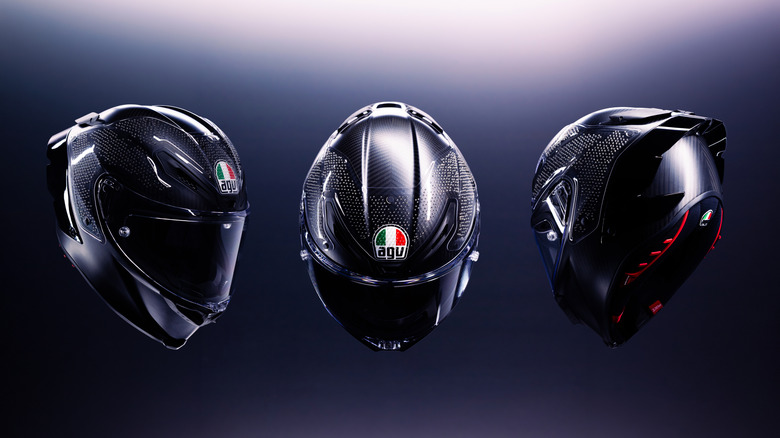
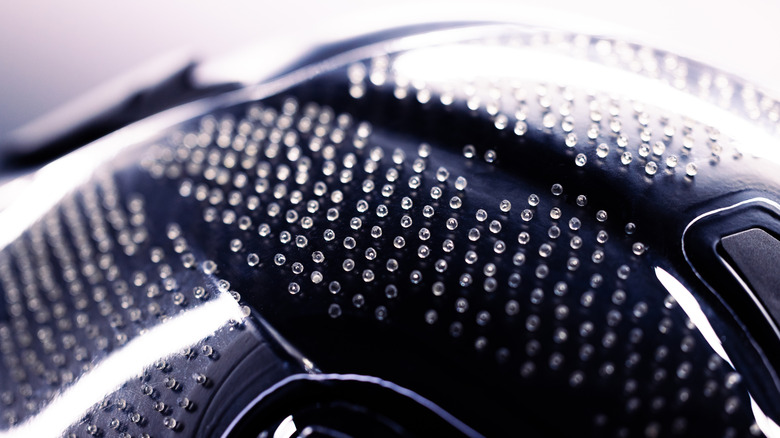
AGV Add Jalopnik on Google: Google Discover Generally, when you buy a helmet, you're hoping it'll absorb an impact meant for your head — in other words, you're not exactly looking for it to shatter apart the second your head makes contact with the asphalt. So when I tell you that AGV's newest, best lid is meant to do just that — break apart when hit — you're probably going to be a little confused. Why are MotoGP riders going around in something less safe than the ECE-certified lid you grabbed from RevZilla? Well, as you might guess, they're not less safe. The new AGV Pista GP R3, an update to the company's formerly flagship Pista GP RR, actually adds more safety with its breakability. The carbon shell is now layered beneath a series of panels that float on what the company says are "hundreds of microspheres," little balls that lift these new panels off the helmet. AGV calls it a "release layer system," with the panels being sacrificial, meant to absorb impacts by shearing off completely. Not for head-on impacts AGV See, when most of us think about a helmet doing its job, we're thinking about stopping a flat surface like a road from making contact with your precious noggin. But heads are round, and modern research has shown that oblique impacts can have the highest risk for concussion. These oblique hits rattle the brain around inside the skull, bashing soft grey matter against hard bone — trust me, the writer who currently has a concussion, when I tell you which of those wins out. Those oblique impacts are where AGV says the new RLS technology makes the most difference with its ability to separate entirely from the shell. AGV isn't the first to put sacrificial features on a helmet — Arai has been making its vents and spoilers pop off for years — but this is the first implementation I've seen that uses so much of the shell for this purpose. Arai makes parts of the helmet that sit proud of the shell break off, but AGV's system makes an outer layer that almost acts as another shell itself, creating huge areas that can shear to reduce those oblique forces. It seems like a truly fantastic system, which just leaves one question: Now that it's debuted as an upgrade to a $1,500-plus-dollar lid, when will it trickle down to something affordable?



















 +73 others