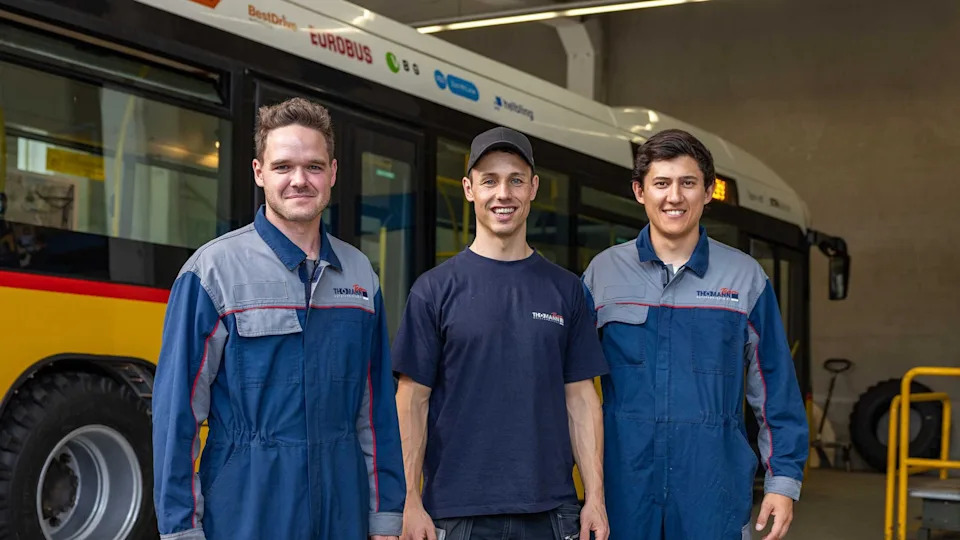



















A Swiss startup spun out of ETH Zurich has demonstrated wireless charging of an electric bus through its rear wheel, using inductively coupled coils embedded in the tire rather than mounted under the vehicle frame, a design that sidesteps the biggest technical problem in road-based wireless charging and could substantially reduce the operating cost of electric bus fleets.The company, Winduction, was founded by ETH graduates Sonam Bhuka, Sylvain Fricker, and Laurin Schwitter. Its prototype, demonstrated Oct. 5, 2026, shows a postal bus with its rear wheel resting on a charging plate roughly the size of a shopping cart. With no cable connecting the plate to the bus, the battery charge display climbs steadily upward.Why wheel and not chassisEvery existing wireless charging system for electric vehicles faces the same constraint: the air gap between the road surface and the vehicle's undercarriage. That gap, which varies by vehicle type and load, reduces efficiency because the magnetic field coupling two coils weakens as distance increases. For a fully loaded bus with high suspension travel, the gap can be large enough to make undercarriage charging impractical.Winduction's insight was simple. "The only thing that always has contact with the ground in every vehicle is the wheel," said Fricker, the company's technical lead. From that observation came the name: Winduction stands for wheel-based induction.The system embeds induction coils in a specially developed bus tire. A ground plate, recessed into the road surface at bus stops, contains the primary coils connected to the electrical grid. When the bus stops and the tire rests on the plate, the magnetic coupling occurs across the minimal gap between the plate and the inner tire wall. The current generated in the tire coils is then transmitted to the vehicle battery.That geometry delivers a transfer efficiency of over 90 percent from plate to battery, less than 10 percent of the input energy is lost as heat, which compares favorably to undercarriage inductive systems where the gap penalty alone can reduce efficiency substantially.No steel insideOne problem required a new material solution. Standard bus tires contain steel belts for structural rigidity. Steel reacts to the alternating magnetic field and converts much of the incoming energy to heat instead of passing it to the coil.Winduction is co-developing a steel-free bus tire with industry partners specifically for this application. The per-unit cost of the specialized tire rises compared to a standard bus tire, but the founders argue that cost is marginal against total fleet lifecycle economics.The cost argumentMost electric buses today charge for five hours overnight in a depot and carry correspondingly large, heavy battery packs throughout the day. Winduction's modeled case uses the route between Zurich Airport and Zurich Oerlikon as a reference. Only two of 24 stops along that route would need in-ground charging plates.The buses would charge incrementally during normal service across 16 hours of operation for a combined total of three hours per day — allowing them to carry significantly smaller and lighter battery packs while maintaining full-day range.The three founders of WinductionSmaller batteries reduce vehicle purchase price, cut weight, lower tire and component wear, and free interior space for additional passengers. Charging during daytime, when solar energy is increasingly abundant and grid demand is lower, further reduces electricity cost and avoids evening peak load charges that overnight depot charging concentrates.The company calculates significant total cost savings over the life of a bus line, though it notes that exact figures depend on route characteristics and are being quantified in ongoing feasibility studies with transport operators.A test infrastructure is currently being built in Winterthur, Switzerland, including both a laboratory facility and a dedicated test bus stop. Winduction is targeting its first pilot operation in 2028 at Zurich Airport, where a fully converted electric bus will carry passengers under real operating conditions, with the charging plates working silently beneath the road surface. The company is supported by the Swiss Federal Office of Transport and the Swiss Climate Foundation.