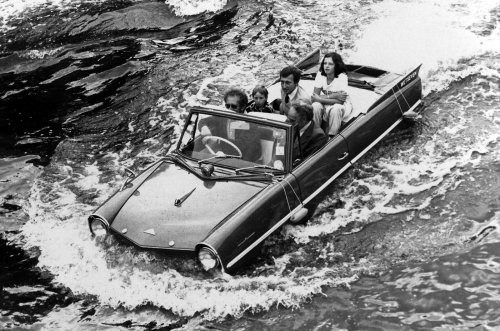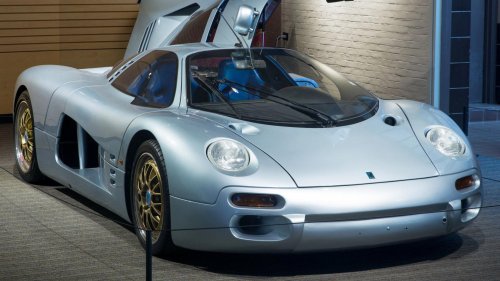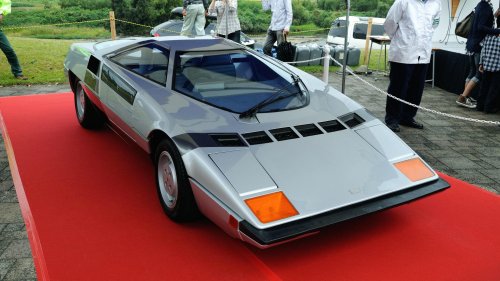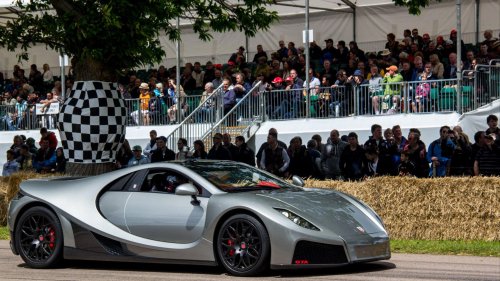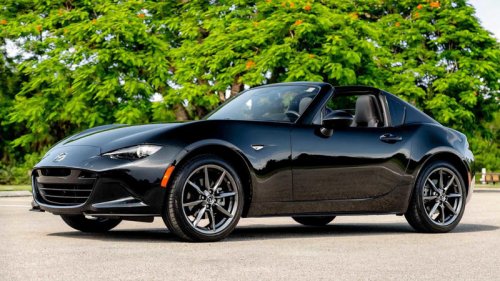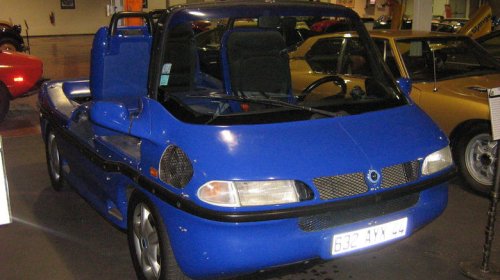
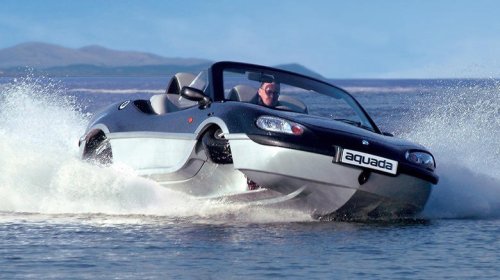
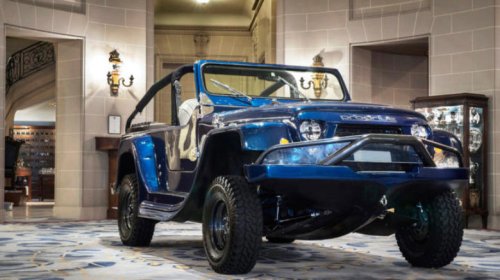
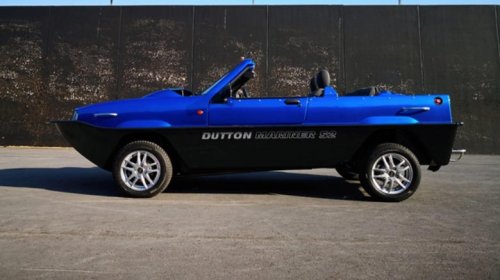
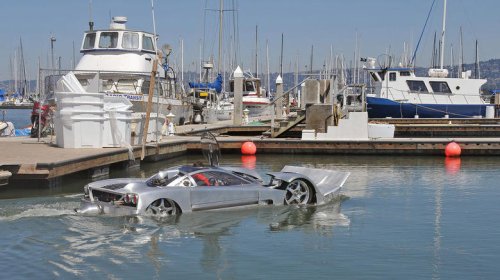
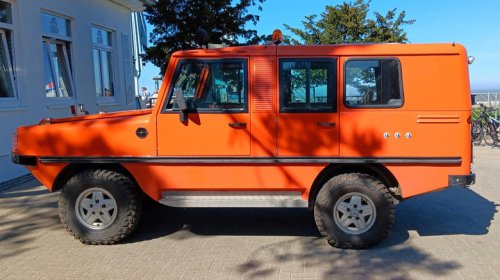


















Hobbycar B612Let's start with the French-born Hobbycar B612 — a true oddity that could be driven as a hard-top, a convertible, or a pickup truck. It just so happened to be an amphibious-capable car. Honestly, it looks like it was dreamt up by a 3-D design intern, though reports say that it is incredibly usable. Unveiled to the public in 1992 it instantly turns heads, though it isn't what you would call glamorous to look at. The "base" version is the one shown above, a cabriolet, if you can call it that; though you did get the option to purchase a hard-top roof as an attachment, and you could also have a pickup truck version of the B612.All versions were steered on land with a steering wheel. Gently ease it into a body of water though, and you'd have to control it with a joystick like a fighter plane. Power came from a transversely mounted engine that was squeezed in beside two water jets that produced about 331 pounds of thrust for the Hobbycar when it was in the water. The three passenger seats could be moved about, placed side-to-side, or facing backwards, depending on what you were in the mood for, and production versions of the car also got an electric windshield that could be raised or lowered. Though the company founder, Francois Wardavoir, set up a $25 million factory to build these things, only 50 to 60 or so are estimated to have been made.Gibbs AquadaNext is the first amphibious car that was able to deliver usable speed on both by road and on the high seas — capable of moving at 110 mph on land and 30 mph in the water. It was called the "Aquada" and was made by a company called Gibbs Amphibians, based out of New Zealand. Typically, most of the amphibious cars in the world have basically been boats that happened to have tires, a steering wheel, and a car engine. Gibbs instead built a brand new vehicle that differed from the norm and debuted in 2003 with a number of patents to its name — over 100 to be specific. Chief among these patents was the innovation of retractable wheels straight out of a James Bond movie — when the Aquada was on water, it would pull its wheels inside, thereby drastically reducing drag. As a result, it was able to reach unprecedented speeds on both land and water, and actually managed to nab a world speed record for amphibious vehicle crossing the English Channel at an hour and forty minutes. Thanks in part is due to the engine that powered the Aquada — a modified 2.5 liter V6 engine from a Land Rover Freelander that pushed out 175 hp and was mated to a five-speed automatic transmission. Unfortunately it never really took off — only 45 units sold.Prodrive Watercar PantherThe Prodrive Watercar Panther held the 2009 record as the fastest amphibious car in the world. Based out of California, this company is a tuning house that imports watercars to the U.K. to bump up their speeds. The specific model on our list is the Prodrive Watercar Panther, which is, in essence, a 4x4 off-roader that doubles as a boat. Prodrive had been gunning for the fastest amphibious car world record for a long time, and succeeded by making a one-off called the Prodrive Watercar Python that was powered by a thundering V8 engine. Then, the company decided to bump things up with a four-seater follow on to the Panther and stick a 250 hp, 3.7-liter emissions compliant V6 in the car instead of the 450 bhp Chevy V8, modify it to be road legal, and open the order books to the general public — and in 2013, that's exactly what it did. This engine manages to push this gargantuan off-roader to a top speed of 44 mph (38 knots) on the water. And it's the only amphibious car in the world that can safely tow a wakeboarder behind it. Also, it takes under 15 seconds to go from land to water mode, which is impressive. All of this is great, but the most likely reason you don't see too many Panthers on the road is the price: $198,000.Dutton MarinerIf we had to choose one word to describe the Mariner, it would be "plucky". It was made by a company called Dutton Amphibious Vehicles, which was in operation from 1995 to 2023, founded by a man called Tim Dutton. When introduced, the Mariner was a two-door, five-seater hard-top car, though you could request a soft-top convertible version as well. The "hull" — if you can call it that — on the Mariner was made out of glass-reinforced plastic (GRP), and thrust on the water came from a 35 hp water jet that drew its power from a belt attached to the Ford Fiesta's engine's crankshaft. Other notable features were the fairly usable 42-liter (11 gallon) fuel tank and the leisurely on-water top speed of eight mph. Interestingly, the Mariner has actually crossed the English Channel (2006) wholly under its own power — though if you pick one up for around $5,000 today, probably best not to attempt to emulate that feat.You could have any Mark-III Ford Fiesta as a donor car to be modified by Dutton into the Mariner, and later, when the Mark-IV Fiesta was released, you could have that modified into the Dutton Commander, another amphibious car made by the ambitious company. As such, you could choose from among any of the engines offered on the Fiesta at the time when you were ordering your Mariner, ranging from 1,100cc units to the relatively powerful 1,800cc variant.The Sea Lion PrototypeThis suspiciously Ferrari F50-looking thing was once gunning for the world record of fastest amphibious vehicle, but evidently has been beat out by the Prodrive Watercar from earlier. The Sea Lion Prototype had a number of quirks, including pass-through water channels behind the front wheels and a massive waterfoil at the front that was supposed to reduce drag, but that had the side effect of making the Sea Lion look like a sports car plus excavator. It's not to be confused with the SEALION 7 from Chinese automaker BYD that is also an amphibious. Amid some dissent, the Sea Lion is still considered by many to be the fastest amphibious car ever built, though it was never commercially produced, and probably is not road legal in many parts of the world. It was powered by a smog-exempt version of the Mazda 13B rotary engine — a favorite among petrolheads — located in a waterproof stainless steel housing that allowed the Sea Lion to reach its top speed of 180 mph on dry land, and 60 mph on the water. The project started in 2006, and took six years to mature into a water-ready prototype. No further prototypes were made, and in 2022, the Sea Lion was put up for sale with an asking price of $259,500.AmphirangerOriginally designed to mimic a special underwater pipe maintenance car, the Amphi-Ranger was in production until 1995 when it was abandoned because of high production costs. Now, there are a great many SUVs out there that have closed-off radiators and long above-the-roofline snorkels to help them ford rivers and crawl through ponds, but there's nothing quite like the Amphiranger. It was made by a German company called Rheinauer Maschinen und Armaturenbau, or RMA for short — and though the Amphiranger looked like it was based on a Mercedes-AMG G-class SUV, it was a fully independent platform, built by RMA from the ground up. The company laid and maintained offshore pipelines, so, in 1985, it began production of its newest creation: an SUV that could also be used as a cruiser boat. In its decade of production, the Amphiranger would have one of three engines: a four-cylinder making 100 hp, a 2.8-liter V6 from Ford making 135 hp, or a 2.9-liter V6 from Ford making 145 hp. In the beginning, you could only get a two-door version of the Amphiranger SUV, though a four-door variant was added towards the end of production at the turn of the decade. The interior was fairly luxurious, and though there was no list price because of the extensive modifications that could be requested, an Amphiranger would have run you the equivalent of several hundred thousand dollars today, adjusted for inflation.