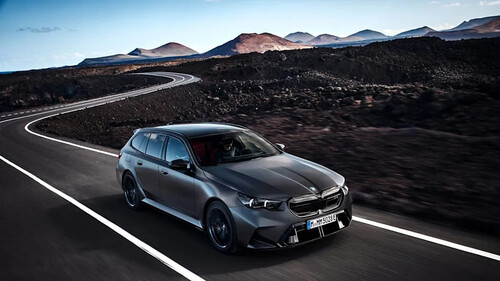
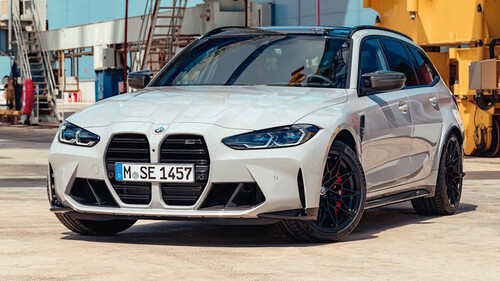
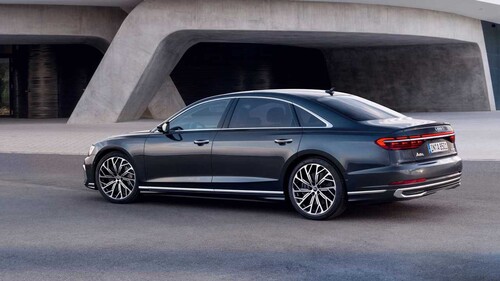
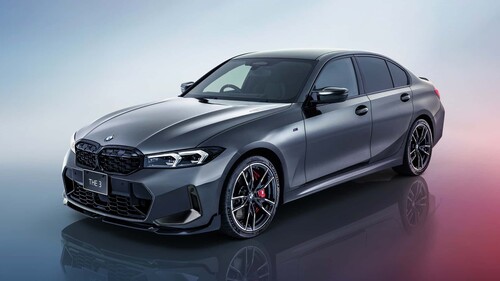
The 2027 BMW 3 Series has been revealed with mild-hybrid assistance for revised 2.0-liter four-cylinder and 3.0-liter inline-six turbocharged engines. With up to 437 horsepower, a new drift function, and a completely new 'shy tech' interior, the 2027 3 Series compact luxury sedan represents another step forward in outright, measurable performance, technological integration, efficiency, and comfort. It's a far cry from the lightweight, engagingly raw, playful approach of the original Neue Klasse, but as BMW has gravitated closer to the luxury of Mercedes and the all-weather security of Audi, there's no doubt that, just like all seven generations of the 3 Series before it, the latest model is a better all-rounder than ever. But the biggest talking point of any new Bimmer tends to be the styling, so let's take a closer look.1BMWUndoubtedly, the most controversial styling decision is putting a four-pipe exhaust on an M Performance model, leeching off the M3's reputation for performance. To be fair, AMG has been producing middleground AMGs with quad exhausts for a while, and while the angular surfaces of the 2027 3er might have also suited a rhombus-shaped dual-exit design, the four round pipes work well here.2BMWFrom the rear three-quarter angle, there's more than a hint of Alfa Romeo about the new 3 Series, though we're sure BMW would rather we liken it to the current 5 Series. The edgy design works better here, and putting a single reverse light in the middle of the diffuser is a neat way of saving costs.3BMWAnother design element borrowed from real M cars is seen in the daytime running light signature, which can be optioned with M Yellow Lights. BMW used to reserve this for CS models, and earlier this year said that all M cars would get access, but we weren't expecting to see it on M Performance models. However, we appreciate the cunning; in a world where lighting signatures are important visual identifiers, and the list of legal colors is severely limited, BMW is setting a trend others will wish they had come up with first.4BMWLike the i3, Iconic Glow outline lighting gives the 3 Series an interpretation of kidney grilles, and the front and rear lids are recessed in the middle, where the BMW roundel lives. Lower down, the theme continues, including on cars without M Sport bodywork, with a lower intake grille separated by an upright partition.5BMWIn profile, the 2.5-box shape is clean, with a nice, long hood culminating in a sharp, forward-angled nose. The car also has a good dash-to-axle ratio and a short rear end that isn't hiding a fastback-style hatch; the 2027 3 Series is a traditional sedan. BMW no longer mentions the Hofmeister kink in its press releases, despite continuing to loosely imitate it, but the glasshouse of the gas 3 Series is still noteworthy. Since the combustion car isn't hiding a large floor-mounted battery pack, the window seals are concealed behind a black trim element, rather than being completely hidden. In the electric 3 Series, doing this would have made the glass-to-bodywork ratio even worse.6BMWI've written on this site numerous times about my dislike of BMW's cost-saving-motivated reluctance to produce M-specific bodies with aggressive rear arches that flow into the rear doors. But as the above angle of the 2027 3 Series shows, it's not necessary and won't be for the M3 either. The shoulder line kinks into the rear haunch crisply, with the bulge kicking up into the L-shaped taillights just enough to be noticeable and steering clear of vulgarity. However, I'd prefer physical door handles, not only for safety reasons, but also to break up the mass of side-on bodywork and hide the 3er's ever-increasing size.7BMWThe front wheel arches are also pleasantly muscular, and the angled vertical side intakes help make the transition from G20 to G50 easier to understand. Annoyingly, BMW has no restraint when it comes to M badges, and the largest fender garnish ever seen on a non-M car sits just above the wheel center line.8BMWThe most egregious watering down of the M3 iconography is seen in the M350's badge. On the one hand, it makes BMW's choice to use indecipherable double-digit numerals to designate engines more coherent across all non-M Division vehicles, but the emphasis it places on this car's wannabe M3 status feels a little cheap. Personally, I wish we'd go back to this 3.0-liter-powered car being a 330 and the 2.0-liter four-pot 330 being known as the 320, but the era of sleeper cars is all but dead.9BMWEven the wing mirrors and the optional M Sport seats are not immune from M's branding machine, with the latter getting illuminated M logos in the headrest recesses.10BMWUnder the hood, BMW lightly revised the old M340i's engine cover design. As with that car, the automaker couldn't resist putting yet another M badge on display, along with some carbon fiber-style detailing. Along with the addition of stiffening bars from each strut tower to the front valance for 2027 (only on the M350), we like the retention of the retro BMW wordmark with five lines on either side, and the six notches in the plastic engine cover add more character than some rivals' designs.11BMWThe trunk continues to use inconspicuous hinge mechanisms that are almost never in your way while loading. Additional storage pockets on the side are also handy, and while the rear 40:20:40 seatbacks don't fold flat, the trunk floor's depth in all directions is excellent. If this were a plug-in hybrid, we'd be having a different conversation.12BMWEven without M Sport bodywork, the 2027 3 Series looks good. Without the trunk lip spoiler, 20-inch wheels (19s are standard), and M badges of the M350, the 330 and 330 xDrive are certainly a touch more elegant. Both cars might benefit from simpler wheel designs, which would also be appreciated during the weekly wash, but it's hard to find fault here.13BMWWith gray paint, white DRLs, and less tricolor detailing and badges, the 330 is subtler, but it still has that sporty look BMW buyers want to show off.14BMWInside is where the gripes begin, but also where more praise is due. While we dislike the shape and haptic buttons of the steering wheel, it feels excellent in your hands, and the recesses for the buttons are more clearly defined. The pads also only illuminate when their functions are available, which should help prevent accidental presses. Projecting the important driver info along the base of the windshield is excellent for keeping eyes on the road, but it's also why the wheel is shaped so unusually.15BMWThe 17.9-inch 'free-cut' central infotainment touchscreen makes far more use of available area than the over-bezeled displays in the latest Audi and Mercedes products, and it's meant to make it easy for the driver to reach, but as you can see, climate control functions reside on the screen. It's distracting, imprecise, and leaves more smudges on the surface. BMW has tried to make this less annoying by adding quick shortcuts for direct or indirect airflow, and the climate controls are always in the same place on the screen.16BMWThere are still physical buttons for the hazard lights and rear-window defroster, and the transmission selector is a switch. There are also physical knobs for audio volume and the parking brake. Ahead of this area, the center console houses a pair of cupholders and a magnetized pad with inductive smartphone charging. Clearly, a completely new design would be necessary for a manual, so we doubt anything less than an M car will even be considered for a three-pedal setup in the Neue Klasse era.17BMWAll 3 Series models get a glazed panoramic glass sunroof that makes the cabin feel exceptionally airy. A plant-based composite fiber roof may be added to the eventual M3, and that could contribute to an even more focused driving experience, but here, comfort takes precedence. Seen here is the M350, as you can tell from the striped safety belts and the M Sport seats up front. Climate controls sit at the back of the center console, and seat controls are in the doors. Heating, ventilation, lumbar support, and backrest-width adjustment are optional, but massaging is only available on the electric i3.18BMWAlongside the i3, the 2027 3 Series pushes BMW design forward while tipping its hat to the past. Proportionally, the gas car is far more attractive, but the EV holds its own in the style department, hiding its bulk through clever use of lines and curves. With prices ranging from just under $50,000 for the base 330 to just under $66k for the range-topping M350, and the all-electric i3 50 xDrive starting at $61,500 before destination, the 2027 3 Series range offers more variety, more tech, better comfort and performance, and greater efficiency at a compelling price for the segment. That's what we think – share your opinions on the new 3 Series with us in the comments below.BMW